

OpenAI’s GeneBench-Pro benchmark and Anthropic’s Claude Science launch show AI agents moving into scientific workflows where audit trails, evaluation and human review matter more than demos.
NEW DELHI, July 3, 2026, 6:01 PM IST – The week’s most useful AI news for technical teams is not another claim that agents can replace experts. It is the opposite: OpenAI has introduced GeneBench-Pro, a hard benchmark for AI agents working through messy computational biology problems, and the early results show that even frontier systems still need careful review before their outputs can drive real decisions.
The announcement matters beyond life sciences. Platform teams, DevOps leaders and AI practitioners are being asked to support agentic systems that can call tools, inspect data, run jobs and produce recommendations. GeneBench-Pro is a reminder that the bottleneck in those systems is often not whether an agent can execute a command, but whether it can choose the right analysis path, notice bad assumptions and stop before a plausible answer becomes a wrong operational decision.
OpenAI said GeneBench-Pro contains 129 research-level evaluations across genomics, quantitative biology and translational medicine. Each task gives an agent a dataset, limited context and a target estimate tied to a downstream decision. The model must inspect the data, select a method, iterate when diagnostics do not fit the first plan and produce a final answer. OpenAI said 82 of the 129 problems were reviewed by outside domain experts, and that 10 representative cases have been released publicly on Hugging Face.
The headline result is sobering. OpenAI reported in its GeneBench-Pro paper that GPT-5.6 Sol reached a 28.7 percent pass rate at its highest reasoning level, rising to 31.5 percent in separately reported Pro runs. The same paper identified Claude Opus 4.8 as the strongest non-GPT baseline at 16.0 percent. Those figures should not be read as a universal ranking for all enterprise work, because the benchmark is specialized and published by OpenAI. They do, however, support a practical conclusion: current agents can make meaningful partial progress on expert workflows, but they are not reliable enough to run consequential analysis without human controls.

The strongest engineering signal is the failure mode. OpenAI’s paper says models often identify local diagnostic clues but fail to turn those observations into the corrective choice that changes the analysis path. In software and cloud operations, that maps cleanly to a familiar risk: an assistant may notice a flaky test, a suspicious log pattern or a cost spike, yet still pick the wrong remediation if it does not connect the signal to the right system context.
That is why GeneBench-Pro is relevant to readers who do not work in biology. The benchmark is really about long-horizon judgment under uncertainty. Teams building internal AI agents for incident triage, release engineering, infrastructure cost analysis, security review or data quality checks face the same class of problem: the data is incomplete, the first hypothesis is often wrong and a confident summary can be less valuable than a traceable decision process.
Anthropic’s June 30 launch of Claude Science points in the same direction from the product side. The company described Claude Science as an AI workbench for scientists that integrates research tools, packages, databases and compute resources, while producing auditable artifacts. Anthropic said the beta app can run locally on macOS or Linux, or connect to remote machines over SSH and HPC login nodes. It also said the system includes more than 60 curated skills and connectors across areas such as genomics, single-cell analysis, proteomics, structural biology and cheminformatics.
The useful point is not that every engineering team needs a biology workbench. It is that serious agent products are starting to look less like chat interfaces and more like governed execution environments. Anthropic’s post emphasizes reproducible outputs, code-backed figures, compute management and reviewer agents that check citations and calculations. TechCrunch also reported that Claude Science is positioned as a workflow product rather than a new specialized model. That distinction is important for enterprise buyers: the operating layer around the model may matter as much as the model name.
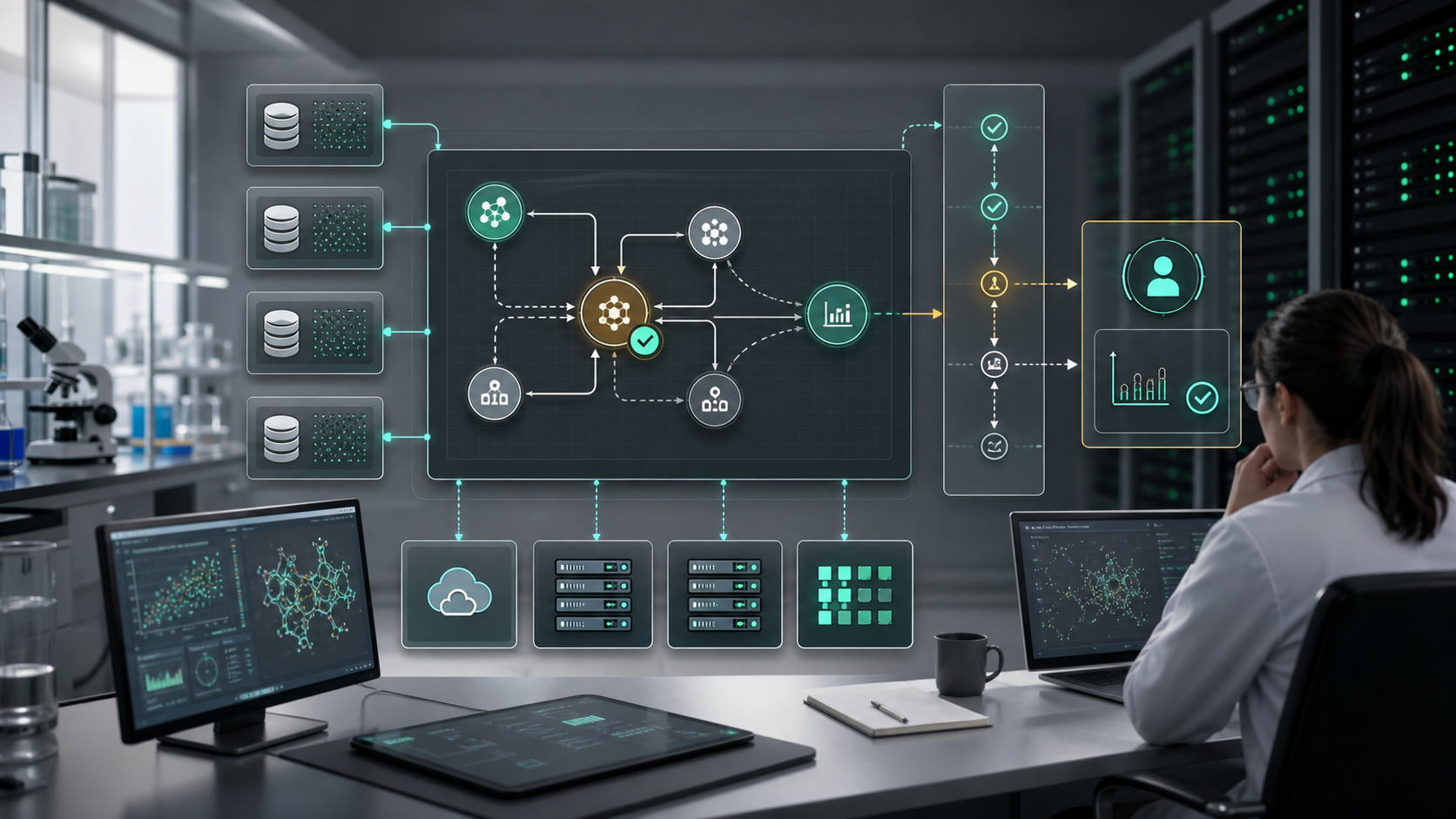
For DevOps and platform teams, the practical takeaway is to treat agent adoption as an evaluation and controls problem, not only a prompt-design project. Before giving agents broader permissions, teams should define task-specific success criteria, collect failure traces, require source and artifact provenance, and keep human approval around irreversible actions. This is the same maturity path that reliable CI/CD, observability and LLMOps programs already follow: measure, gate, review and only then automate more of the workflow.
There is also a cost angle, but it needs careful framing. OpenAI said external reviewers estimated a typical GeneBench-Pro problem could take a human expert 20 to 40 hours, while model inference could cost only several dollars per problem. That gap explains why organizations are interested in partial automation. It does not prove that an AI answer is ready to ship. The economic case becomes stronger when agents draft first-pass analyses, surface anomalies and prepare reproducible work for expert review, not when they bypass the people accountable for the decision.
The same logic applies to software delivery. AI agents can already help with repository search, test generation, log summarization, migration planning and runbook drafting. GravityDevOps has previously covered the basics of prompt engineering for developers, retrieval-augmented generation and LLMOps. The current wave adds a harder requirement: teams need evaluation suites that resemble their real work, not only public leaderboards or vendor demos.
Several open questions remain. OpenAI says it will provide a 50-question subset to Artificial Analysis for independent third-party benchmarking. Until that outside evaluation is available, GeneBench-Pro should be treated as a detailed vendor-published benchmark, not a settled market scoreboard. Claude Science is also in beta, so its value will depend on how well its audit trails, connector permissions and reviewer-agent checks hold up in real lab and enterprise environments.
The evening read is straightforward. AI agents are moving into domains where the output can influence scientific, operational and business decisions. The next phase will reward teams that build evaluation harnesses, provenance checks and permission boundaries around those agents before handing them production authority.
Sources: OpenAI GeneBench-Pro announcement, OpenAI GeneBench-Pro paper, GeneBench-Pro public case studies on Hugging Face, Anthropic Claude Science announcement, TechCrunch report on Claude Science.

