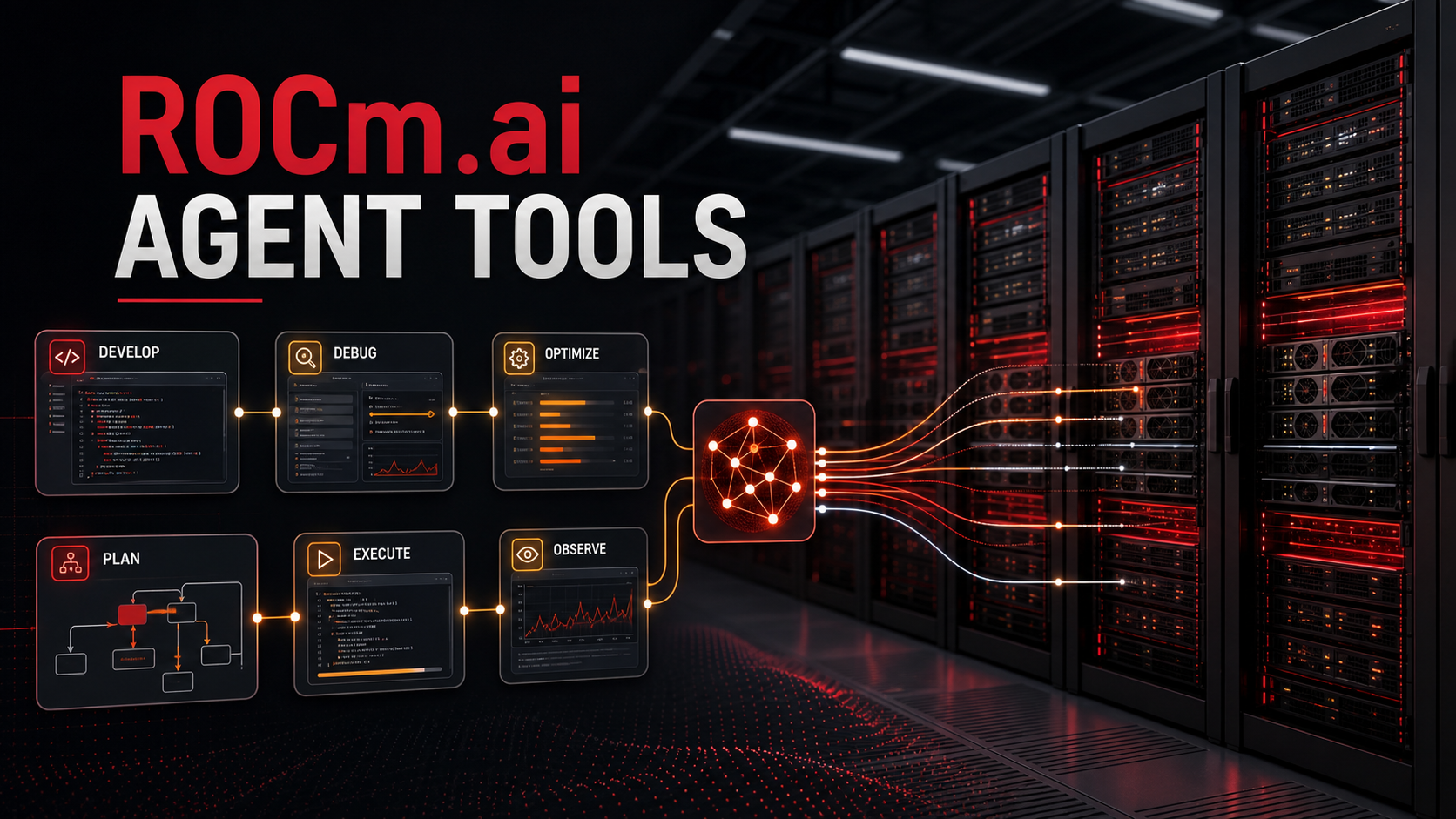

AMD’s new ROCm.ai layer brings vendor-authored skills, a unified command line and automated inference tuning into popular coding-agent workflows. The launch arrives alongside production Helios rack systems, but broad availability and independent performance validation are still ahead.
BENGALURU, India — July 24, 2026, 9:05 a.m. IST — AMD has introduced ROCm.ai, an AI-native developer environment designed to let engineers use natural-language coding agents to install, deploy, troubleshoot and optimize workloads on AMD hardware, as the chipmaker begins production of its Helios rack-scale AI systems.
The announcement matters beyond the latest accelerator cycle. For teams evaluating a second GPU platform, the difficult work is often not procuring silicon but maintaining drivers, containers, framework compatibility and tuned inference paths. ROCm.ai is AMD’s attempt to move more of that operational knowledge into the tools developers already use, while Helios packages GPUs, CPUs, networking and the ROCm software stack as a single system.
AMD said ROCm.ai combines three main components: a new ROCm command-line interface, AMD-authored skills for coding assistants, and Hyperloom, an open-source agentic system intended to automate end-to-end inference optimization. Availability is scheduled to begin in August 2026.
What AMD confirmed
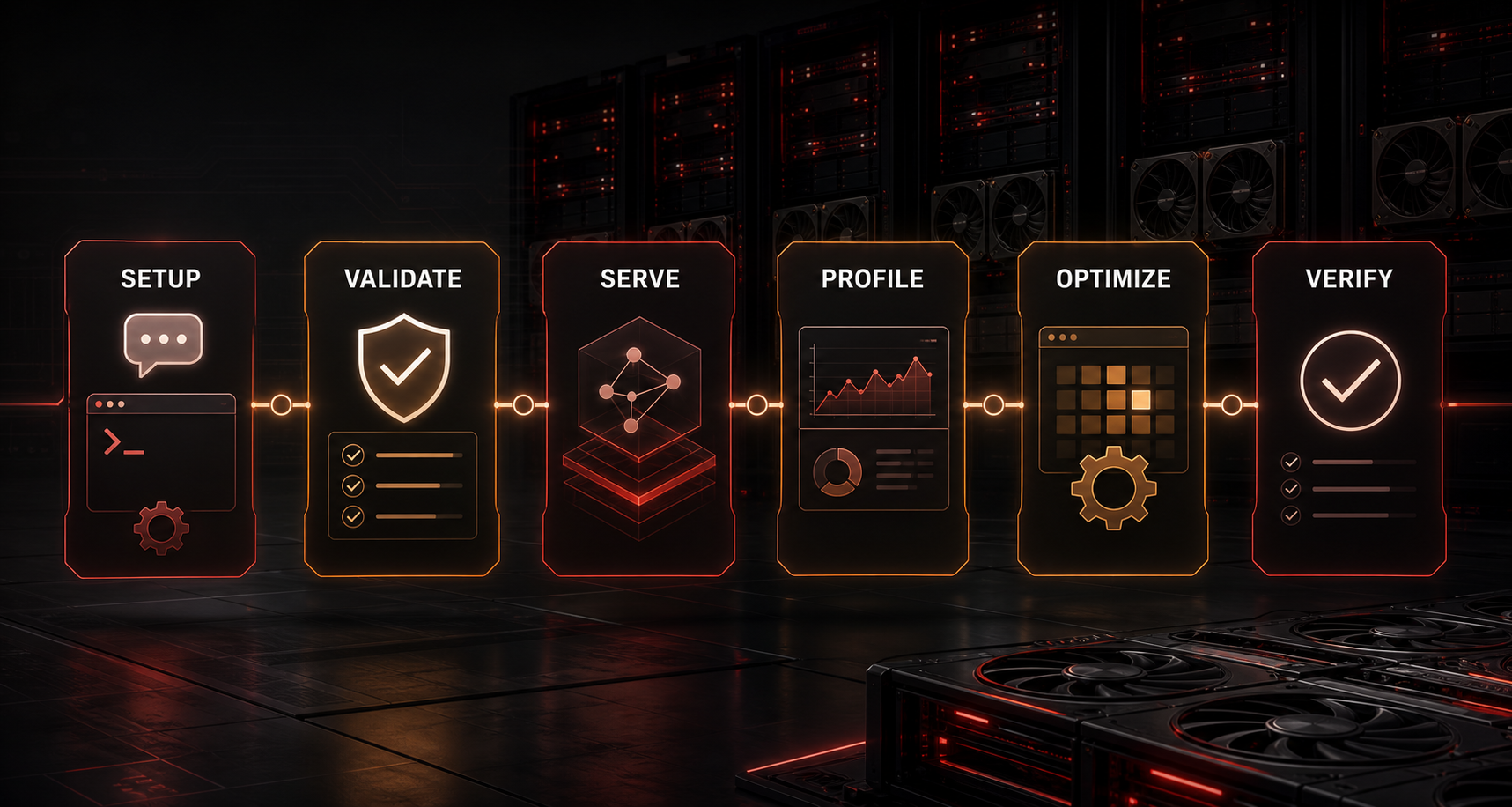
The ROCm CLI is intended to provide one interface for installation, environment validation, model serving, updates and troubleshooting. AMD said the tooling will use hardware-aware workflows and support secure, air-gapped deployments, a significant requirement for regulated and disconnected environments.
AMD Skills packages the company’s own platform guidance for assistants including Claude, Codex and Cursor. Instead of producing only general Linux or GPU advice, those agents are meant to receive AMD-specific context for migration, debugging and performance work. The practical promise is less time spent reconciling documentation across drivers, libraries, model servers and accelerator generations.
Hyperloom addresses a narrower but expensive problem: inference optimization. AMD described it as an open-source system that can profile a workload, analyze bottlenecks, optimize kernels and validate the result. The company says work that previously required weeks of specialist effort could be reduced to hours. That is a product claim, not yet an independently established outcome, and teams should test it against their own models, latency targets and serving stacks.
AMD also reported an average 3.3-times inference improvement and a 2.4-times training improvement for a preview ROCm.ai software configuration compared with ROCm 7 on the same MI355X hardware. The tests used selected models and newer software components, including updated ROCm, vLLM and SGLang builds. Because AMD conducted the tests and the comparison includes multiple software changes, the figures should not be read as a universal speedup attributable to one tool.
That distinction is important for capacity planning. Reproducible results will depend on model architecture, precision, context length, concurrency, kernel coverage, framework versions and the exact server configuration. Platform teams should treat the figures as a reason to benchmark, not as a purchasing forecast.
Helios moves from roadmap to production
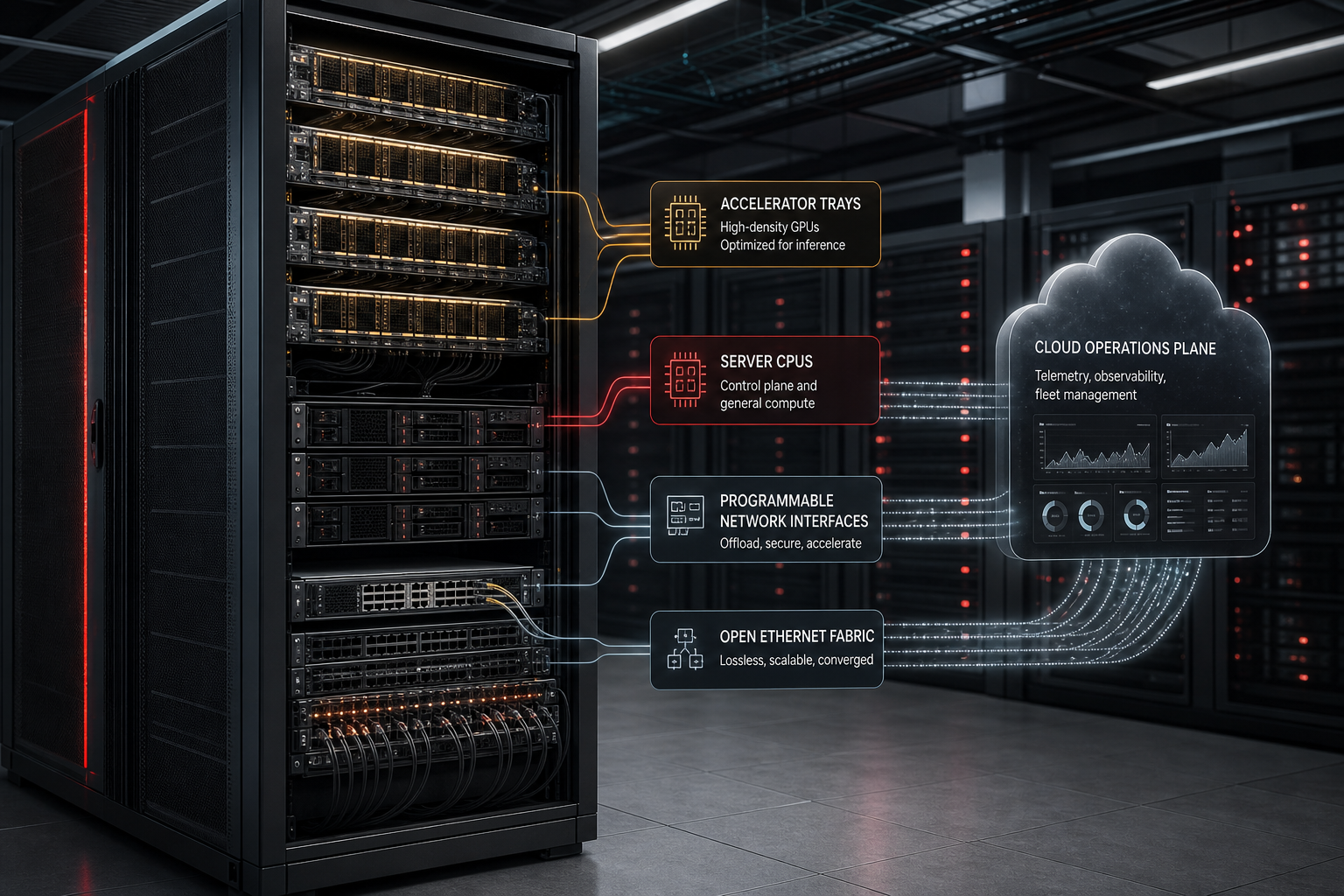
ROCm.ai was announced as part of a wider infrastructure launch at AMD’s Advancing AI event. AMD said its Helios rack-scale systems are now in production. Each rack combines 72 Instinct MI455X GPUs, 18 sixth-generation EPYC “Venice” CPUs, Pensando networking and ROCm software.
The company named OpenAI, Anthropic, Meta, Microsoft, Oracle and several cloud infrastructure providers among planned users or partners. OpenAI expects to bring Helios online beginning in the fourth quarter of 2026, while Meta is testing and validating workloads. AMD and Anthropic have also announced a multi-year engineering collaboration that includes using Claude to optimize Instinct workloads and accelerate ROCm development.
A separate AMD-Cerebras collaboration illustrates another infrastructure trend: disaggregating different stages of inference. The proposed service will use AMD Helios for prompt processing and long-context work, while Cerebras systems handle token generation. Cerebras plans to offer the combined workflow through its cloud later this year. The design may give infrastructure teams more freedom to place each phase on the hardware best suited to it, but it also adds orchestration, observability and failure-domain questions that operators will need to evaluate.
Reuters reported that Helios systems will start shipping in the coming months. That moves the platform closer to real deployments, although announced capacity and future deployment schedules remain forward-looking until systems are installed and serving production traffic.
What developers and platform teams should watch
ROCm.ai could lower the expertise barrier around AMD accelerators, but an agent interface does not eliminate supply-chain risk. Teams still need pinned driver and container versions, signed artifacts, controlled network access, repeatable builds and rollback plans. Any coding agent allowed to change kernels, dependencies or runtime settings should operate through reviewed changes and bounded credentials.
There is also a governance question. Vendor-authored agent skills can improve accuracy, yet they become another dependency that must be versioned, audited and tested. Platform teams should record which skill version generated a change, retain the underlying commands and diffs, and verify recommendations against approved compatibility matrices. Treat natural language as the interface, not the evidence.
For organizations already building a repeatable LLMOps practice, the immediate opportunity is to add AMD to a hardware qualification matrix rather than redesign the stack around an announcement. Run representative models through the same load generator, compare time to first token and output-token throughput, include power and network costs, and test failure recovery under sustained concurrency.
Teams using retrieval-augmented generation should also benchmark the complete service path, not only GPU kernels. Vector retrieval, reranking, prompt assembly, cache behavior and network latency can dominate real request time. GravityDevOps’ guide to retrieval-augmented generation explains why the surrounding pipeline matters as much as the model server.
The competitive significance is clear but not yet settled. Nvidia’s CUDA ecosystem remains deeply embedded across AI development and operations. AMD is betting that open frameworks, Ethernet-based rack networking and agent-assisted platform knowledge can narrow the software and deployment gap. The evidence will come from reproducible customer workloads, stable release cadence and how quickly fixes move from agent suggestions into tested upstream software.
What happens next
ROCm.ai is expected to become available in August. Developers should look for public repositories, licensing details, supported hardware matrices, skill update policies and reproducible Hyperloom evaluations. Cloud and platform teams should also watch the first Helios deployments later this year for availability, telemetry integration and failure-recovery data.
For now, AMD has made a credible shift in where it is competing. The announcement is not only about faster accelerators; it targets the operational friction that determines whether alternative AI infrastructure can be adopted safely. Whether ROCm.ai delivers that advantage at scale will depend on transparent tooling and results that customers can reproduce outside AMD’s labs.
Sources
This report is based on AMD’s ROCm.ai announcement, AMD’s Advancing AI infrastructure release, AMD’s technical networking overview, Reuters reporting on Helios production, and Axios reporting on the AMD-Cerebras collaboration.


