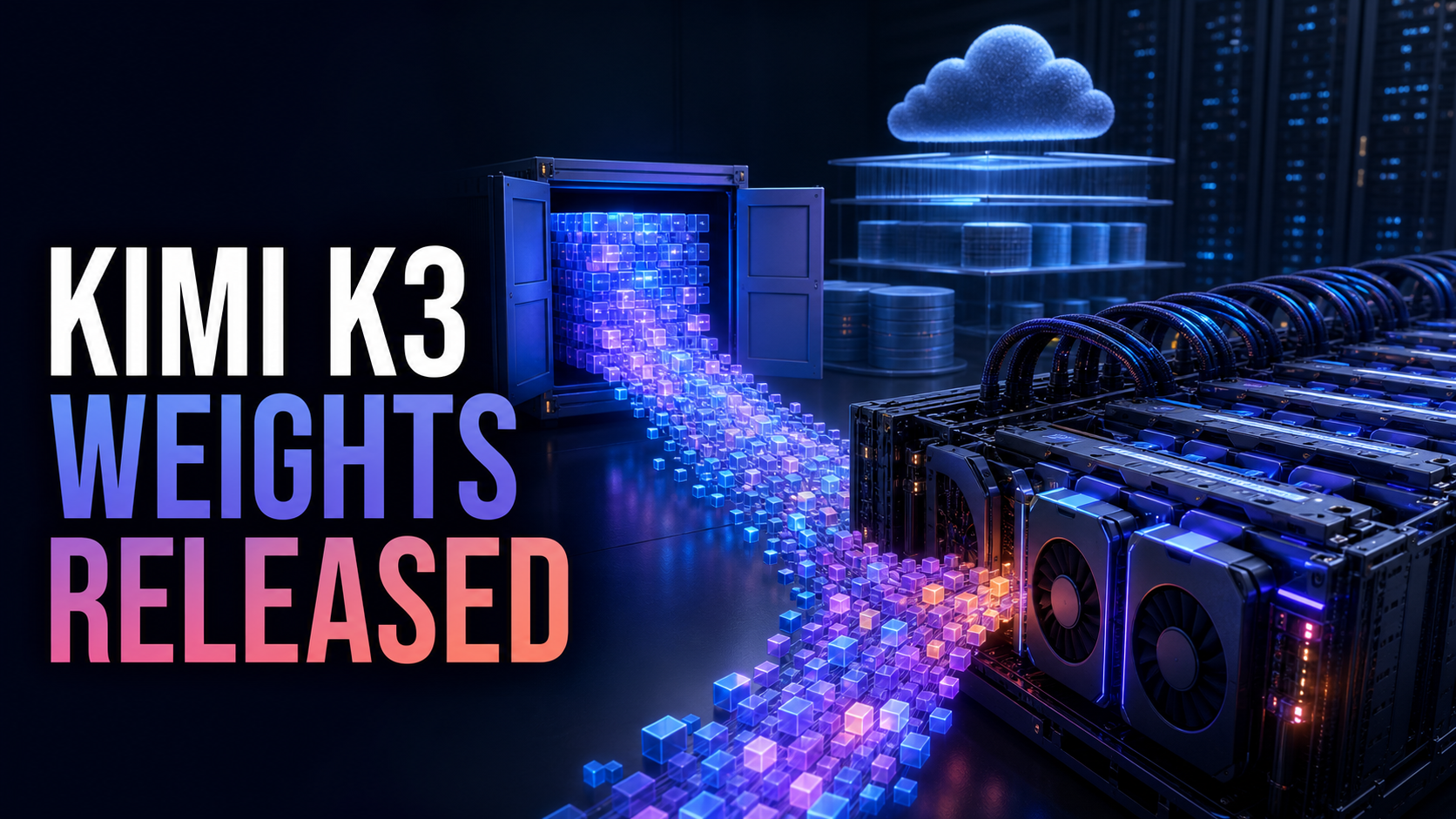

NEW DELHI, July 27, 2026, 9:20 p.m. IST — Moonshot AI has released the full weights for Kimi K3, turning its 2.8-trillion-parameter flagship from an API-accessible model into a checkpoint that infrastructure teams can download, inspect and deploy on their own systems.
The release appeared on Moonshot AI’s official Hugging Face repository on Monday evening in India. The repository contains 96 model shards and totals roughly 1.56 terabytes, along with configuration, processing and inference files. That makes the operational story as important as the model release itself: Kimi K3 is open-weight, but it is not a conventional single-server deployment.
For developers and platform teams, the immediate significance is control. The weights create a path to private inference, domain adaptation, reproducible evaluation and deployment outside a proprietary API. They also bring a demanding capacity-planning exercise involving storage, accelerator memory, interconnects, model-serving software and a custom commercial license.

What Moonshot released
Moonshot describes Kimi K3 as a native multimodal mixture-of-experts model with 2.8 trillion total parameters and 104 billion parameters activated for each token. Its official model repository lists a 1,048,576-token context window, 93 layers, 896 routed experts and 16 selected experts per token. The published checkpoint uses MXFP4 weights and MXFP8 activations.
The repository was updated at 9:05 p.m. IST on July 27, according to its public metadata. A direct inventory showed 114 files, including 96 numbered SafeTensors shards. Their combined size is about 1.56TB. Those are observable repository facts, separate from Moonshot’s performance claims.
Moonshot says the architecture combines Kimi Delta Attention, or KDA, with gated multi-head latent attention. Three quarters of the attention layers use KDA, while every fourth layer uses gated MLA. The company also introduces Attention Residuals, a mechanism designed to retrieve representations from earlier depths, and a Stable LatentMoE design for sparse expert routing.
A Hugging Face community architecture review published before the checkpoint landed said the model activates only 1.8% of its routed expert pool at a time. The review called Attention Residuals the genuinely novel element, while noting that the benchmark table combines first-party results, cited third-party scores and different evaluation harnesses.
Benchmark claims need independent testing
Moonshot reports competitive results across coding, terminal-use, reasoning and long-horizon task benchmarks. The company’s model card says Kimi K3 scores 88.3 on Terminal-Bench 2.1, 81.2 on FrontierSWE and 42.0 on SWE-Marathon at its maximum reasoning setting.
Those numbers should be treated as vendor-reported until independent teams reproduce them under controlled prompts, tool permissions, inference settings and hardware. Harness differences matter particularly for agentic coding tests, where a result can reflect the surrounding toolchain as much as the base model.
External evidence supports the broader conclusion that K3 is competitive, but not every headline comparison. Reuters reported that Arena.ai ranked it first on a web interface-building benchmark and that other evaluators placed it near leading proprietary systems. The Associated Press reported that demand for the hosted service was strong enough for Moonshot to pause new subscriptions while it added capacity. Neither point proves that K3 will outperform another model on a specific company’s workload.
What platform teams should evaluate
The checkpoint’s size changes the deployment equation. A 1.56TB artifact needs more than enough aggregate accelerator memory; production serving also requires room for runtime overhead, key-value cache, batching and redundancy. High-speed interconnects become important when expert layers are distributed across accelerators, and cold starts or node replacement can be slowed by moving hundreds of gigabytes of weights.
Teams considering self-hosting should begin with a controlled evaluation environment, not a production migration. Useful first measurements include quality on private tasks, tokens per second at realistic concurrency, time to first token, cache behavior at long context, failure recovery, power consumption and total cost per completed task. GravityDevOps’ guides to LLMOps and retrieval-augmented generation provide additional context for evaluation pipelines and grounding.
Security review is equally important. The repository includes custom Python modeling and processing files, so teams should pin a reviewed revision, inspect executable code and model-loading dependencies, generate a software bill of materials where possible, and isolate initial runs. Open weights improve inspectability, but they do not make a model or its serving stack automatically safe.
The license also needs legal review before commercial deployment. Moonshot’s custom Kimi K3 License broadly allows use, modification and distribution, but requires a separate agreement for model-as-a-service businesses whose aggregate revenue exceeds $20 million over any consecutive 12 months. It also imposes attribution requirements on certain very large commercial products. This is more permissive than a closed API, but it should not be described simply as an unrestricted open-source license.
A meaningful release, with an infrastructure caveat
The release is a consequential addition to the open-weight ecosystem because it gives researchers and well-resourced operators access to a frontier-scale multimodal checkpoint rather than only a hosted endpoint. It also makes the architecture and claimed efficiency gains available for closer inspection.
But open availability is not the same as easy portability. Most teams will still consume Kimi K3 through a hosted provider or wait for validated quantizations and mature serving support. Large clouds, specialist inference providers and research clusters are better positioned to run the initial deployment experiments.
For technical decision-makers, the practical question is therefore not whether a 2.8-trillion-parameter model can be downloaded. It is whether the control gained from self-hosting justifies the hardware, engineering and licensing burden for a measured business workload. The newly released weights finally make that question testable.
Sources: Moonshot AI’s Kimi K3 repository and model card, Moonshot AI’s technical announcement, Hugging Face community architecture review, Reuters, and The Associated Press.


