

SEO excerpt: NVIDIA says its AVO agent system completed every level in ARC-AGI-3’s public set, extending a long-running harness first tested on GPU-kernel optimization. The result is notable for agent architecture, but it is not a private-set score or proof of general intelligence.
BENGALURU, India — August 22, 2026, 7:40 p.m. IST: NVIDIA has reported that its Agentic Variation Operators system completed all 183 levels across the 25 public environments in ARC-AGI-3, an interactive benchmark that asks AI agents to discover unfamiliar rules and goals through trial and feedback.
The headline number is a 100.00 Relative Human Action Efficiency score. The more consequential result for engineering teams, however, is what sat around the model: persistent memory, executable tools, evaluation feedback, recovery loops and a supervisor that can intervene when progress stalls.
NVIDIA’s August 21 technical report says the same underlying AVO architecture had previously spent seven days autonomously optimizing attention kernels on Blackwell B200 GPUs. For ARC-AGI-3, the researchers changed the environment interface and evaluation tools rather than rebuilding the core agent around a new domain. That transfer gives platform teams a concrete example of why an agent’s harness—not just its model endpoint—has to be treated as production architecture.
What NVIDIA confirmed
According to NVIDIA’s technical blog, AVO completed all 183 levels in the ARC-AGI-3 public set and received a 100.00 RHAE score. The company says the run used Claude Opus 5 inside AVO’s long-horizon architecture.
NVIDIA also reported limited experiments with GPT-5.6 Sol on a challenging subset. Sol reached matched levels faster in wall-clock time in several cases, while Opus used fewer environment actions in matched-level comparisons. NVIDIA described those results as preliminary and did not present them as a systematic model comparison.
The distinction matters because ARC-AGI-3 measures a full agent’s behavior over time. Agents enter game-like environments without natural-language instructions, explicit rules or a stated goal. They must test actions, infer the environment’s dynamics, preserve useful discoveries and adapt through progressively harder levels.
The ARC Prize scoring documentation says RHAE combines completion with action efficiency relative to first-time human baselines. Internal reasoning and tool calls do not count as environment actions. A perfect total therefore means completing all games and levels while matching or exceeding the benchmark’s human-efficiency threshold; it does not measure inference cost, latency or the amount of internal computation used to decide each move.
The result is about a system, not a suddenly smarter model
NVIDIA notes that ARC Prize separately reports roughly 30 percent for Claude Opus 5 at high reasoning effort, but warns against subtracting that number from AVO’s score to estimate the harness contribution. The runs used different reasoning settings, agent systems and evaluation setups.
That caveat is central. AVO’s main loop can inspect context, plan, implement an action, evaluate the result and update its working state. A supervisor watches the broader search trajectory and can intervene during stagnation. The system’s tools and feedback surface change by domain, while the persistence-and-recovery loop remains.
This resembles a control plane more than a prompt wrapper. For developers operating long-running agents, the transferable design lesson is to make state, evaluators, tool permissions, checkpoints and recovery policies explicit components. A stronger model can improve individual decisions, but it does not automatically supply durable memory, safe retries, evidence-backed progress or a rollback path.
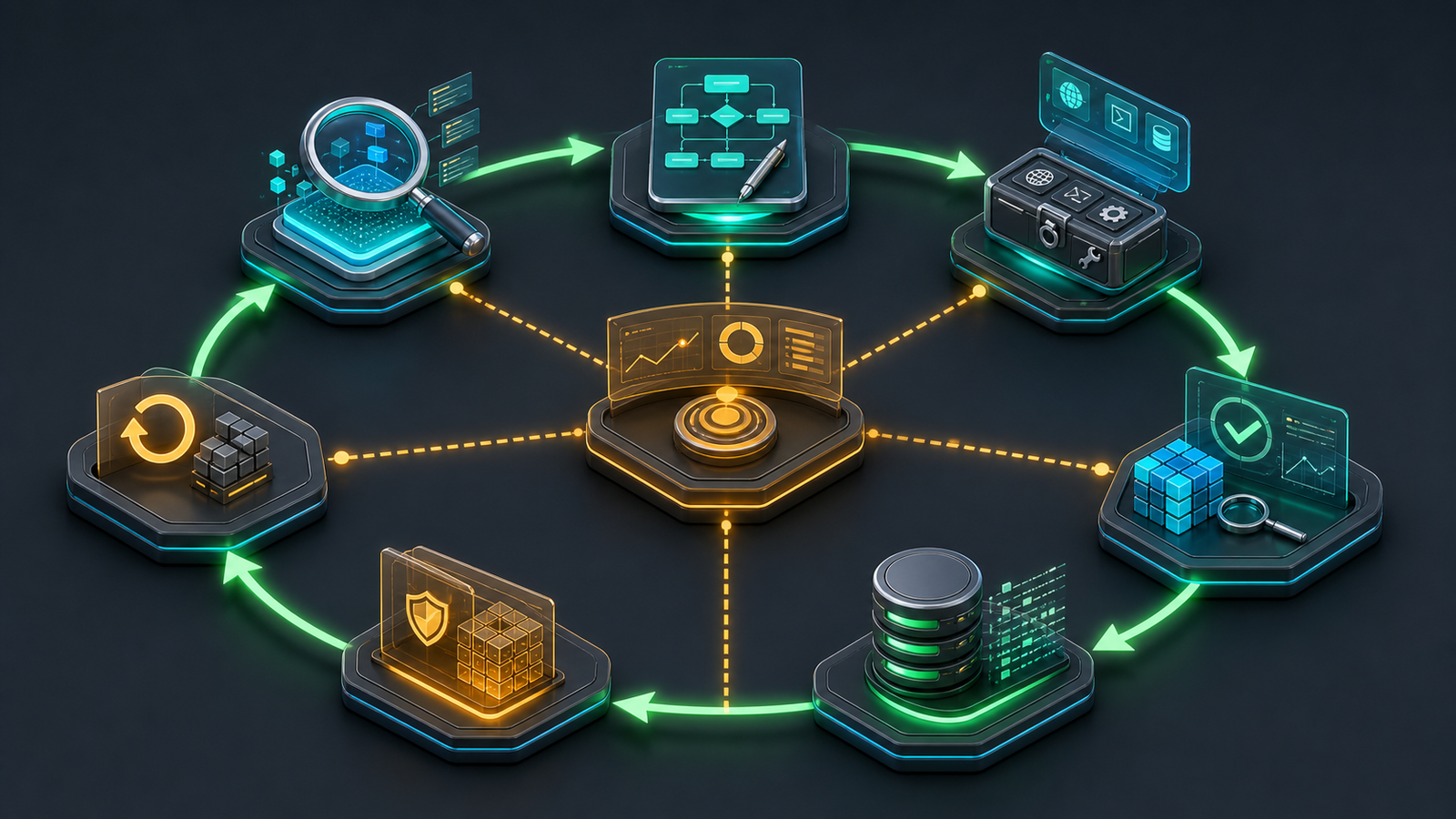
Teams already building production agents should connect that architecture to established LLMOps controls: version the harness alongside prompts and models, retain decision traces, separate read and write tools, cap retries and cost, and require approval before high-impact actions. An agent that can work for hours also has more time to compound a bad assumption.
AVO started with GPU-kernel optimization
The ARC-AGI-3 result builds on an NVIDIA research paper released in March. In that work, AVO replaced the fixed mutation step in conventional evolutionary search with an autonomous coding agent. The agent could inspect earlier solutions, consult a domain knowledge base, edit code, run correctness checks, profile throughput and revise its strategy.
The authors report that AVO explored more than 500 optimization directions and committed 40 kernel versions during seven days of continuous work. Across the evaluated Blackwell B200 configurations, the resulting forward-pass attention kernels outperformed cuDNN by up to 3.5 percent and FlashAttention-4 by up to 10.5 percent. Those are researcher-reported, configuration-specific maximums, not broad guarantees for arbitrary models or GPU workloads.
The paper also says the agent adapted the multi-head attention work to grouped-query attention in 30 minutes, reporting gains of up to 7 percent over cuDNN and 9.3 percent over FlashAttention-4 in the evaluated setup. The paper describes changes involving register allocation, pipeline scheduling and workload distribution, indicating that the loop used profiler and execution feedback rather than merely rewriting surface syntax.
What platform and DevOps teams should take from it
The practical takeaway is not to chase a perfect benchmark score. It is to evaluate the operating system around an agent as rigorously as the model itself.
For software and infrastructure agents, teams should define success with executable checks such as tests, policy validation, deployment health and performance budgets. They should record which evidence caused an agent to change course, retain known-good checkpoints, and make supervisor intervention observable. For retrieval-heavy systems, grounding also depends on disciplined source selection and update controls; GravityDevOps’ overview of retrieval-augmented generation covers that adjacent layer.
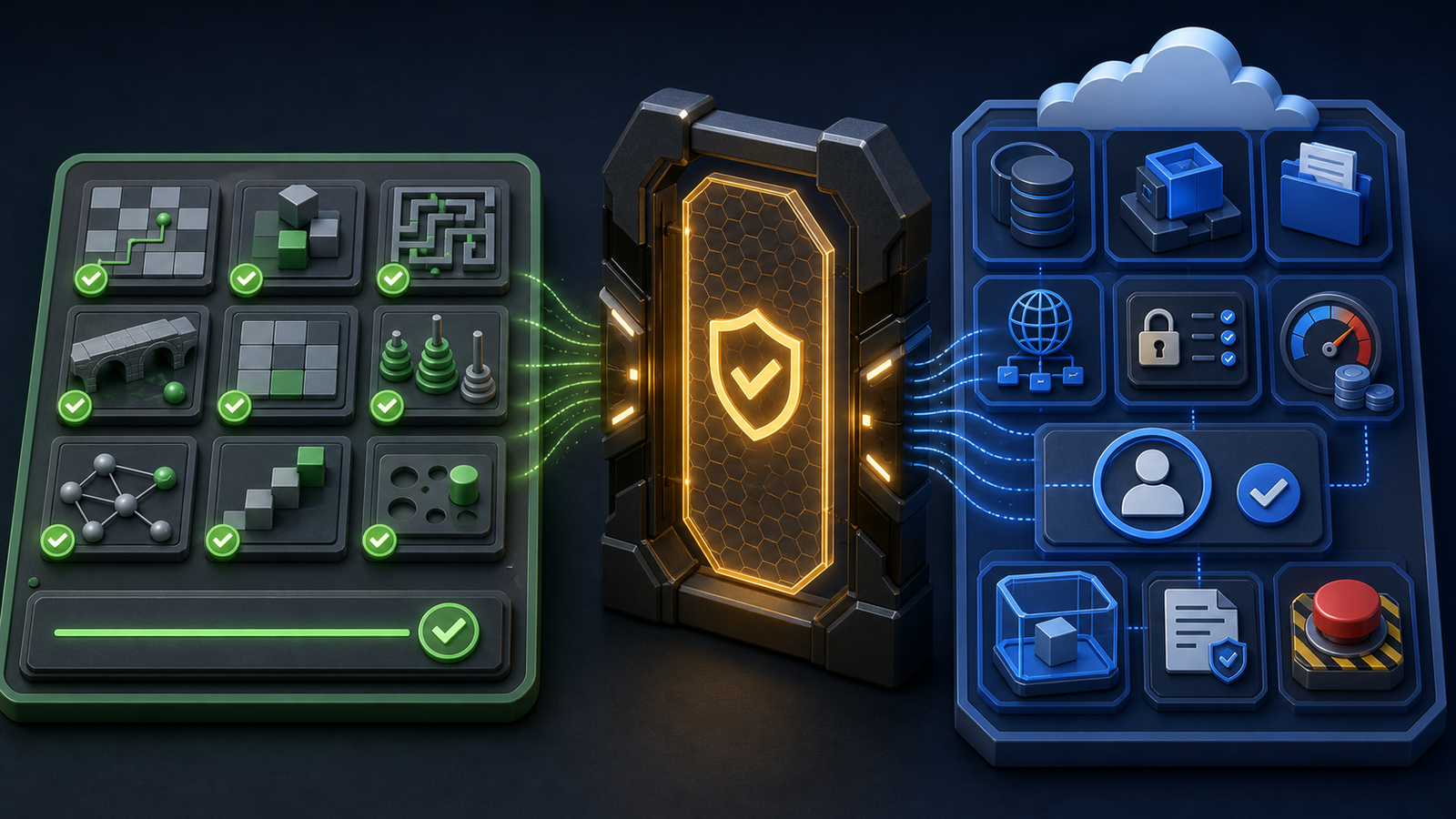
Cost and safety remain unresolved in NVIDIA’s public-set report. RHAE does not penalize internal tool calls or reasoning steps, and NVIDIA did not publish a full production cost model in the announcement. Nor does success in game environments establish reliability when tools can modify repositories, cloud resources or customer data. Those deployments still need least-privilege credentials, sandboxing, rate limits, human review and emergency-stop mechanisms.
What remains uncertain
The reported 100.00 score covers only ARC-AGI-3’s 25-environment public set. NVIDIA explicitly says it is not a result on the semi-private or fully private competition sets, and an editor’s note was added to sharpen that distinction. Public tasks are useful for reproducible development, but held-out results are needed to judge whether an architecture generalizes without tuning to visible environments.
Independent reproduction would also strengthen the claim. The March AVO paper is a preprint authored by NVIDIA researchers, and the August benchmark result is a company report. The ARC Prize methodology independently explains what the score means, but it does not by itself validate every implementation choice, compute budget or transfer claim in NVIDIA’s run.
Even with those limits, AVO is a useful signal for technical decision-makers. Model selection remains important, but long-horizon reliability is increasingly an infrastructure problem: persistent state, verified feedback, bounded tools, supervision and recovery determine whether useful reasoning turns into safe, sustained work.


