


BENGALURU, India — September 19, 2026, 5:04 PM IST — Amazon Web Services has launched SageMaker HyperPod Inference Gateway, a Kubernetes-native routing layer designed to send large language model requests to the GPU pod best equipped to handle them rather than relying on conventional round-robin balancing.
The new Amazon EKS managed add-on uses live signals including key-value cache utilization, queue depth, active requests, prompt-prefix cache hits and LoRA adapter residency. AWS says the per-cluster gateway can be installed on existing SageMaker HyperPod infrastructure without changing model servers or client applications.
The launch matters because request routing has become a material part of the cost and latency profile for production AI. A standard Kubernetes load balancer can treat two replicas as equivalent even when one has a full cache or a long queue and the other is underused. In GPU fleets, that blind spot can create latency spikes while expensive accelerators sit idle.
What AWS announced
According to the AWS launch announcement, the gateway deploys as the amazon-sagemaker-hyperpod-inference EKS add-on. It combines an Envoy Gateway, a body-based router that reads the model requested through an OpenAI-compatible API, and an endpoint picker that scores eligible model-serving pods from Prometheus metrics.
That design supports several operationally important cases. Requests can be separated into model pools from one gateway. Fine-tuned LoRA requests can be steered toward a pod where the required adapter is already resident in GPU memory. Workloads with repeated prompt prefixes can favor replicas that are more likely to have reusable cached state.
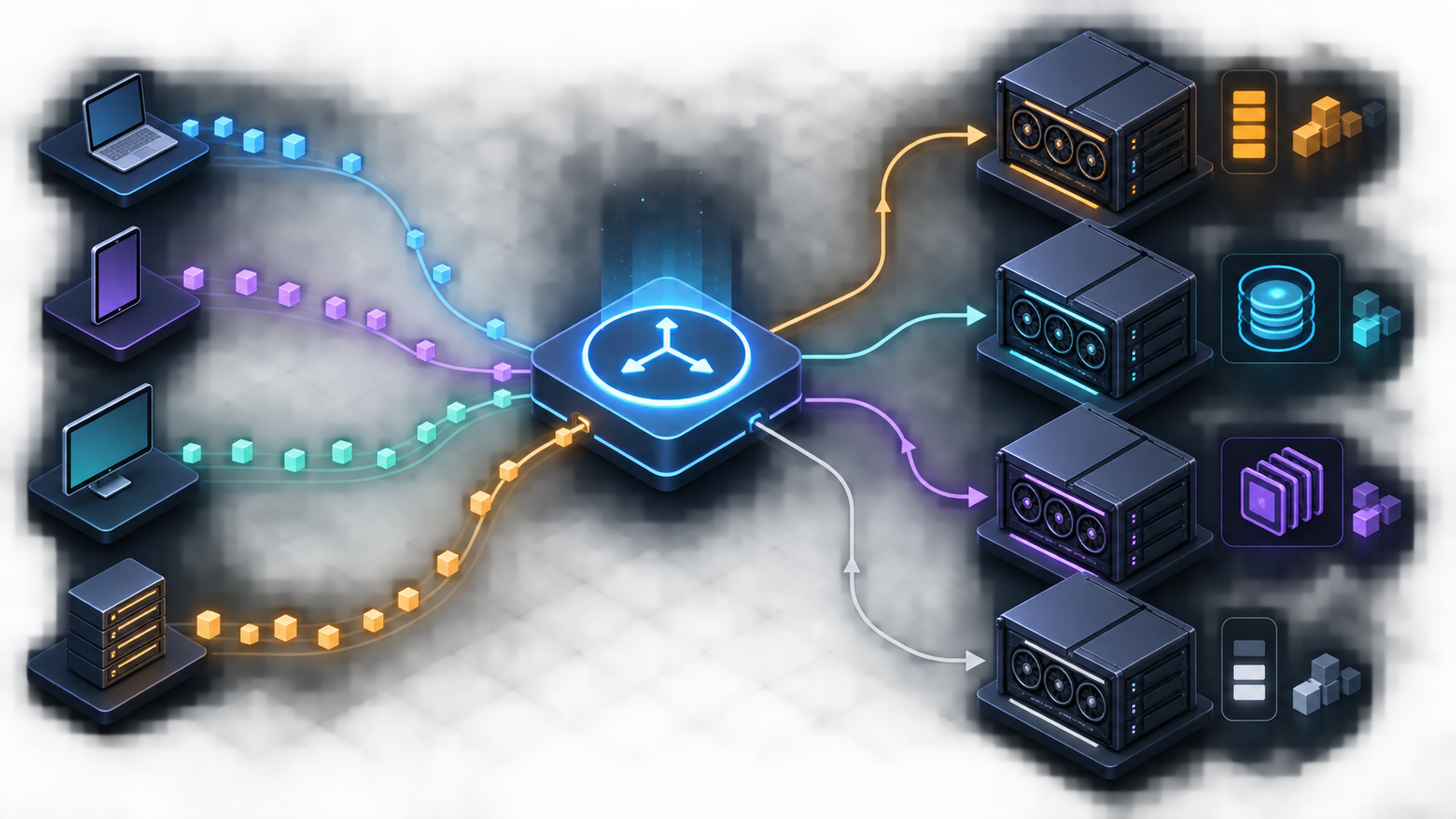
The launch builds on the open-source Kubernetes Gateway API Inference Extension, which introduced model-aware endpoint selection for accelerator-backed inference. That project describes the same underlying problem: long-running model requests and in-memory token caches make generic HTTP load-balancing assumptions less reliable.
AWS reports large tail-latency gains, with limits
AWS tested four models ranging from 8 billion to 235 billion parameters on H100 and A10G instances. Against Kubernetes round-robin routing on the same replicas, the company reported P99 time-to-first-token reductions of 97% for mixed GPU generations using Llama 3.1 8B, 98% for bursty traffic using Llama 3.1 70B, and 43% for a shared-prefix workload using Llama 3.1 8B.
Those figures are vendor benchmarks, not a guarantee for every deployment. AWS also reported comparable performance between the gateway and round robin for a uniform fleet under steady traffic. The practical reading is narrower than the headline number: inference-aware routing appears most valuable when hardware, queues, caches or request patterns diverge across replicas.
The current release is the per-cluster Tier 1 gateway and is available where the HyperPod inference add-on is offered, according to AWS. A planned Global Inference Router for cross-cluster and cross-region failover, centralized rate limits and cost-aware traffic shaping is not yet available. AWS also lists canary traffic splitting and priority-based admission control as future work.
What platform and DevOps teams should examine
For teams already operating model servers on SageMaker HyperPod and EKS, the immediate opportunity is to compare routing policy with real production traffic rather than migrate application code. The endpoint remains OpenAI-compatible, and AWS says the gateway works with compatible serving stacks including vLLM, SGLang and Text Generation Inference.
Before adoption, teams should baseline P50, P95 and P99 time to first token, inter-token latency, throughput and HTTP 429 rates. They should also segment tests by prompt length, model pool, adapter, GPU type and burst profile. An aggregate latency chart can conceal exactly the imbalances the gateway is meant to correct.
Observability will be central. AWS says the add-on surfaces pod-level metrics through Prometheus, pool metrics through Prometheus and Grafana, and cluster-level latency and error signals through CloudWatch. Platform teams should map those signals into existing service-level objectives and capacity policies instead of treating the default scoring weights as universally optimal.
Failure behavior also deserves validation. The per-cluster layer can stop sending traffic to pods with stale metrics and return a 429 response with a retry header when a pool is exhausted. Applications still need bounded retries, backoff and overload controls. The cross-region behavior described for the future global tier should not be assumed to exist in today’s release.
Why inference routing is becoming infrastructure
The gateway reflects a broader shift in LLM operations. Model quality is only one part of production performance; placement, cache locality, queue state and adapter residency increasingly determine what users experience and what operators pay. That moves inference routing into the same design conversation as autoscaling, rollout safety, observability and LLMOps.
Teams evaluating the service should keep the control-plane trade-off in view. The add-on preserves familiar Kubernetes and GitOps workflows, but it is part of the SageMaker HyperPod and EKS stack. Organizations comparing managed and portable approaches should measure the operational value of AWS integration against the effort of running an upstream or alternative inference-gateway implementation.
For application teams, the safest next step is a representative canary: replay anonymized traffic against round robin and inference-aware routing, validate tail latency and GPU utilization, and confirm that failures behave predictably. Developers building retrieval-heavy systems may also want to revisit RAG architecture, because long and repeated prompt prefixes are one of the workload shapes where cache-aware routing can have an outsized effect.
What remains uncertain
AWS has not published independent benchmark validation for the new gateway, and the launch post does not establish a universal cost saving. Results will depend on request mix, replica count, hardware diversity, model-server telemetry and the degree of cache reuse. Pricing and regional availability should be checked in the applicable AWS account before a rollout.
Even with those limits, the release is a concrete signal for cloud and platform teams: generic load balancing is no longer the default technical assumption for high-scale model serving. The useful question is not whether a router is “AI-aware,” but whether its scheduling inputs and failure modes improve measured service objectives under the team’s own traffic.
Sources: AWS launch announcement; AWS product documentation; AWS SageMaker inference review; Kubernetes Gateway API Inference Extension overview.


