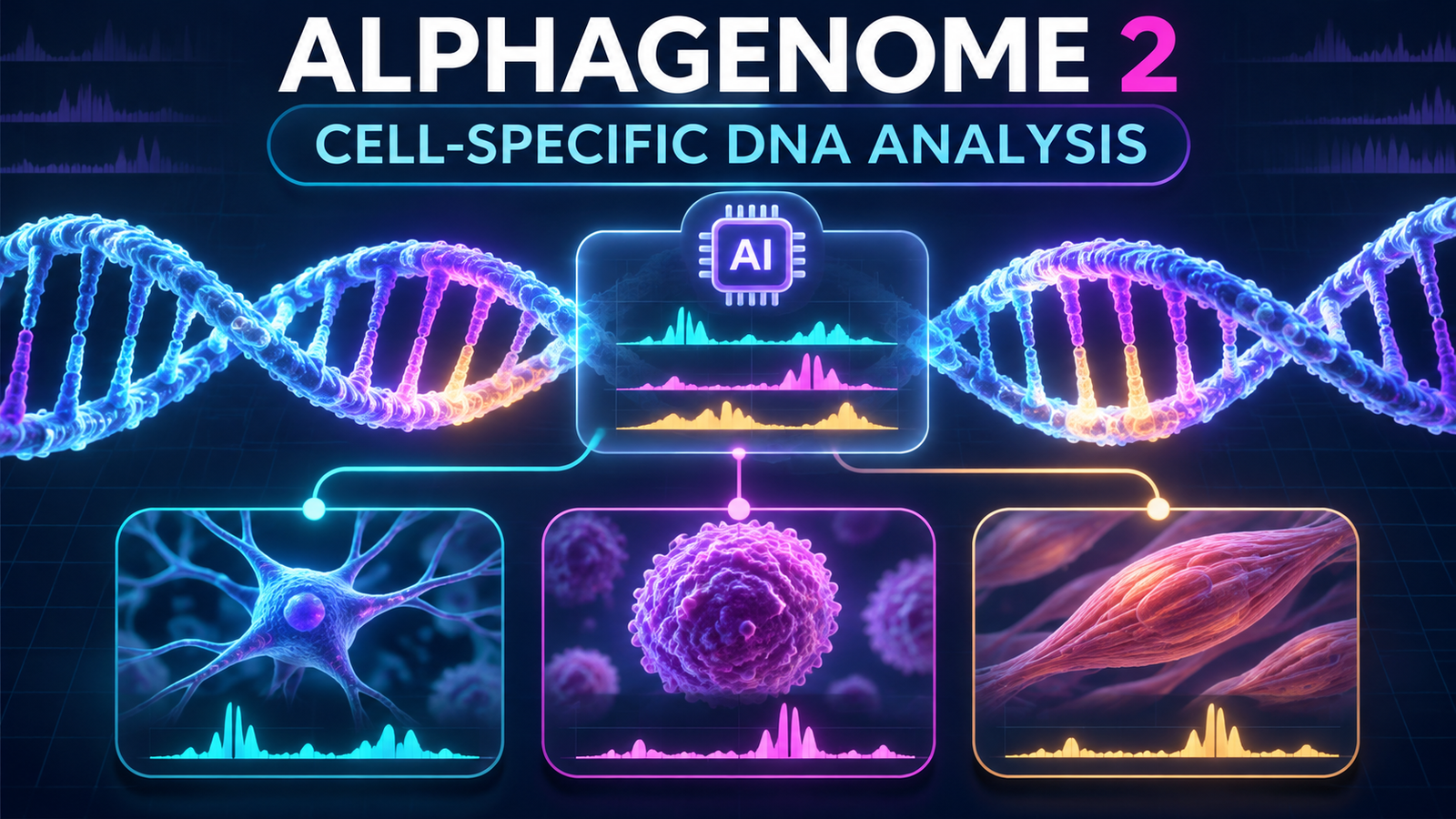

NEW DELHI, November 12, 2026, 6:16 PM IST — Google DeepMind has released AlphaGenome 2, a DNA sequence model designed to predict how genetic variants affect specific human cell types and states. The model is available now through the AlphaGenome API for non-commercial research, while commercial access is in private preview.
The release moves genomic prediction beyond broad tissue averages and toward condition-specific analysis. For research software teams, the immediate significance is not a clinical shortcut but a new specialized inference service that can combine a DNA sequence with a chosen cell condition, or with a representation derived from a laboratory’s own single-cell data.
That distinction matters. The same stretch of DNA can behave differently in an immune cell, a heart cell or a disease-affected state. DeepMind says AlphaGenome 2 conditions every stage of its architecture on the target biological context, allowing one underlying model to produce different predictions for different cells without retraining for each experiment.
What Google DeepMind confirmed
DeepMind said it trained AlphaGenome 2 on more than 107 million individual cell profiles drawn from 68 tissues, using both human and mouse samples. The model accepts a DNA sequence of up to one million letters alongside a biological condition and predicts molecular readouts including gene expression, chromatin accessibility, histone modifications and DNA methylation.
In tests on the TenK10K single-cell dataset, the company reported that AlphaGenome 2 identified 30% of causal variants compared with 16% for the original AlphaGenome fine-tuned on single-cell data. It also reported identifying the direction of gene effects in 43% of cases, versus 23% for the earlier system and other specialized tools. Those are vendor-reported research results, not evidence of clinical performance.
The accompanying technical preprint describes AlphaGenome 2 as a conditional sequence-to-function model. DeepMind also demonstrated that researchers can provide a small single-cell RNA sequencing sample, compress it into a cell-state representation and apply the model to a state it did not see during training. The company says this can support cross-modality imputation, such as predicting chromatin accessibility from observed gene activity.
Independent reporting in Nature highlighted the model’s ability to narrow the search for cell types in which a DNA variant is likely to act. DeepMind’s own case study reproduced aspects of a published inflammatory bowel disease finding involving the ETS2 gene, but the company explicitly says AlphaGenome 2 is for research only and has not been validated or approved for clinical or diagnostic use.

API access changes the engineering problem
The AlphaGenome documentation exposes programmatic methods for interval and sequence prediction, variant scoring, batch requests, cell encoding and Atlas queries. The service is free for non-commercial use, but request rates vary with demand. Google notes that precomputed Atlas lookups support higher rates than live model predictions and positions the live service for thousands of predictions rather than millions.
For platform teams, that makes workload classification essential. A pipeline that can answer a question from the precomputed AlphaGenome Atlas should not automatically invoke live inference. Batch queues, bounded concurrency and retry policies can protect research jobs from variable quotas, while cached inputs and immutable result manifests can reduce repeated requests.
Versioning also needs to cover more than model names. Teams should retain the reference genome build, genomic interval, alternate allele, chosen cell condition, output types, client-library version and scoring method with every result. That is the scientific-computing equivalent of the lineage controls used in LLMOps: a prediction is difficult to audit if the exact input and serving configuration cannot be reconstructed.
Repositories that operationalize the API should separate research orchestration from interpretation. Continuous integration can validate schemas, deterministic preprocessing and provenance records, but it cannot establish biological truth. A sensible release gate requires domain review and, where a result affects a research decision, comparison with experimental evidence or an independent method.
Data governance remains a deployment boundary
AlphaGenome 2 can condition predictions on a researcher’s own single-cell data. That capability increases its value, but it also raises the sensitivity of the input path. Before uploading human-derived data, organizations should determine whether the dataset is de-identified, whether consent permits external processing, which region handles the request, how long inputs and outputs are retained, and whether commercial preview terms match institutional policy.
DeepMind’s public announcement does not turn those questions into default guarantees. Until an organization has reviewed the applicable service terms and privacy controls, synthetic or public reference data is the safer choice for integration tests. Secrets for API access should stay in a managed vault, and production logs should record identifiers and hashes rather than raw genomic or single-cell records.
This is also where a retrieval layer can help without replacing the scientific model. Teams can connect prediction records to papers, assay metadata and review notes using a controlled retrieval-augmented generation workflow, but generated explanations should remain traceable to source evidence. Prompt design alone is not a substitute for access control, provenance or validation; GravityDevOps’ prompt engineering guide covers that broader distinction.
What remains uncertain
AlphaGenome 2 is a preprint-backed research release, not a medical device, and the reported benchmarks cover selected datasets and tasks. Performance may vary across ancestry groups, rare cell states, assay quality and conditions poorly represented in training data. The commercial service is also not generally available, and DeepMind has not published a universal production rate limit or public commercial pricing in the announcement.
Still, the launch is a meaningful shift for computational biology teams. It packages a technically demanding conditional genomics model behind an API while preserving a clear boundary between prediction and proof. The teams most likely to benefit first are those that treat the service as a versioned research dependency—with quotas, provenance, privacy review and laboratory validation—not as an automated diagnostic answer.

