


SEO excerpt: Microsoft has reportedly begun routing tens of thousands of weekly Excel and Outlook AI prompts to its own MAI models, turning model selection into a live cost, quality and governance decision for enterprise platform teams.
NEW DELHI, July 14, 2026, 12:33 p.m. IST — Microsoft has started using its internally developed MAI models for part of the AI workload inside Excel and Outlook, according to a Bloomberg report, marking a meaningful production test of whether specialized first-party models can reduce the cost of high-volume enterprise AI without visibly weakening the user experience.
Bloomberg reported that tens of thousands of prompts in the spreadsheet and email applications are now completed each week by Microsoft’s own models. The report cited a person familiar with the work, who was not identified because the deployment details are internal. Microsoft did not provide additional comment when contacted by TechCrunch, so the exact routing rules, model mix and quality thresholds remain unconfirmed.
The development matters beyond Microsoft 365. It is an early public signal that large software platforms are moving from choosing one flagship model to operating portfolios of models, with requests routed according to task complexity, latency, cost and policy requirements. For developers and platform teams building their own AI services, model routing is becoming an operational control rather than a procurement choice made once at the start of a project.
What is confirmed
Microsoft publicly introduced seven internally developed MAI models at Build 2026, spanning reasoning, coding, image, transcription and voice workloads. Its official Build materials describe the broader platform as model-diverse and say Microsoft Foundry can optimize applications with models suited to a particular job.
The company has also confirmed product-level deployment of several models. MAI-Code-1 is available in GitHub Copilot and Visual Studio Code, while MAI image models are active in PowerPoint and rolling out to OneDrive. Microsoft says its 35-billion-active-parameter MAI-Thinking-1 was designed for high efficiency and low token cost, though its benchmark comparisons remain vendor claims and should not be treated as independent proof of production quality.
Microsoft has made a more specific claim for spreadsheet work. In a company announcement describing its MAI family, it said an Excel-tuned model matched GPT-5.4 while operating up to ten times more efficiently. Microsoft did not publish enough detail in that announcement to independently reproduce the comparison, including the full task set, traffic distribution or cost methodology.

What remains unclear
The Bloomberg report establishes the reported scale of MAI use but does not disclose which exact models handle Excel and Outlook requests, which prompt categories are eligible, or what proportion of total traffic has moved. It also does not say whether users can see which model answered a request or whether Microsoft automatically falls back to OpenAI or Anthropic models when a task crosses a complexity threshold.
That lack of detail limits conclusions about model quality. Routing tens of thousands of prompts is operationally significant, but it is not evidence that a smaller or specialized model can replace a frontier model across every Office workload. Spreadsheet formula assistance, email summarization, long-document reasoning and tool-using agent tasks have different accuracy and latency profiles.
Why platform teams should pay attention
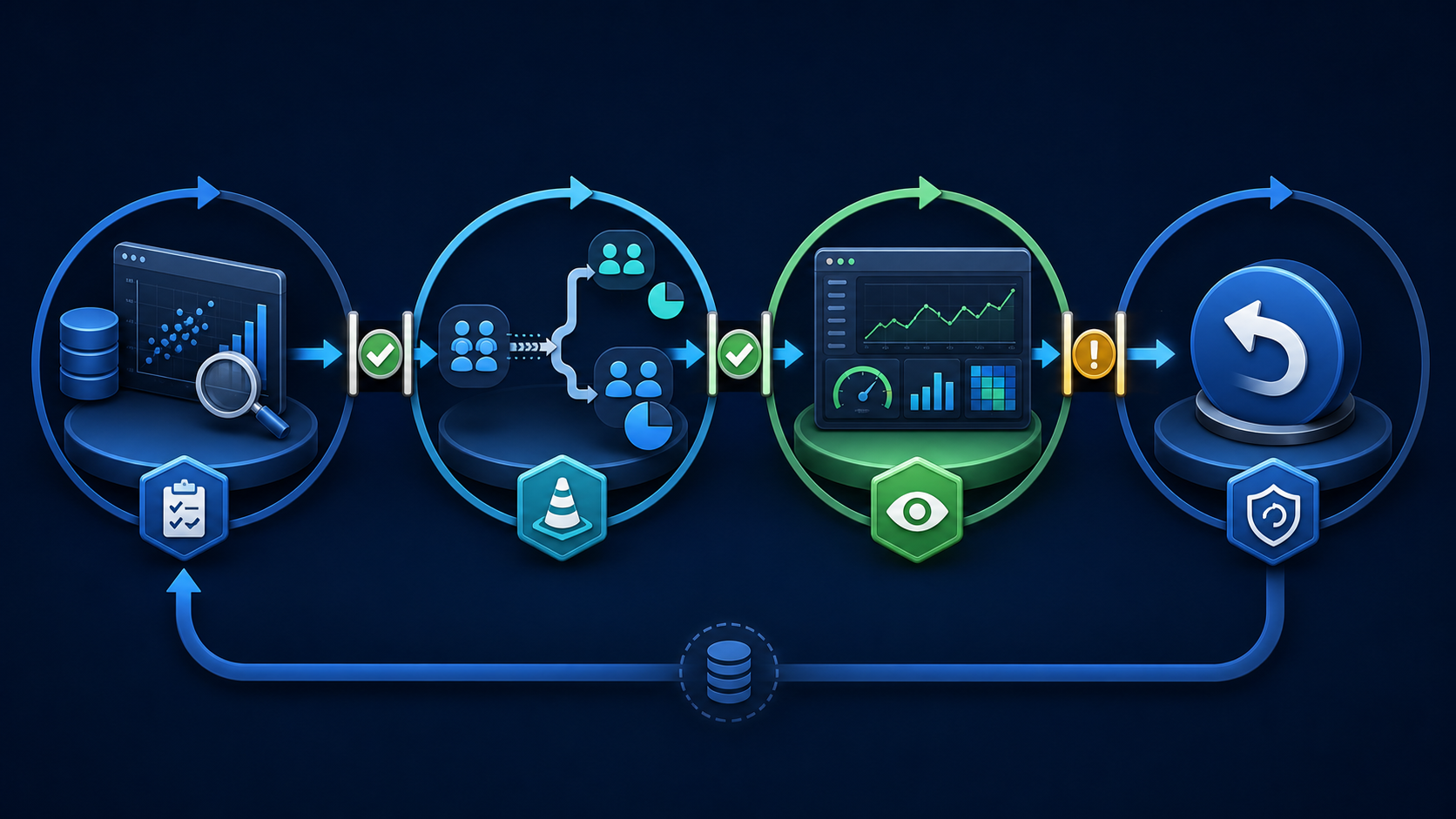
For enterprise AI operators, the central lesson is not to copy Microsoft’s reported model choice. It is to make the routing decision measurable. A production gateway should record the selected model, task class, latency, token use, estimated cost, fallback path and evaluation outcome without logging sensitive prompt content unnecessarily.
Teams should also version routing policies alongside application code. A policy change can alter output quality even when the user interface and prompt stay the same. Canary traffic, regression evaluations and rollback controls are therefore as important for model-route changes as they are for ordinary service deployments.
Quality thresholds should be tied to workload risk. A low-cost model may be appropriate for drafting an email subject line, while financial spreadsheet analysis or an agent that can modify records should face stronger evaluations, human review and authorization controls. Readers building these systems can use GravityDevOps’ guides to LLMOps and retrieval-augmented generation for the monitoring and grounding layers around a routed model stack.
A shift from model loyalty to workload economics
Microsoft continues to use third-party models and promotes a multi-model ecosystem, so the reported Office deployment is better understood as diversification than a wholesale replacement of OpenAI or Anthropic. The company is simultaneously a major OpenAI partner, a distributor of outside models through Azure, and a model developer with an incentive to lower its own inference bill.
That combination creates a template other cloud and software providers are likely to follow: reserve expensive frontier models for the requests that need them, direct repeatable tasks to smaller or tuned models, and keep fallback capacity across providers. The operational trade-off is more complexity. Every additional route expands the evaluation matrix, incident surface and audit trail that platform teams must maintain.
For now, the most important unanswered question is whether Microsoft will give enterprise administrators more visibility into the model selected for each workload. Without route-level telemetry, customers may see better economics but have less evidence for investigating output drift, compliance questions or quality regressions.
Sources
This report draws on Bloomberg’s report on MAI traffic in Microsoft applications, TechCrunch’s follow-up and Microsoft’s response, and Microsoft’s official Build 2026 platform announcement. Claims about model performance and efficiency are attributed to Microsoft and have not been independently verified here.


