

NEW DELHI, July 24, 2026, 6:15 p.m. IST — OpenAI is rolling out Health in ChatGPT to eligible adults in the United States, allowing users to connect Apple Health and supported medical records to the chatbot. The expansion moves sensitive, continuously updated personal data into everyday AI conversations—and gives engineering and platform teams a concrete new reference point for consent, retention and workload separation.
The product is available gradually to logged-in U.S. users aged 18 and older across Free, Go, Plus and Pro plans on the web and iOS. OpenAI says the connected information can help compare test results over time, summarize changes since an appointment and relate sleep or activity patterns to a user’s routine. The company also stresses that the feature is intended to support, not replace, medical care.
For developers and technical decision-makers, the more consequential part of the launch is the boundary around the data. Health is a consumer ChatGPT feature, not an API announcement and not a clinical deployment environment. OpenAI’s support documentation says it is not intended for covered-entity use, does not include a Business Associate Agreement and is not HIPAA-eligible.
What OpenAI confirmed
Users can connect Apple Health, supported U.S. provider portals, One Medical and Function Health. Other wearable and fitness services can contribute information when they already share data through Apple Health, although proprietary metrics may not transfer.
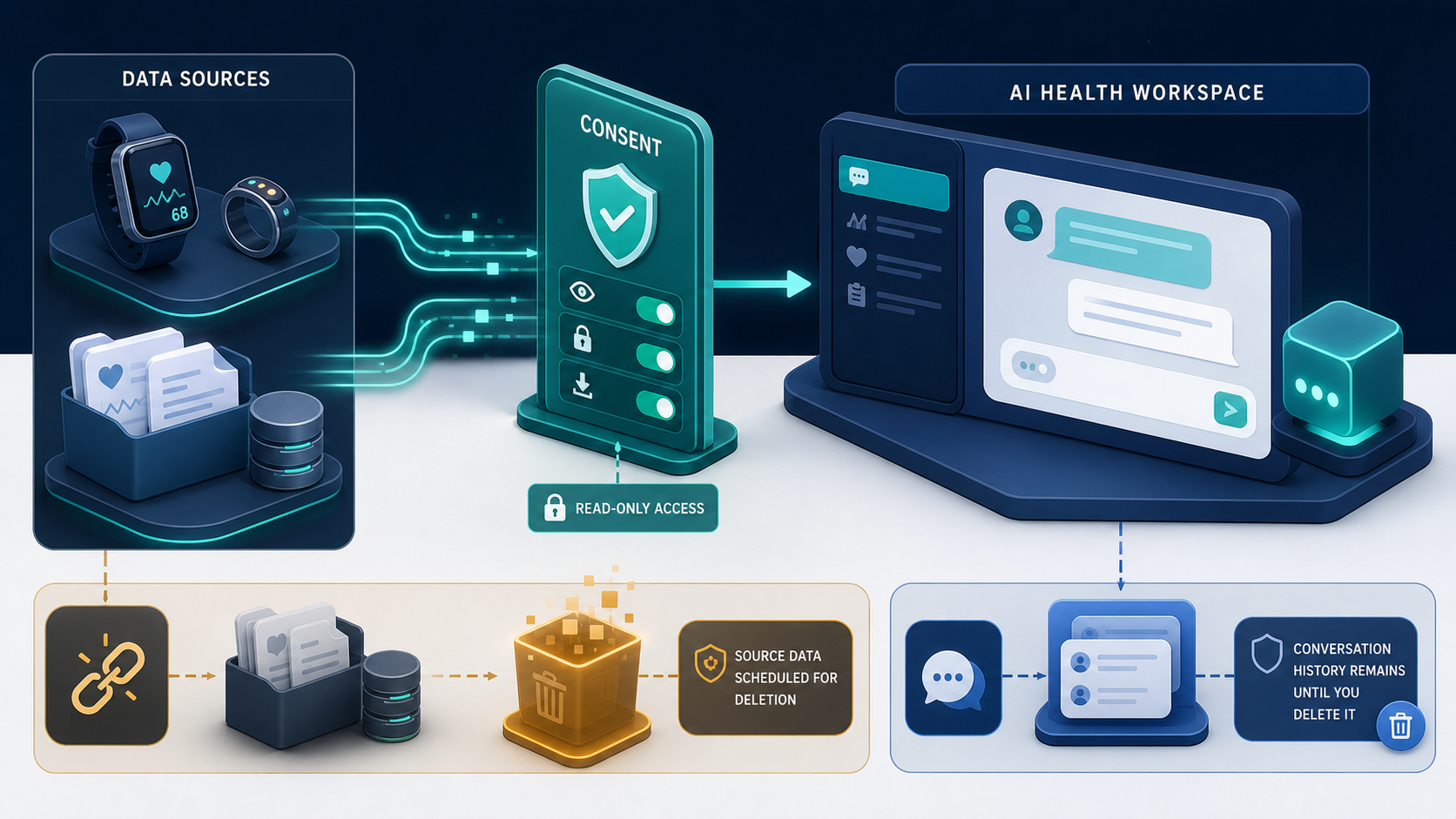
The integration is read-only: ChatGPT can use connected records when answering a question but cannot write information back to Apple Health or a provider record. By default, ChatGPT asks before using connected health data in a conversation. Users can approve one request or grant ongoing access, and can later change that permission.
OpenAI says connected medical records, Apple Health data and conversations that use them are not used to train its foundation models or target advertising. Its health privacy notice adds an important qualification: a limited number of authorized personnel and trusted service providers may access data received through the health features to improve model safety unless the user has opted out.
Disconnection is not the same as complete deletion
The retention workflow deserves close attention. OpenAI says data synced from a disconnected health source is deleted from its systems within 30 days. Information already incorporated into ChatGPT conversation history remains until the user deletes those conversations separately.
That distinction is familiar to platform teams: revoking a connector stops future access, but it does not necessarily erase downstream artifacts created while access was active. A production design should inventory those artifacts—conversation transcripts, summaries, traces, caches, evaluations and support records—and define deletion behavior for each.
The feature also allows health-related conversations to create memories when ChatGPT memory is enabled, although OpenAI says memories are not created directly from synced health data. Users who want stronger separation can use Temporary Chat or a project with project-specific memory.
A reference architecture, not a compliance shortcut
OpenAI’s product choices illustrate several controls that teams building sensitive-data agents should expect to implement: explicit data-source connections, least-privilege read access, consent at the moment of use, visible account disconnection and separate handling of source data and derived conversational content.
They do not, by themselves, establish regulatory compliance. OpenAI explicitly directs healthcare providers, insurers and their business associates toward separate clinical products that support HIPAA compliance. Teams should make the same distinction internally between a consumer assistant used by an individual and an enterprise workload processing protected health information on behalf of an organization.
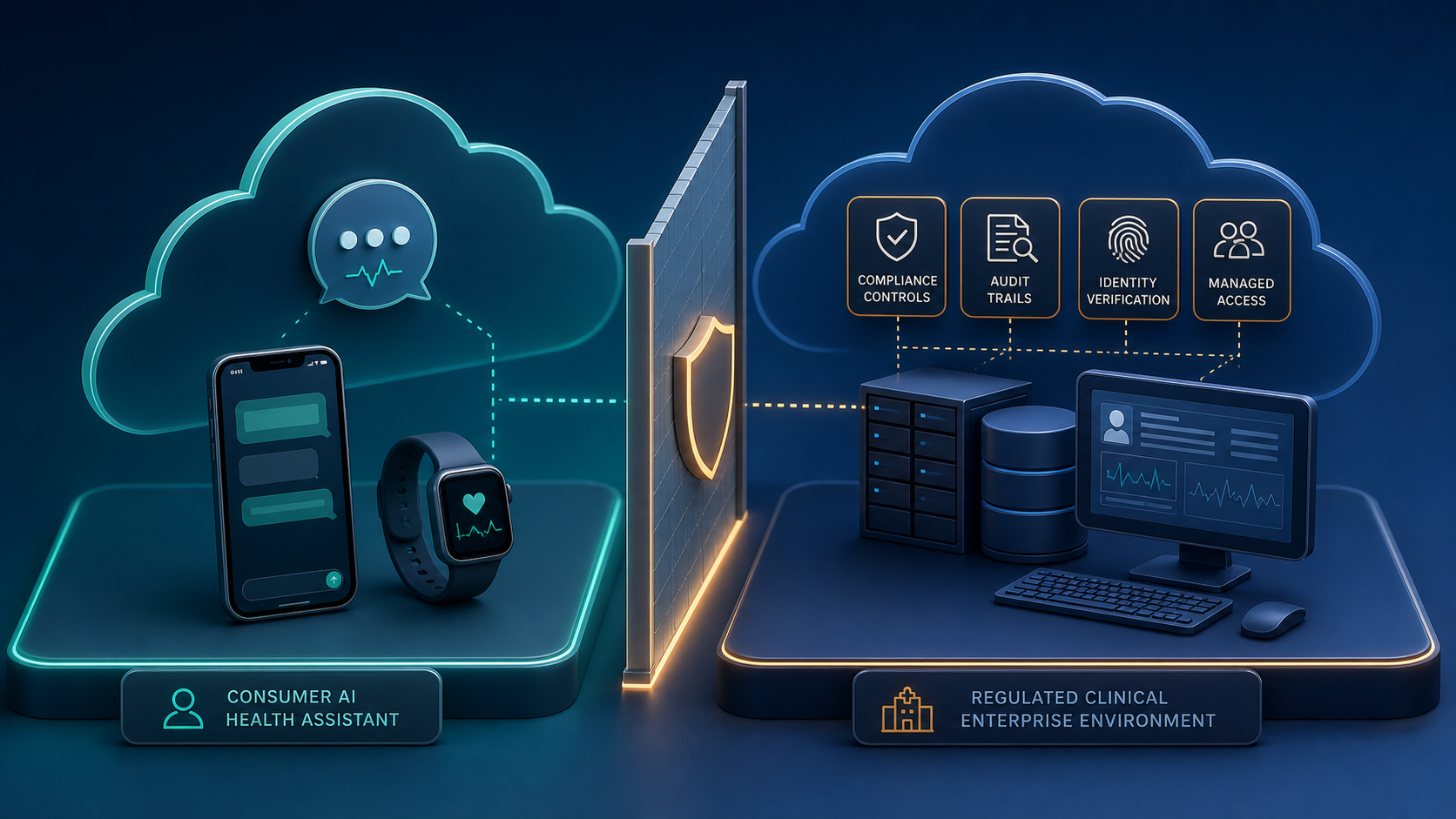
Before approving a connected-data agent, platform and security teams should ask which system is the source of truth, whether access is read-only, how consent is recorded, where derived content is stored, what happens after revocation and which audit evidence is available. The same questions apply beyond healthcare to finance, HR and legal workflows.
For teams building retrieval-based assistants, the launch is also a reminder that retrieval-augmented generation is only one layer of the system. Data lineage, authorization, retention and evaluation must sit around retrieval. Operational ownership belongs in the broader LLMOps lifecycle, not only in prompt design.
Model claims need careful reading
OpenAI says GPT-5.6 Sol is its strongest model for health and that every GPT-5.6 model outperformed GPT-5.5 on HealthBench Professional. Those are company-reported results on an evaluation developed with physician input; they should not be read as proof that the system can diagnose or treat patients safely in every real-world setting.
The company says hundreds of physicians helped create realistic scenarios and scoring rubrics covering accuracy, safety, communication, context awareness, completeness and appropriate escalation. The practical engineering takeaway is narrower: evaluation suites for high-risk agents should measure when a model asks for missing context and when it escalates, not just whether its final answer resembles a reference response.
What remains uncertain
The rollout is gradual, provider availability varies and OpenAI says it may take weeks to reach all eligible accounts. The feature currently works on the web and iOS, while connected Health data is not supported in Codex or Voice mode. OpenAI has not announced an equivalent developer API in this release.
The company’s privacy and safety controls are now documented, but their effectiveness at broad consumer scale will require continued scrutiny. Teams evaluating similar systems should treat the launch as evidence that connected personal data is becoming a mainstream AI product surface—and that deletion, consent and workload classification must be designed before deployment, not added after an incident.
Sources
OpenAI’s launch announcement, the updated Health in ChatGPT support documentation, and OpenAI’s Health Privacy Notice.


