

NEW DELHI, July 26, 2026, 9:33 p.m. IST — Nvidia and South Korea’s SK Group have announced a more than $500 billion AI infrastructure initiative that would combine a large Nvidia Vera Rubin computing buildout with a long-term supply and co-development agreement for next-generation high-bandwidth memory.
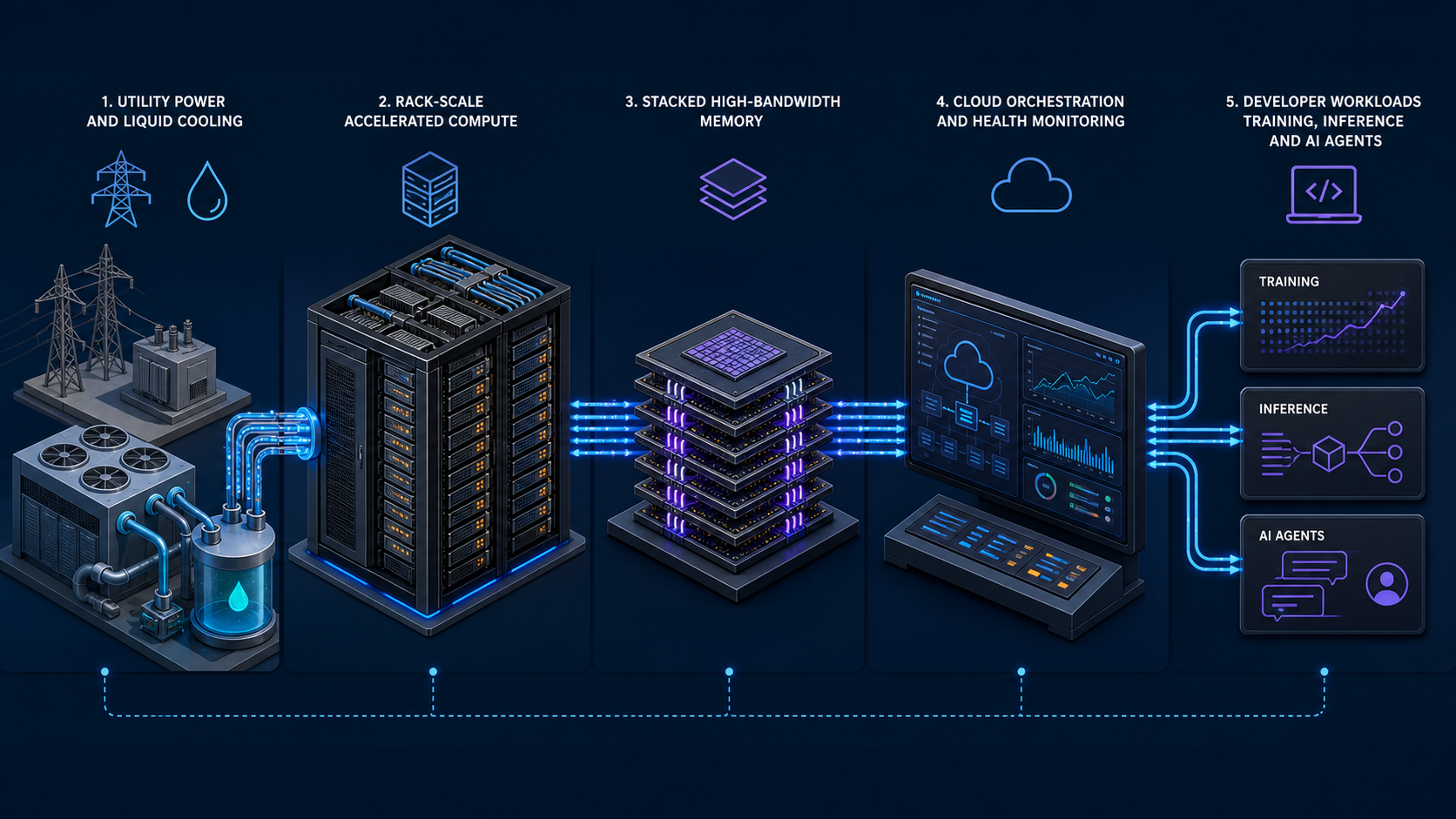
The plan, unveiled after an AI summit in San Francisco, is one of the clearest signs yet that the next phase of AI infrastructure competition is being designed around the entire production system—not only accelerators, but also memory, power, networking, data-centre operations and access to cloud capacity.
For developers and platform teams, the immediate takeaway is not that new capacity is available today. It is that large providers are locking together hardware roadmaps and operational stacks years in advance. That will influence where high-end AI workloads can run, how capacity is contracted and which observability, scheduling and portability controls engineering teams will need.
What Nvidia and SK Group confirmed
In their joint announcement, Nvidia and SK Group said the initiative spans two connected tracks:
- SK Telecom plans to build an AI factory of up to 2 gigawatts using Nvidia’s DSX platform and Vera Rubin accelerated-computing systems.
- SK hynix and Nvidia plan a long-term partnership to secure and co-develop next-generation AI memory, including HBM.
- The first AI factory is planned to come online in 2027.
- The infrastructure is intended to serve sovereign, physical, agentic and enterprise AI demand across South Korea and the wider Asia-Pacific region.
The companies described the arrangement as a $500 billion-plus initiative and said they had signed letters of intent. That distinction matters: the announcement sets a proposed scale and strategic direction, but it is not evidence that the full amount has already been spent or that all capacity has been contracted.
Reuters separately reported the initiative and its two central components: large AI data centres and next-generation memory. A later Reuters report, citing South Korea’s presidential Blue House, placed the SK agreements within a broader group of AI initiatives announced around the summit.
Why HBM4 is part of the infrastructure story
High-bandwidth memory sits close to an accelerator and feeds data to it far faster than conventional server memory. As model sizes and inference volumes grow, memory bandwidth and capacity can become constraints alongside accelerator availability.
The announced system is expected to use SK hynix HBM4 with Nvidia Vera Rubin infrastructure. The co-development element suggests the partners want memory design and system architecture to evolve together, rather than treating HBM as a replaceable component purchased late in the deployment cycle.
That approach resembles full-stack co-design: the accelerator, memory subsystem, interconnect, rack, cooling, scheduler and serving software are tuned as one platform. It may improve utilisation and performance, but it can also deepen dependency on a particular hardware and operations stack. Teams evaluating such capacity should distinguish open interfaces from provider-specific management layers.
Two gigawatts changes the operations problem
A 2-gigawatt ceiling describes power scale, not a guaranteed day-one deployment. Even so, it signals a project whose operating constraints extend well beyond GPU provisioning. Power delivery, cooling, maintenance domains, failure isolation, regional networking and workload placement become first-order platform concerns.
Nvidia says its DSX architecture includes lifecycle management, health automation, resiliency and multi-tenant operations. Those are vendor claims that will need evidence from production deployments. Platform buyers should ask for workload-level service objectives, failure-domain documentation, capacity guarantees and measured recovery behaviour—not only peak token throughput.
A separate NAVER, Brookfield and Nvidia announcement on July 24 proposed expanding a Korean sovereign AI factory from 55 megawatts to 200 megawatts. It is a different project, but it reinforces the wider trend: Korea is pairing domestic cloud operations and data governance with large Nvidia deployments.
Practical impact for developers and DevOps teams
The SK-Nvidia agreement will not change a Kubernetes manifest or model endpoint overnight. It does, however, sharpen several planning priorities for teams that expect to consume large AI clusters.
- Measure outcomes per resource. Track successful requests or completed agent tasks against accelerator time, memory use, energy and cost. Raw tokens per second do not capture retries, tool failures or low-quality outputs.
- Design for queued capacity. Large training, post-training and batch-inference jobs should tolerate admission controls, pre-emption and regional capacity changes.
- Keep serving portable where practical. Containerised runtimes, standard model formats and infrastructure abstractions can reduce migration cost, although performance tuning will remain hardware-specific.
- Expand observability beyond the model. Monitor memory pressure, network saturation, scheduler delays, node health and thermal or power-related throttling alongside application latency and quality.
- Separate data residency from marketing labels. A sovereign AI service still requires precise answers about data location, encryption, operator access, telemetry, backups and incident response.
GravityDevOps readers building production AI systems can use the site’s LLMOps guide for the broader lifecycle and its RAG guide for retrieval architecture. Teams automating delivery should also review the comparison of CI/CD tools with AI workload controls and model artefacts in mind.
What remains uncertain
The announcement does not provide a detailed construction schedule for the full 2-gigawatt target, customer pricing, regional availability, binding purchase volumes or independently verified performance. It also does not establish how much of the $500 billion-plus figure represents data-centre construction, equipment, memory supply or other long-term commitments.
Those gaps are material. The plan should be read as a strategic commitment backed by letters of intent, not as fully delivered infrastructure. Execution will depend on permitting, power, construction, memory production, networking and customer demand.
The broader context
AI infrastructure providers are increasingly competing on the cost and reliability of complete systems rather than individual chips. Memory suppliers, telecom operators and cloud platforms are therefore becoming central participants in AI deployment strategy.
SK Group brings both sides of that equation: SK hynix is a major HBM producer, while SK Telecom can operate and sell access to AI cloud infrastructure. Nvidia supplies the accelerated-computing architecture and software stack. If the partners deliver at the announced scale, the project could expand Asia-Pacific access to frontier-class compute. Until capacity, pricing and service levels are published, engineering teams should treat that outcome as plausible but not yet confirmed.
Sources
This report draws on the Nvidia and SK Group announcement, Reuters reporting on the initiative, the earlier SK Telecom infrastructure announcement and NAVER’s statement on the separate 200-megawatt expansion.


