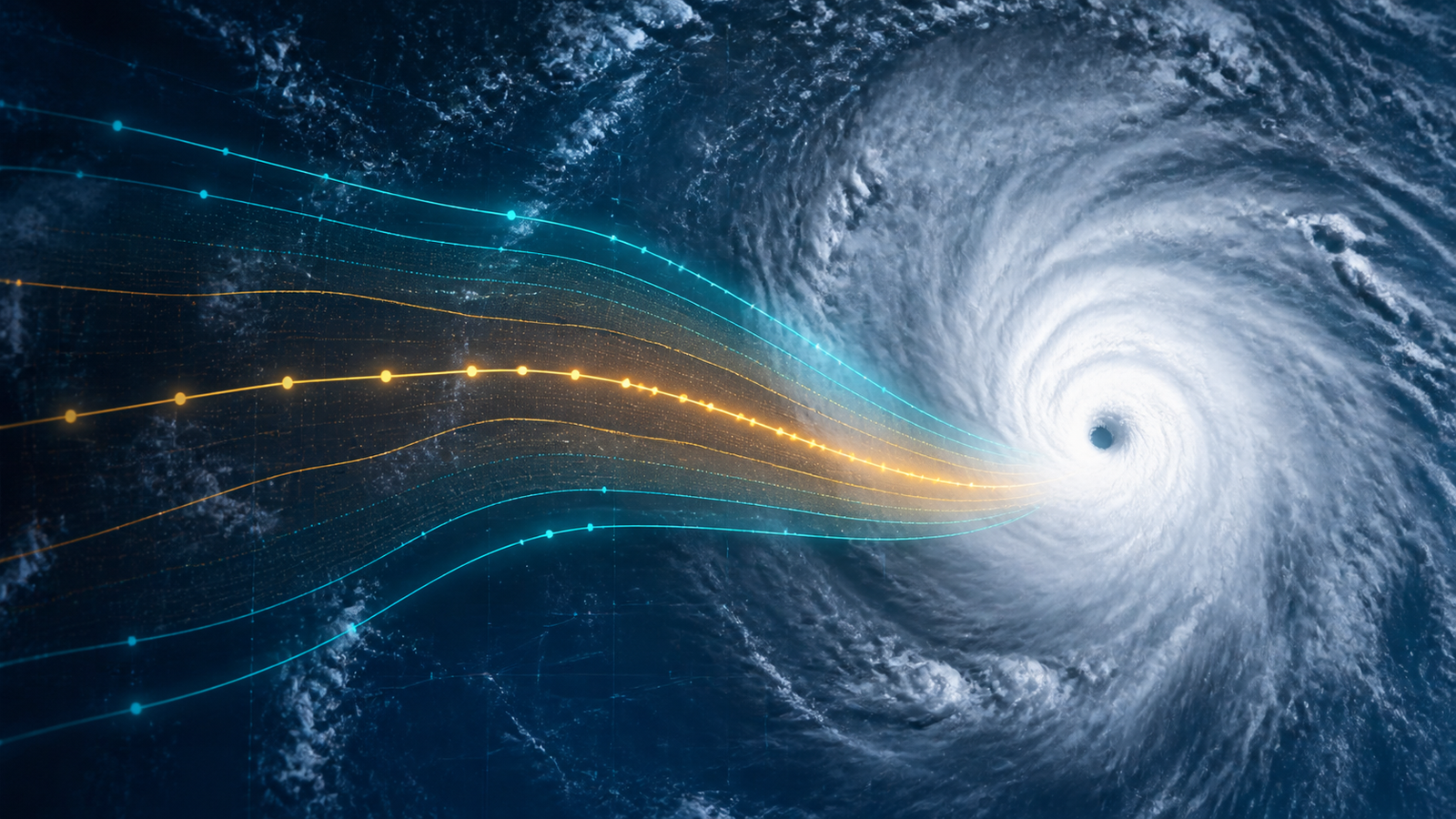

Google DeepMind has released the code and model weights for WeatherNext Cyclones after a Nature paper reported an average lead-time gain of at least one day over leading operational models. For engineering teams, the release turns a research claim into an inspectable MLOps and resilience workload.
NEW DELHI, August 9, 2026, 10:55 PM IST — Google DeepMind has open-sourced an artificial-intelligence weather model designed to forecast tropical cyclone tracks, intensity and wind structure, giving researchers and operational teams access to a system that its developers say can match a conventional two-day forecast at a three-day horizon.
The release matters beyond meteorology. WeatherNext Cyclones is a production-scale example of probabilistic AI being used in a high-stakes decision pipeline, where speed is valuable but uncertainty, provenance and human oversight cannot be treated as optional. It also gives cloud and platform teams a concrete open-source workload for studying large ensemble inference, data lineage and operational validation.
What Google and the paper confirmed
In an August 6 announcement, Google DeepMind said WeatherNext Cyclones can generate forecasts for a storm’s track, intensity and wind structure up to 15 days ahead. The system can produce 1,000 possible scenarios for each cyclone, compared with the 50-member ensembles common in global physics-based forecasting.
A paper published in Nature the same day reports that, when evaluated on tropical cyclones from 2023 through 2025, the model delivered an average lead-time advantage of a day or more across track, intensity and wind-radius predictions. The authors describe that accuracy gain as comparable to roughly a decade of operational forecasting progress.
Those findings are significant, but they should be read carefully. Nature labels the current article an unedited early-access manuscript that will undergo further editing. The model is also decision support for trained forecasters, not a replacement for official forecasts or public warnings. Google explicitly directs users to local meteorological agencies for authoritative guidance.
A single model tackles a difficult forecasting trade-off
Cyclone forecasting has traditionally split two related problems. Large-scale atmospheric currents largely determine where a storm will travel, while localized physical processes around its core determine how strong it becomes. Global models are well suited to the first problem; higher-resolution regional models have generally been needed for the second.
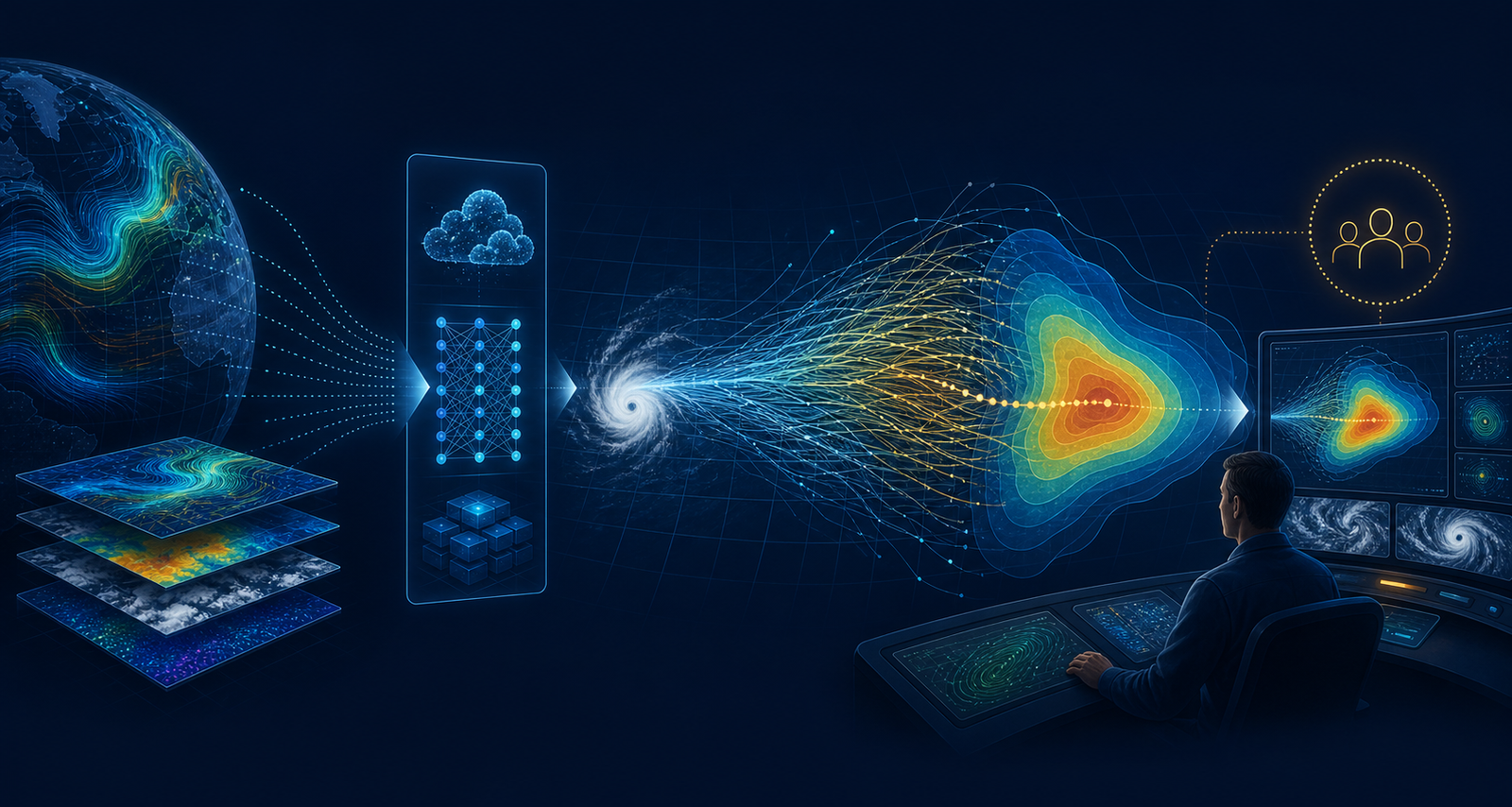
WeatherNext Cyclones was co-trained on nearly 20 terabytes of global atmospheric data and the IBTrACS archive covering almost 5,000 historical storms. Google says the model combines global weather dynamics with curated cyclone observations, allowing one system to model track, intensity and wind extent.
The model uses inputs at a 28-by-28-kilometre resolution—far coarser than conventional regional intensity models—yet the paper reports state-of-the-art results. Google says a single 15-day forecast can run in less than a minute on a Tensor Processing Unit. A compact WeatherNext 2-mini variant uses 111-by-111-kilometre inputs and can run on a single TPU through a public Colab notebook.
Open weights create a real engineering opportunity
Google has published WeatherNext code and model resources on GitHub, including WeatherNext Cyclones, WeatherNext 2 and WeatherNext 2-mini. That makes the release more useful to engineering teams than a benchmark announcement alone: researchers can inspect the pipeline, reproduce selected experiments and test localized extensions.
For DevOps and cloud teams, the immediate opportunity is not to place an experimental model directly behind a public alerting service. It is to build a controlled evaluation path. Teams should pin model and dependency versions, record the source and timestamp of every atmospheric input, store ensemble outputs with immutable run metadata, and compare predictions against authoritative observations before considering any operational use.
The 1,000-member ensemble is particularly relevant to platform architecture. It shifts the problem from serving one deterministic prediction to scheduling many related inference jobs, tracking their common inputs, aggregating probabilistic outputs and preserving enough lineage to explain a forecast later. This resembles mature LLMOps practices, but the acceptance criteria are scientific calibration and forecast skill rather than response quality.
Infrastructure teams in cyclone-prone regions, including India, can also treat improved forecast lead time as an input to resilience planning. Earlier, better-calibrated signals could support staged capacity moves, backup verification, traffic redistribution and disaster-recovery readiness. Those actions should remain gated by official warnings and established incident policy; an AI forecast should not independently trigger disruptive production changes.
What teams should validate before deployment
The paper’s average results do not guarantee the same performance for every basin, storm type or local operating condition. Teams evaluating the release should break out performance by geography, lead time and storm intensity, with particular attention to rapid intensification and low-frequency tail risks. They should also test how missing, delayed or revised input data affects downstream predictions.
Cost and latency need equal scrutiny. Fast inference on a TPU does not eliminate the storage, orchestration and observability burden of a 1,000-member ensemble. A production experiment should track accelerator time, queue delay, failed members, data-transfer volume, aggregation latency and the calibration of resulting probability maps.
Software controls matter as well. The model, inference environment and evaluation data should move through a versioned release process with reproducible builds and review gates. Existing CI/CD tooling can manage code and infrastructure changes, but scientific validation needs a separate approval gate so a technically successful deployment cannot silently replace a trusted forecast baseline.
Balanced outlook
WeatherNext Cyclones is a meaningful AI release because it combines a peer-reviewed research record, collaboration with operational forecasting organizations and public model access. It also demonstrates why high-stakes AI should be judged as a system rather than by a headline metric: data quality, ensemble calibration, human review and operational governance are part of the product.
The open-source release now gives independent researchers a chance to test Google’s claims across regions and conditions. Until that broader validation accumulates, the practical posture for platform teams is disciplined experimentation—reproduce, measure, compare and keep official forecasters in control of decisions that affect public safety.
Sources
Primary reporting and technical references: Google DeepMind announcement; Nature paper; and the WeatherNext open-source repository.


