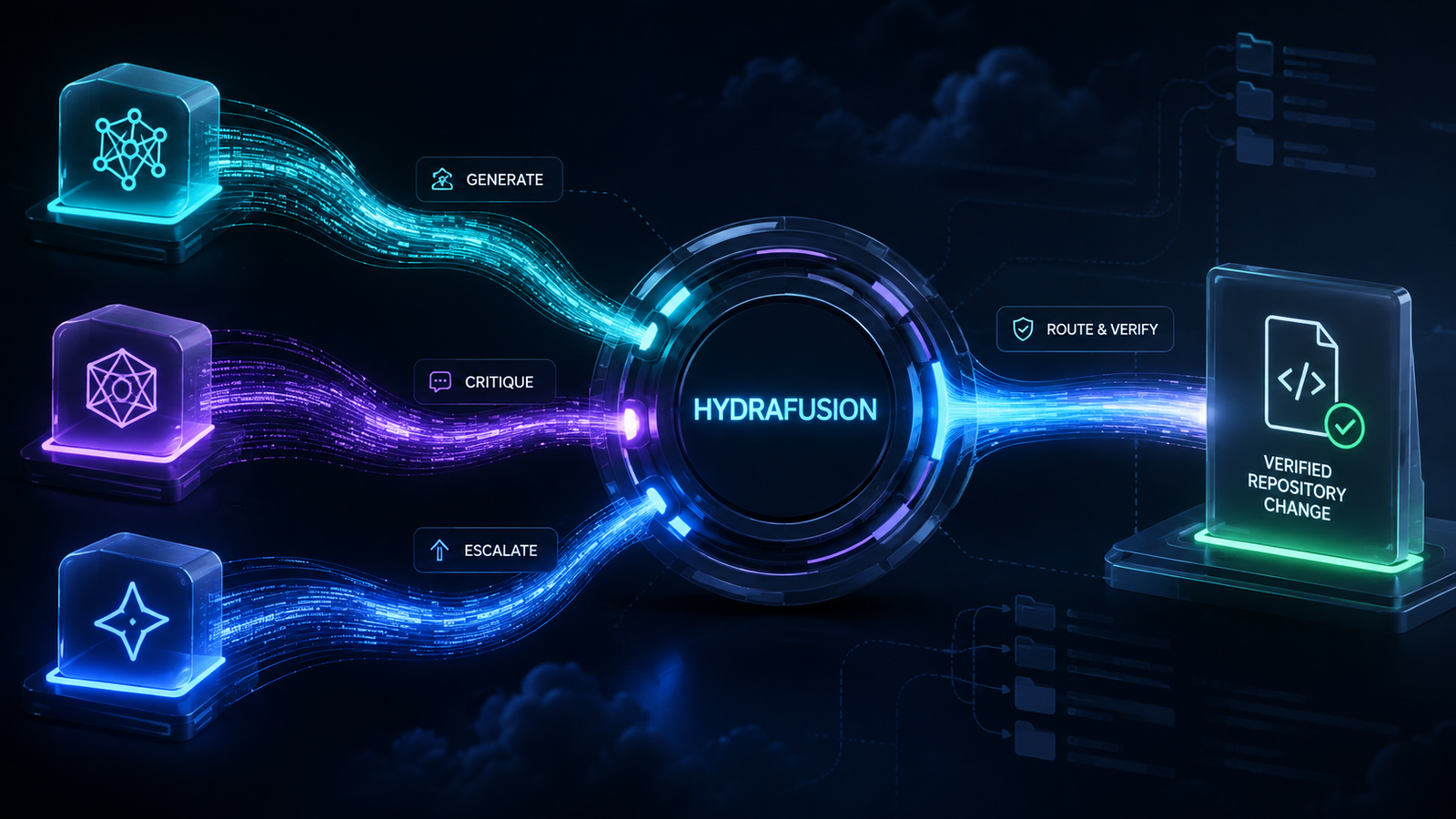

NEW DELHI, September 6, 2026, 5:02 p.m. IST — GitHub has opened Project HydraFusion, a research preview in GitHub Copilot that can route a coding task through one model, escalate it from a cheaper model to a stronger one, or add an independent cross-family review before returning a result.
The release moves Copilot beyond choosing a single model for an entire prompt. HydraFusion instead builds a runtime workflow around the task, with GitHub positioning orchestration—not another standalone model—as the mechanism for balancing coding quality, latency and inference cost.
For platform and engineering leaders, the immediate significance is operational. A compound coding agent creates more model calls, more failure paths and more usage to account for, but it can also avoid paying frontier-model rates for every step. GitHub says HydraFusion tracks the cost, role, outcome, latency and diagnostics of each workflow leg while returning one permission-aware change set to the developer.
What GitHub confirmed
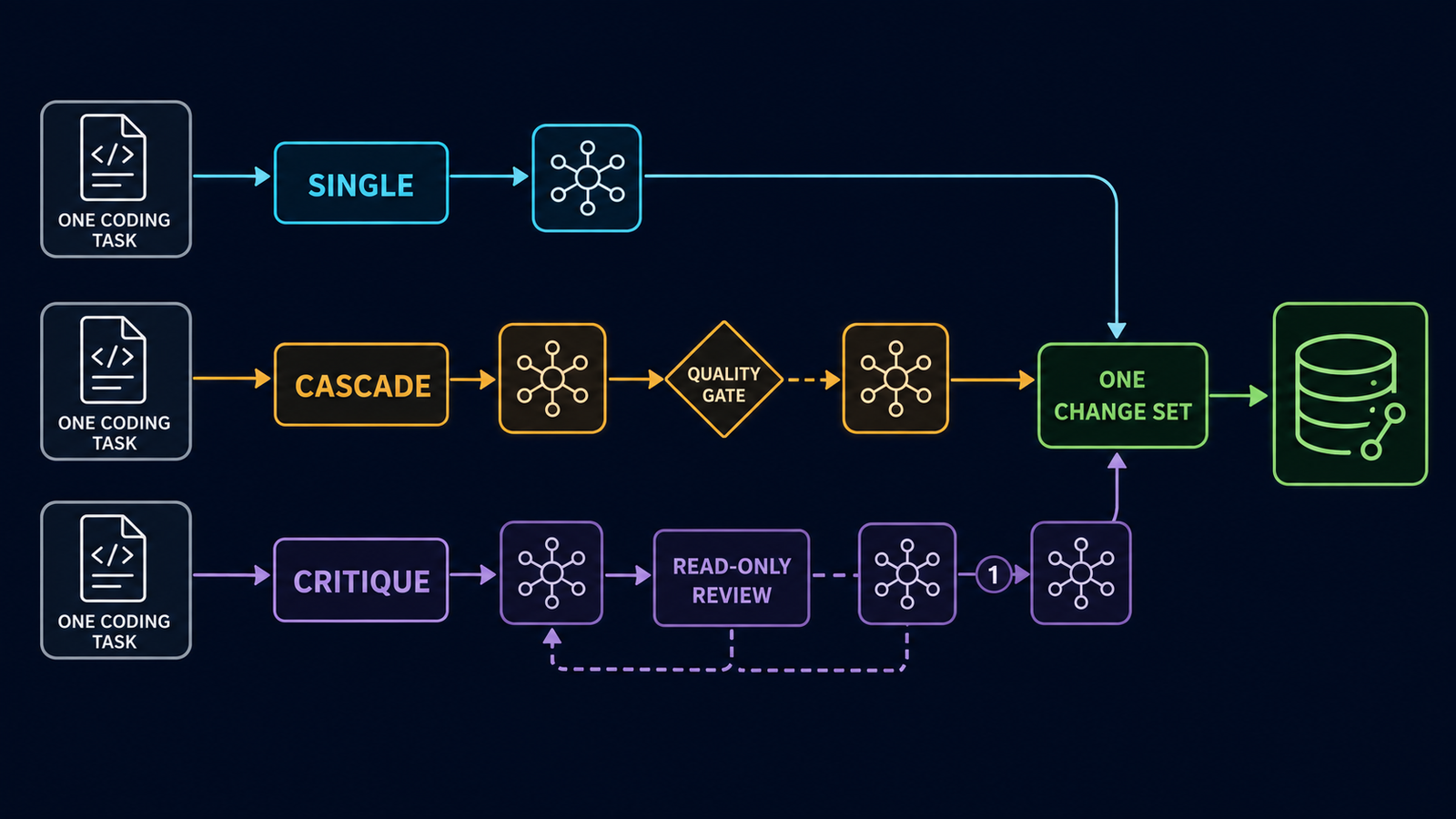
According to GitHub’s launch announcement, HydraFusion currently selects among three patterns:
- Single: one selected model solves the task directly.
- Cascade: an efficient model drafts the solution, then a quality gate either accepts it or escalates the task to a stronger model.
- Critique: one model drafts, a read-only critic from a different model family reviews the work without tools, and the drafting model gets one revision.
The preview is available across all GitHub Copilot plans through the experimental menu in Copilot CLI. GitHub recommends it first for substantial, well-scoped, single-prompt jobs in autopilot mode; longer multi-turn sessions remain an area of active work. Usage is charged from the tokens consumed by the underlying models at their standard rates, rather than through a separate flat HydraFusion price.
Repository safety is part of the design
Multi-model routing is not only a model-selection problem. Every extra leg can time out, fail, modify files or leave partial state behind. GitHub says HydraFusion gives each leg explicit timeout and cancellation behavior, validates model bindings and fallback behavior before execution, and applies no patch if a workflow is cancelled or fails validation.
The critique path is deliberately read-only and tool-less. Solver steps keep the normal permission-aware agent loop and shared workspace, but the critic evaluates the draft in an isolated context. Intermediate drafts are withheld because they may be revised or discarded. The user receives one final response and one coherent set of repository changes.
Those controls are a useful design pattern for teams building their own agent runners: separate review from mutation, define cancellation semantics, meter every leg, and make the final commit boundary explicit. They do not eliminate the need for branch protection, CI checks, secret isolation or human approval on high-risk changes. For related deployment safeguards, GravityDevOps’ LLMOps guide covers the monitoring and lifecycle controls around production AI systems, while its CI/CD tools comparison outlines the delivery gates that should remain independent of model output.
Benchmark savings come with important caveats
GitHub evaluated fixed HydraFusion policies against Claude Opus 5 across TerminalBench 2.1, DeepSWE and an internal CheckpointBench assembled from Copilot sessions. The company reported 67% lower estimated cost and a 4.9-point quality gain on TerminalBench 2.1. On DeepSWE, cost was 36% lower while quality was 1.5 points lower; on CheckpointBench, cost was 65% lower with quality 0.1 point lower.
Those are vendor-run, controlled offline results—not independent proof that every team will save the same amount. GitHub says the comparison used the same inputs, tools, execution limits, pricing assumptions and medium reasoning level, and that cost included drafting, critique, revision, escalation, retry and fallback. It also acknowledges that the best reported policy was tuned through repeated work on the same three evaluation families.
That distinction matters. VentureBeat’s independent analysis noted that HydraFusion reduced estimated cost on all three benchmarks but exceeded the Opus baseline only on TerminalBench. The TerminalBench 2.1 maintainers have also documented dependency drift in some tasks, while DeepSWE is designed around original, long-horizon repository work. Together, the tests are useful signals, but not a substitute for workload-specific evaluation.
What DevOps teams should measure
Teams testing HydraFusion should compare it with a fixed-model baseline on their own repositories and track end-to-end outcomes rather than token price alone. The useful measures are accepted pull requests, CI pass rate, review rework, elapsed latency, cancellation frequency, escalations to stronger models and total cost per merged change.
Audit requirements also become more demanding when one visible task may invoke several providers. Platform owners should confirm which models can receive repository context, how provider retention rules apply, whether policy allows cross-provider routing, and whether logs expose enough detail to reconstruct an incident without leaking source code or secrets.
GitHub’s current Copilot model and pricing documentation explains that interactions consume input, output and cached tokens, with overages billed in AI credits. Because HydraFusion can add critique, revision or escalation legs, a cheap-looking first call does not by itself establish a cheap workflow.
The bottom line
HydraFusion is an early but concrete test of a broader shift in coding agents: the product’s competitive advantage may increasingly sit in the router, quality gates and repository transaction model rather than in a single model name. GitHub has disclosed more workflow and cost-accounting detail than many routing announcements, but the preview is still experimental and its headline savings remain company-generated evidence.
For developers, the sensible first use is a bounded, verifiable coding task with strong tests and a known fixed-model baseline. For platform teams, the bigger opportunity is to treat model orchestration as an observable production system—one whose quality, spend, permissions and failure behavior must all be measured together.


