

NEW DELHI, September 8, 2026, 5:00 PM IST — Arm has launched AI Portal, a developer hub for finding, comparing and deploying AI models optimized for Arm-based cloud, edge, mobile and embedded systems.
The portal is available now with task-specific model listings, performance and accuracy data, code examples and deployment workflows. Arm says developers can compare latency, memory use and model size before selecting a model for a target device, while coding agents can retrieve portal resources through Arm’s Model Context Protocol server.
The launch matters because moving an AI model from a repository to production hardware is still fragmented. Teams often have to reconcile model provenance, runtime compatibility, quantization choices, device constraints and benchmark conditions across several sites. Arm is trying to make that discovery layer machine-readable as well as human-readable, but the portal does not eliminate the need for workload-specific validation.
What Arm launched
Arm’s announcement says AI Portal covers language, speech, vision and neural graphics workloads. Initial listings include models from the Qwen, Gemma and Ultralytics YOLO families, with resources spanning ExecuTorch, LiteRT and ONNX Runtime.
The live AI Portal organizes resources by task and hardware class, including cloud CPU, mobile CPU, mobile GPU, edge Linux and embedded NPU targets. It also offers deployment-ready examples, reference applications, scripts and guided learning paths.
Agent access is more than a marketing label. Arm publishes an MCP endpoint for supported coding environments, including Codex, Claude Code and GitHub Copilot. That lets an agent search for models and deployment resources from inside a development workflow. It does not give the agent authority to deploy into a production environment unless a team separately grants that access.
Availability is split across three layers
The launch has three different maturity levels that engineering teams should keep separate:
- Model discovery and comparison: available now for supported models and target classes.
- MCP access: connection instructions are published on the portal, while Arm’s launch announcement describes broader agent-ready resources as early access ahead of general release.
- Bring-your-own-model optimization: an early-access program covers analysis, quantization, model conversion and real-device validation. Arm says more tooling is coming.
That distinction is important for platform plans. A portal listing can shorten evaluation work today, but it should not be treated as proof that every optimization workflow, proprietary-model path or agent integration is generally available.
Benchmark claims need device-level context
Arm reported that Qwen3-TTS ran more than four times faster on a vivo X300 smartphone using single-thread execution, mixed quantization and SME2 acceleration. It also reported a performance improvement of more than 40 percent for YOLO26n in specified single-thread configurations on the vivo X300 and Raspberry Pi 5.
Those are vendor-reported results for particular models, devices, data types and execution settings. They are not a general prediction for every application. Ultralytics separately describes YOLO26 as designed for edge and low-power systems, but production teams should reproduce latency, throughput, memory, accuracy, power and thermal behavior with their own inputs.
The portal itself sets a useful boundary. On its optimization tools page, Arm says inclusion is not an endorsement or certification of a third-party model and does not guarantee accuracy, safety, security, legal compliance or fitness for production. Model licenses and usage restrictions still apply.
What developers and platform teams should do
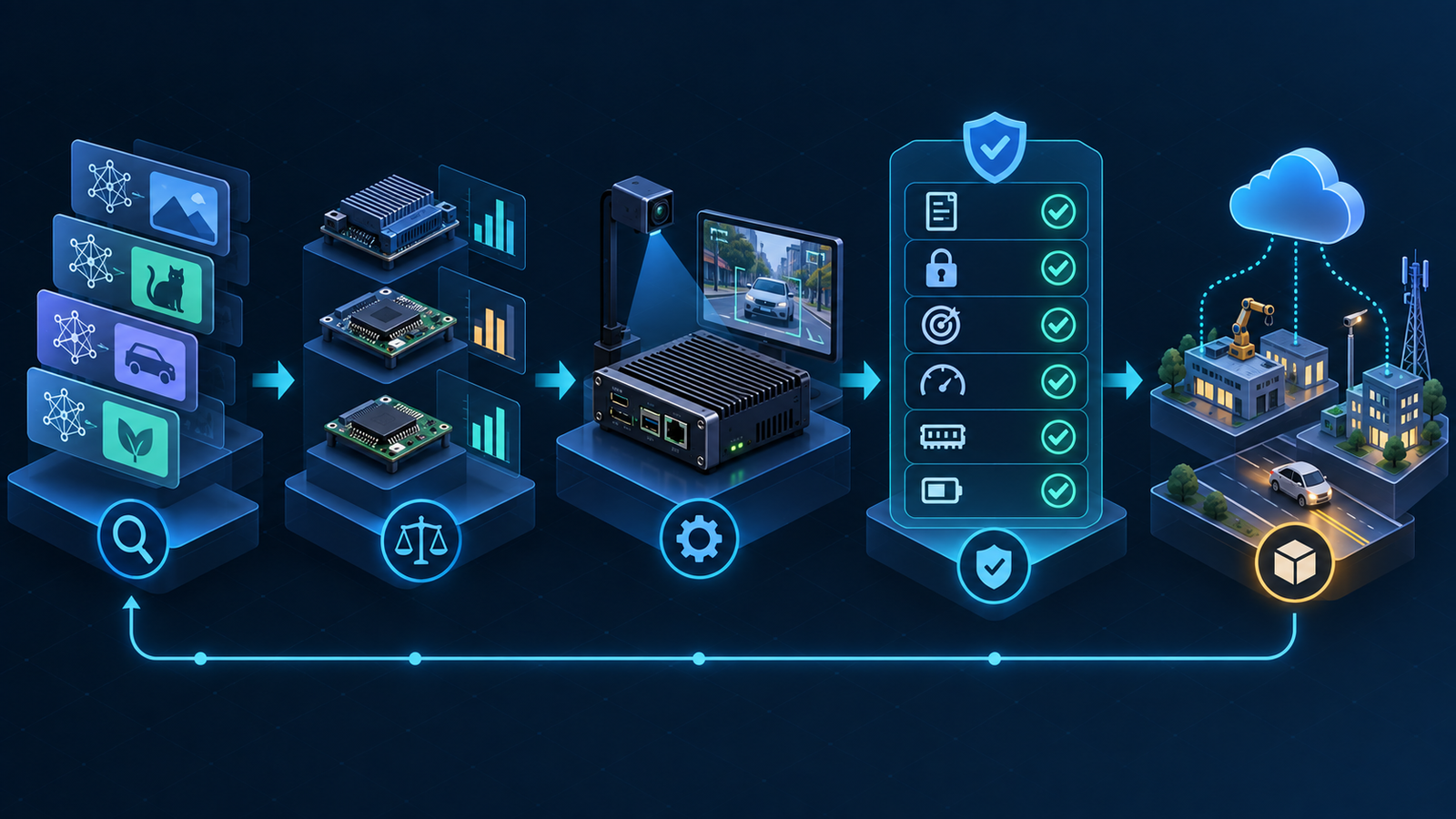
For teams already deploying on Arm, the portal can become a discovery input to an existing evaluation pipeline. A practical adoption path is to shortlist models by task and target, record the exact model and runtime version, reproduce measurements on representative hardware, and promote only artifacts that pass accuracy, latency, memory, power and security gates.
Teams using the MCP connection should treat retrieved model cards, examples and performance data as untrusted external context. Keep the coding agent read-only during discovery, pin dependencies and artifact digests, scan downloaded assets, and require review before generated configuration reaches a build or deployment pipeline.
That control plane fits the broader discipline described in GravityDevOps guides to LLMOps, retrieval-augmented generation and CI/CD tooling: discovery should feed a reproducible pipeline, not bypass it.
What remains uncertain
Arm has not published a universal timetable for all upcoming optimization tools, a complete support matrix for every model and device, or independent benchmark results covering the portal’s catalog. The value will depend on how quickly listings remain current, how transparently benchmark conditions are documented and whether model provenance and license metadata survive automated workflows.
For now, AI Portal is best understood as a consolidated entry point for Arm-optimized software and an agent-readable discovery layer. It can reduce search and integration work, but production readiness still has to be established by the team operating the target system.


