

NEW DELHI, September 17, 2026, 5:00 PM IST — Huawei has unveiled the Ascend 960 SuperPoD, a liquid-cooled AI system that moves optical links closer to its processors and is designed to scale as high as 4,096 accelerators inside one tightly coupled computing domain.
The announcement, made at Huawei Connect in Shanghai, is more than another accelerator launch. It is a systems-level attempt to make thousands of chips behave like one machine by combining Huawei’s UnifiedBus interconnect, unified memory addressing and a new near-packaged-optics engine called Hi-ONE. For platform and infrastructure teams, the practical question is whether that architecture can deliver predictable performance, availability and software portability outside controlled demonstrations.
What Huawei confirmed
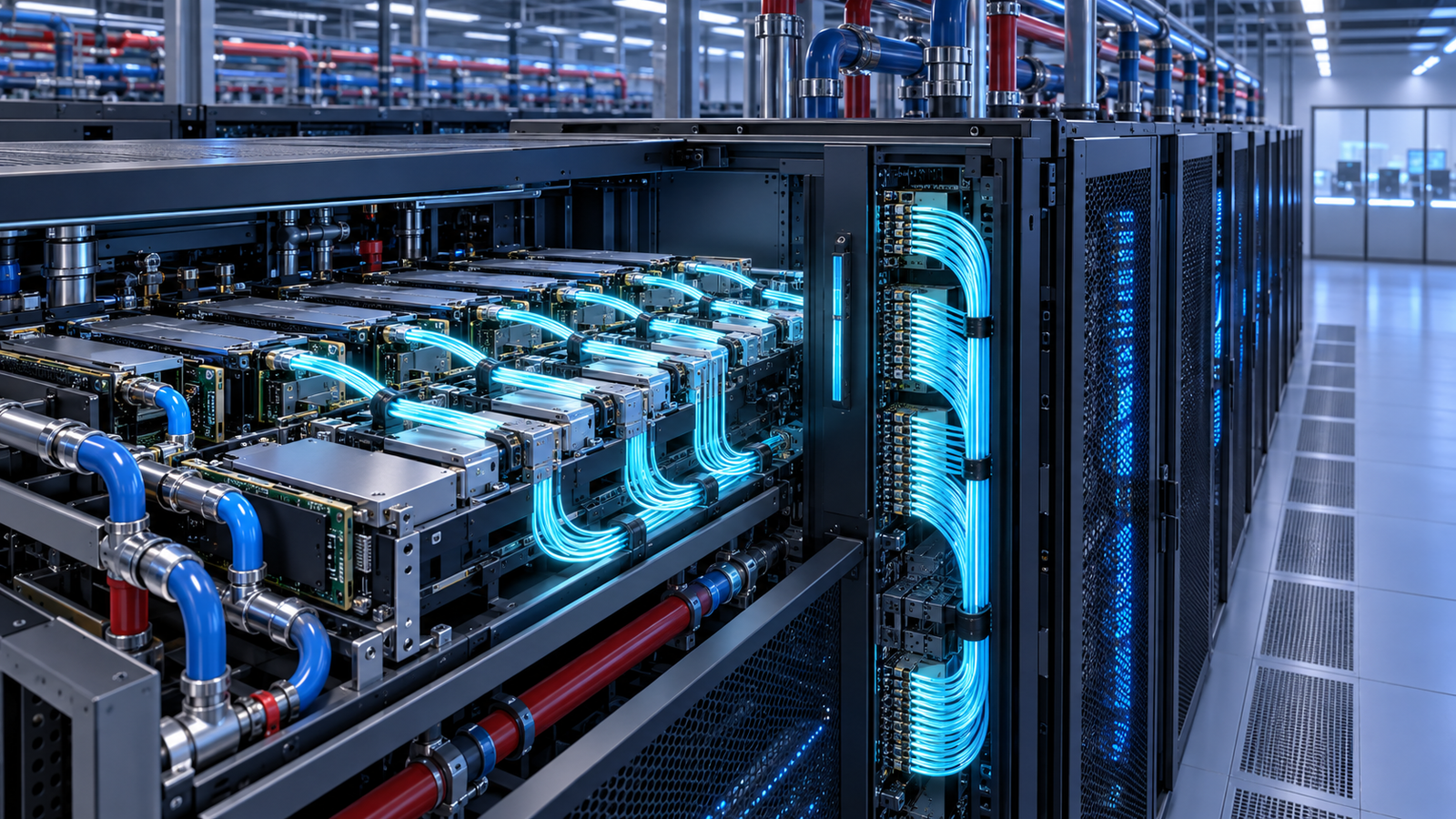
Huawei said the Ascend 960 SuperPoD uses an orthogonal chassis layout, full liquid cooling and near-packaged optics. The company claims a maximum configuration of 4,096 Ascend processors, 8 EFLOPS of FP8 compute and 16 EFLOPS at FP4 precision. Those are vendor figures rather than independently verified benchmarks, so they should be treated as design targets until customers publish workload-level results.
The optical subsystem is central to the pitch. Huawei said one SuperPoD uses 5,500 Hi-ONE optical engines in place of about 48,000 conventional 800G optical modules. It claims the change cuts system power by more than 550 kilowatts, doubles mean time between failures and lifts system availability to 99.8 percent. Huawei describes Hi-ONE as a 7.2-terabit near-packaged-optics product with an integrated light source.
The company also presented a broader architecture called Peerium. Huawei says it combines nested parallelism, unified memory addressing and peer-to-peer connections across processors, memory, storage and networking. Its English-language announcement says an Atlas 950 SuperCluster containing 256,000 accelerator cards is already being deployed, while the Atlas 960 system is still under testing.
That distinction matters: Thursday’s event introduced the system and technical design, but it did not establish broad production availability. The Associated Press reported the launch as part of China’s effort to build domestic AI infrastructure amid restrictions on access to leading US chips and chipmaking equipment.
Why the optical fabric matters
As model size and expert parallelism grow, an accelerator’s useful performance increasingly depends on how quickly it can exchange parameters, activations and key-value cache data. More chips do not automatically produce proportionally faster training or inference. Network contention, collective-communication latency, memory pressure and failed links can erase much of the theoretical gain.
Near-packaged optics shortens the electrical path between switching silicon and optical conversion. In principle, that can improve bandwidth density and energy efficiency at the scale Huawei is targeting. The trade-off is operational complexity: optics, liquid cooling and tightly coupled fabrics create new failure domains that need mature telemetry, sparing strategies and maintenance procedures.
What developers and platform teams should watch
The first test is software compatibility. Huawei said its CANN compute architecture is now fully open and operating through an ongoing open-source community process. Teams evaluating Ascend infrastructure should still benchmark framework support, custom operators, debugging, observability and model conversion against the CUDA-based workflows they use today.
The second test is workload evidence. Procurement teams should ask for end-to-end measurements on their own model shapes, precision settings, context lengths and failure scenarios. Peak FP8 or FP4 throughput is not a substitute for tokens per second per watt, checkpoint recovery time, job completion rate or cost per successful training run.
The third test is operational blast radius. A fabric that presents thousands of processors as one machine can simplify scheduling, but a shared interconnect or memory layer can also amplify a localized fault. Platform teams will need clear answers on partitioning, health isolation, rolling maintenance, link degradation and how schedulers respond when part of the optical fabric is unavailable.
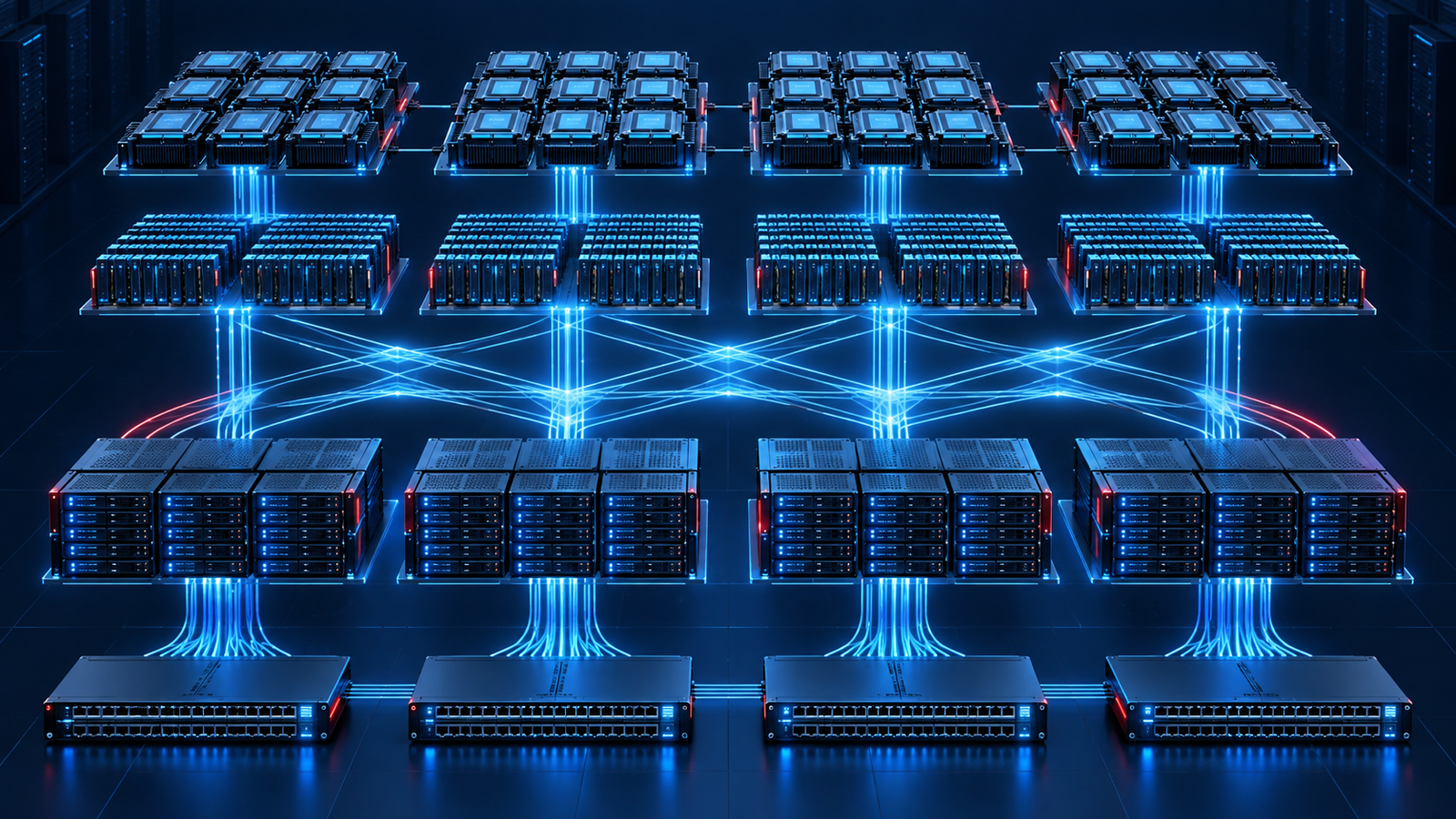
Huawei also announced that multiple SuperPoDs can be joined through UnifiedBus networking or RoCE. It said a two-layer CLOS design can scale to 512,000 cards and a multi-plane topology to one million. Those are maximum architecture claims, not proof that a million-card production cluster is operating today.
A broader shift toward system-scale AI
The Atlas 960 reflects an industry-wide shift from comparing individual accelerators to comparing complete systems. Memory hierarchy, interconnect bandwidth, cooling, storage and scheduler efficiency now determine whether expensive compute remains productive. That makes the work look increasingly like LLMOps and large-scale distributed systems engineering rather than simple server provisioning.
For teams building retrieval-heavy services, the storage and cache layer is part of the same equation. Huawei also announced an OceanStor M900 cluster aimed at petabyte-scale key-value caching. Engineers considering such designs should map them against the data freshness, retrieval and evaluation requirements described in GravityDevOps’ guide to retrieval-augmented generation.
Huawei’s announcement creates a credible new systems architecture to evaluate, especially for organizations operating within China’s hardware ecosystem. It does not yet settle comparative performance or total cost of ownership. The next meaningful evidence will come from production deployments, independent benchmarks and public details on availability, pricing and failure handling.
Sources
Reporting is based on Huawei’s Ascend 960 SuperPoD announcement, its English-language Peerium architecture briefing, and independent coverage from The Associated Press and the South China Morning Post.


