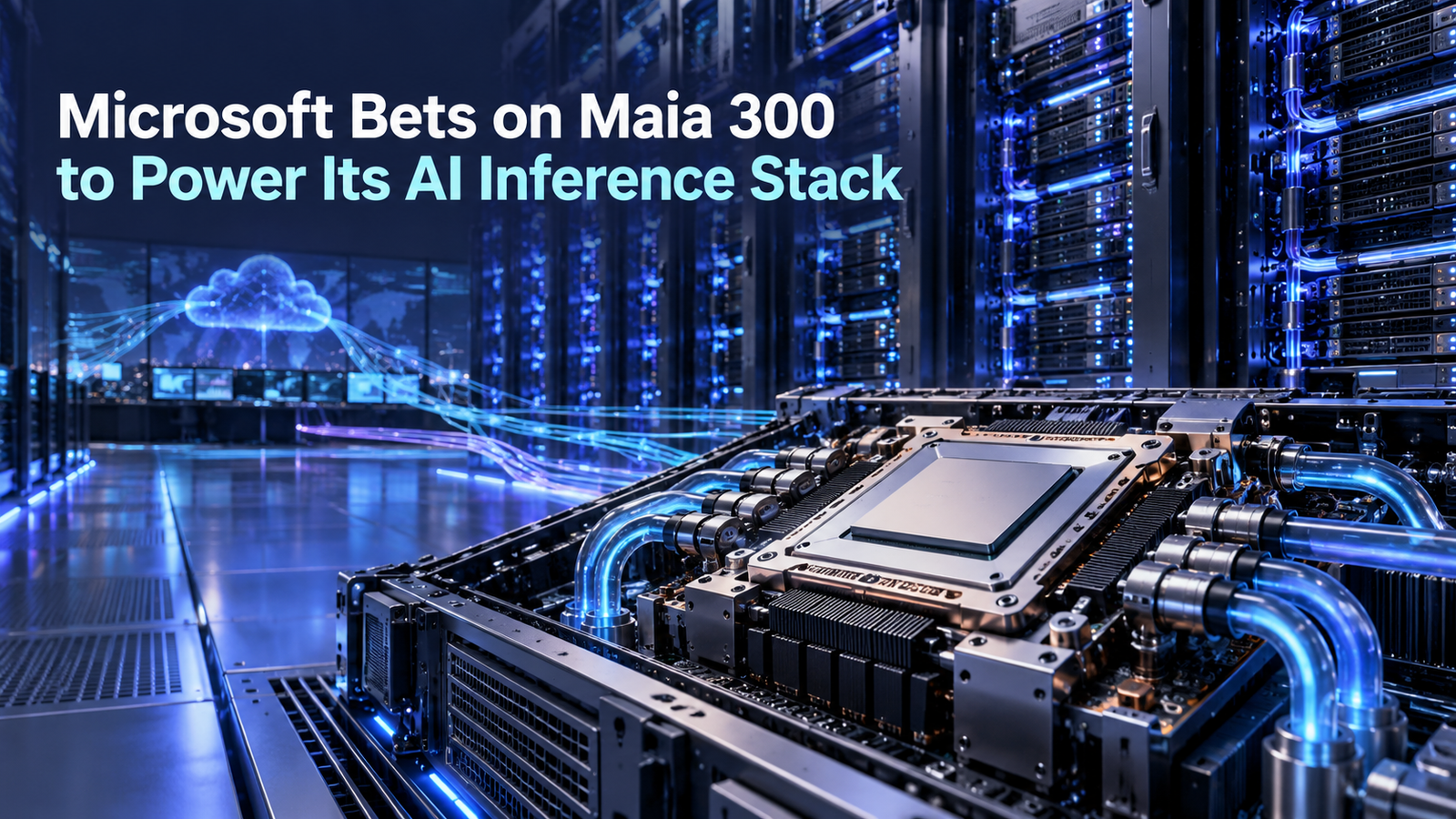

NEW DELHI, October 13, 2026, 5:07 PM IST — Microsoft will make its homegrown Maia accelerator family the primary inference system for its own products and services as it begins multi-gigawatt deployments in 2027, a move that pushes one of the world’s largest cloud operators deeper into custom AI silicon.
The company said Maia 200 is already serving production workloads in Microsoft Copilot and supporting development of its next-generation models. GitHub Copilot and Microsoft Foundry are expected to follow by the end of this year. Its newly disclosed Maia 300 system is designed for long-context reasoning, latency-sensitive conversations and sustained multi-step agent workloads.
The announcement matters beyond a new chip specification. Inference — the work of running trained models to produce answers, code and agent actions — is becoming a recurring infrastructure cost for cloud providers and their customers. Microsoft is now co-designing silicon, memory, networking, racks, cooling and software around that workload, seeking more usable tokens within fixed power and datacenter limits.
What Microsoft confirmed
Microsoft said Maia 300 will enter production deployments in 2027. A full rack will contain 96 accelerators within a 167-kilowatt power envelope, with 27.6 terabytes of high-bandwidth memory and 1.7 petabytes per second of aggregate memory bandwidth.
Each accelerator is specified with 288 gigabytes of HBM4 memory and 18 terabytes per second of peak memory bandwidth. The design separates compute, memory-controller and input-output functions across chiplets, placing the compute chiplets on TSMC’s N2P manufacturing process. Microsoft also uses a software-defined dataflow architecture intended to keep model data close to the compute that needs it.
At rack scale, Microsoft claims Maia 300 can deliver as much as seven times the token throughput of Maia 200 and 40 percent more tokens per megawatt than leading GPU-based systems. Those are vendor claims, not independently reproduced benchmarks. Microsoft did not name the GPU systems used for the 40 percent comparison, so buyers should not treat the number as a direct price-performance guarantee for their own models.
Reuters reported that Microsoft could deploy more than one million Maia 300 chips next year. The company has publicly committed only to beginning multi-gigawatt deployments in 2027, and Axios reported that reaching that scale will extend beyond next year.
Why inference is driving custom silicon
Training frontier models attracts attention because it demands large clusters, but inference is continuous. Every Copilot response, code completion and agent step consumes compute, memory bandwidth and power. Long context also expands the key-value cache that inference systems must keep available, while agentic workflows can sustain many steps and tool calls for a single request.
Microsoft’s architecture targets that memory movement directly. Its technical overview says the system uses locality-aware memory placement, lower-precision formats and a two-tier Ethernet-based fabric that can connect up to 12,288 accelerators in a superpod. Liquid cooling removes more than 80 percent of the rack’s thermal load, while rack and row telemetry inform power allocation and workload placement.

The strategy also reduces Microsoft’s dependence on a single accelerator supplier, but it does not eliminate GPUs from Azure. Microsoft described Maia as the primary inference platform for its own services, not a universal replacement for third-party Azure customers. The company continues to present Azure as a heterogeneous platform supporting OpenAI models, Microsoft models and open-source model families.
That distinction is important. A first-party Copilot workload has predictable software, scale and traffic patterns that can justify deep hardware optimization. An enterprise team serving several changing open models may still value mature GPU tooling, broad framework compatibility and portable kernels more than a hyperscaler-specific efficiency gain.
What developers and platform teams should watch
For most engineering teams, Maia 300 is not yet a procurement decision. Microsoft has not announced general-purpose Maia 300 instance types, customer pricing, regional availability or service-level commitments. The practical task now is to make AI workloads measurable enough to benefit if a new backend becomes available.
Teams should baseline cost per successful task rather than cost per raw token alone. Useful measurements include time to first token, sustained generation rate, end-to-end agent latency, cache efficiency, tool-call retries, energy or capacity constraints, and quality at the precision formats used in production. An accelerator that produces more tokens can still be a poor fit if model quality falls, queueing rises or an agent performs unnecessary steps.
Portability also deserves attention. Keep application orchestration separate from provider-specific model endpoints, record model and hardware changes alongside deployments, and run representative evaluations before shifting production traffic. GravityDevOps’ guides to LLMOps and retrieval-augmented generation offer useful background for building that evaluation and observability layer.
Platform teams should also expect power and cooling constraints to influence cloud capacity planning more visibly. Microsoft’s emphasis on tokens per megawatt, rack telemetry and workload placement shows that AI serving is being optimized as a datacenter system, not simply as a faster processor. Quotas, regional supply and capacity reservations may remain as important as model choice.
A large plan with important unknowns
Microsoft’s announcement confirms that Maia is moving from a development program into a central production role. It does not yet establish how much of Azure’s external AI traffic will run on Maia 300, how the claimed efficiency compares across real customer models, or whether savings will flow through to cloud pricing.
Manufacturing is another constraint. Custom designs still depend on advanced fabrication, packaging and HBM supply — the same bottlenecks affecting Nvidia and other accelerator makers. The multi-gigawatt plan is therefore a direction and scale commitment, not proof that every announced unit will be available on a fixed timetable.
The near-term signal is clear: hyperscalers increasingly see inference hardware as part of their competitive software stack. For developers, the winning response is not to optimize prematurely for Maia. It is to build portable, observable AI services whose cost and quality can be tested on whatever mix of accelerators the cloud exposes next.
Sources: Microsoft’s Maia 300 announcement; Azure architecture deep dive; Reuters; and Axios.

