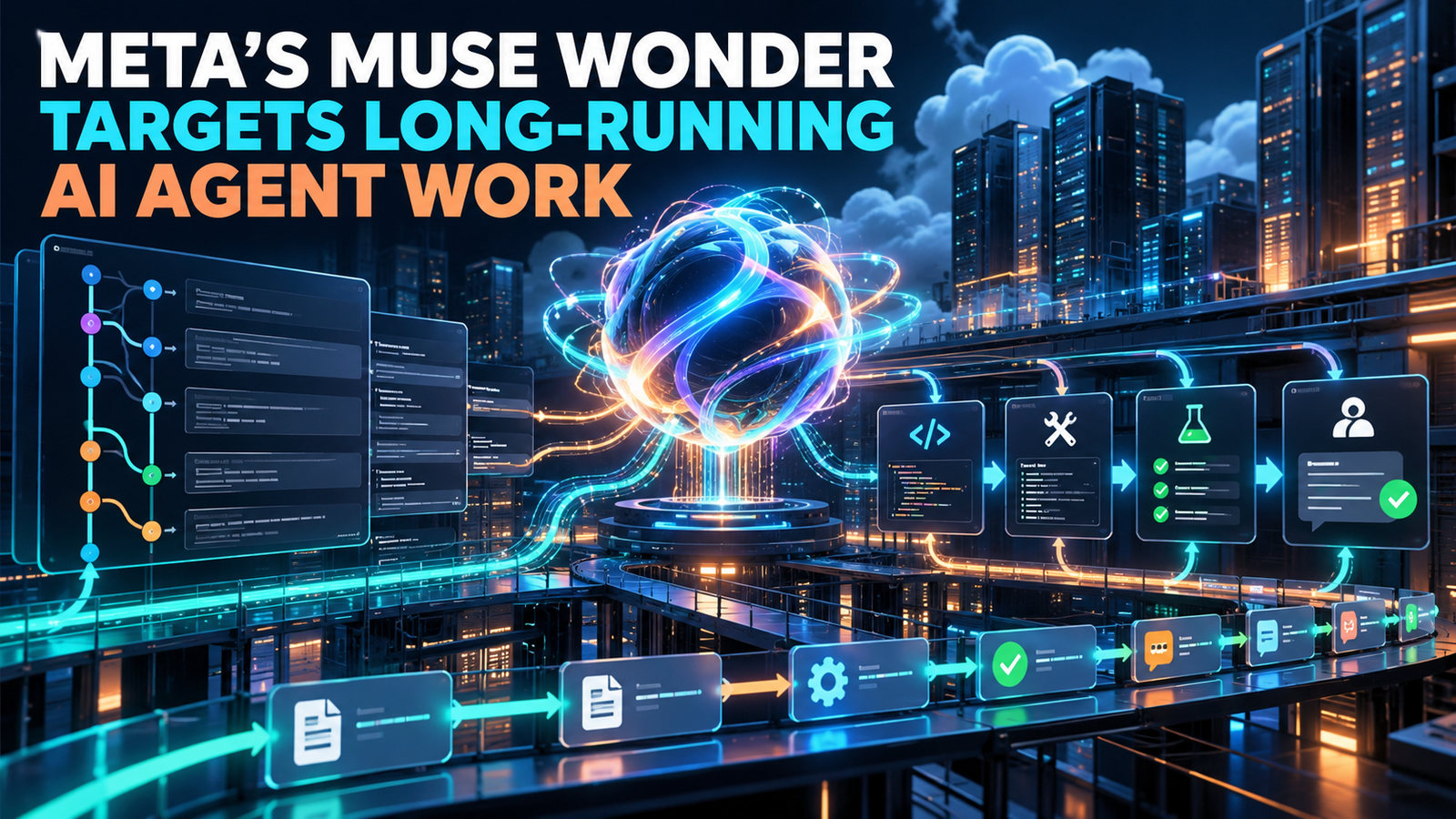

NEW DELHI, October 15, 2026, 5:08 PM IST — Meta has released Muse Wonder, a new frontier model aimed at long-running coding and agent work, through its hosted Model API and Muse Code. A higher-capability version, Muse Wonder Full, is limited to paid Muse Code subscribers.
The launch gives developers another serious option for multi-step software work, but the most important details are operational rather than promotional. Meta is positioning the model for tasks that span many files, tools and execution steps, while keeping the more capable Full variant outside its pay-as-you-go API. Platform teams therefore need to evaluate not only model quality, but also access boundaries, data-handling settings, observability and the cost of sustained runs.
Meta announced the two models on October 12 and said they were trained at its gigawatt-scale Prometheus data center. The company describes Active Memory as the ability to carry relevant information across conversations, and Active Focus as the ability to keep working through blockers, try alternatives and check in before important actions. Those are Meta’s product claims; independent validation across production repositories and enterprise environments remains limited.
What Meta has confirmed
According to Meta’s launch announcement, Muse Wonder is available now through the Meta Model API and Muse Code. Muse Wonder Full is available only to eligible Muse Code subscribers. Meta said the standard model will later power experiences in its Muse assistant, beginning with subscribers.
The Meta Model API documentation lists Muse Wonder under the model identifier muse-wonder-1.0. It accepts text, image, video, audio and PDF inputs, produces text, and exposes a 1,048,576-token context window. The model supports reasoning-effort settings from minimal through max, but Meta explicitly warns that selecting the highest reasoning setting does not turn the API model into Muse Wonder Full.
Meta says the model can plan work, delegate to subagents, call tools in parallel, operate a computer and recover from errors across many steps. It is designed for complex software engineering, including changes across multiple files in real repositories. The same API also supports tool calling, structured output and search grounding, which should make it possible to test the model inside existing agent harnesses without rebuilding an entire orchestration layer.
There is also a significant data-governance distinction. Meta’s documentation says Standard mode does not use prompts, code, files, context or responses to train its models. Contributor mode, which is enabled by default for Muse Code subscribers, provides more usage in exchange for allowing that content to be used for future model training; subscribers can turn it off. Teams handling proprietary repositories, customer data or incident records should verify that setting before connecting production systems.

Why the release matters for platform teams
Muse Wonder arrives as AI vendors compete less on chat responses and more on whether models can finish extended work reliably. Meta’s technical overview points to multi-file coding, browser use and sustained execution as core evaluation areas. That direction matters to DevOps and platform engineers because agent failures increasingly occur in the execution layer: incorrect permissions, stale context, runaway tool loops, unsafe shell actions and weak rollback paths.
A million-token window can reduce context fragmentation, but it does not guarantee that a model will select the right evidence or preserve requirements over a long run. Teams should still keep tasks bounded, make tool permissions explicit and validate every generated change through tests and policy checks. GravityDevOps’ guide to LLMOps covers the monitoring and lifecycle controls needed once model behavior becomes part of a production service.
The split between Muse Wonder and Muse Wonder Full also complicates procurement and evaluation. A benchmark run in the subscriber product may not represent the model available through the API, and raising reasoning effort on the API does not bridge that gap. Engineering teams should record the exact model identifier, access mode and reasoning setting with every evaluation result.
A cautious production path
For an initial trial, platform teams should choose a repository with strong automated tests and no production credentials. Run a fixed task set against the standard API model, capture tool calls and diffs, and compare completion quality, latency and total token use with the organization’s current model. Test interruption, recovery and permission-denial cases as deliberately as successful paths.
Persistent memory deserves a separate security review. Personalization can save users from repeatedly explaining context, but it also creates a new data-retention and retrieval surface. Teams should determine what is stored, how it is scoped across users and projects, how it can be deleted, and whether sensitive information can surface in an unrelated task. A model’s promise to handle private information carefully is not a substitute for tenant isolation, least privilege and audit logs.
Agent systems should also keep irreversible actions behind explicit approval. That includes merging code, changing cloud infrastructure, publishing releases and modifying access controls. The principles in GravityDevOps’ AI agent security guide remain applicable: sandbox execution, restrict tool permissions, inspect external content for prompt injection and preserve an auditable record of decisions.
What remains uncertain
Meta has published benchmark results and says Muse Wonder leads on several personal-agent, professional-agent, memory and coding evaluations. Those results are vendor-reported, however, and workload-specific independent testing will be more useful than leaderboard comparisons for most engineering teams.
Meta also says a fuller report with additional safety evaluations is still coming. Until that document and broader field evidence are available, claims about privacy, cyber safeguards and reliability should be treated as assertions to test rather than guarantees. Axios similarly noted that agents which remember personal information and act for users introduce new privacy and security challenges, while Reuters framed the release as part of Meta’s effort to compete more directly with OpenAI and Anthropic.
For developers, the useful news is not that a benchmark winner has been declared. It is that Meta now offers a hosted model explicitly designed for long-horizon agent work, with concrete API access and a documented million-token context window. Whether it belongs in production will depend on reproducible repository-level tests, clear data controls and the same disciplined release engineering applied to any other powerful automation system.
Sources
Meta Newsroom, Meta AI Research, Meta Model API documentation, Axios and Reuters reporting were reviewed for this article. Product capabilities and safety statements attributed to Meta have not been presented as independently verified facts.

