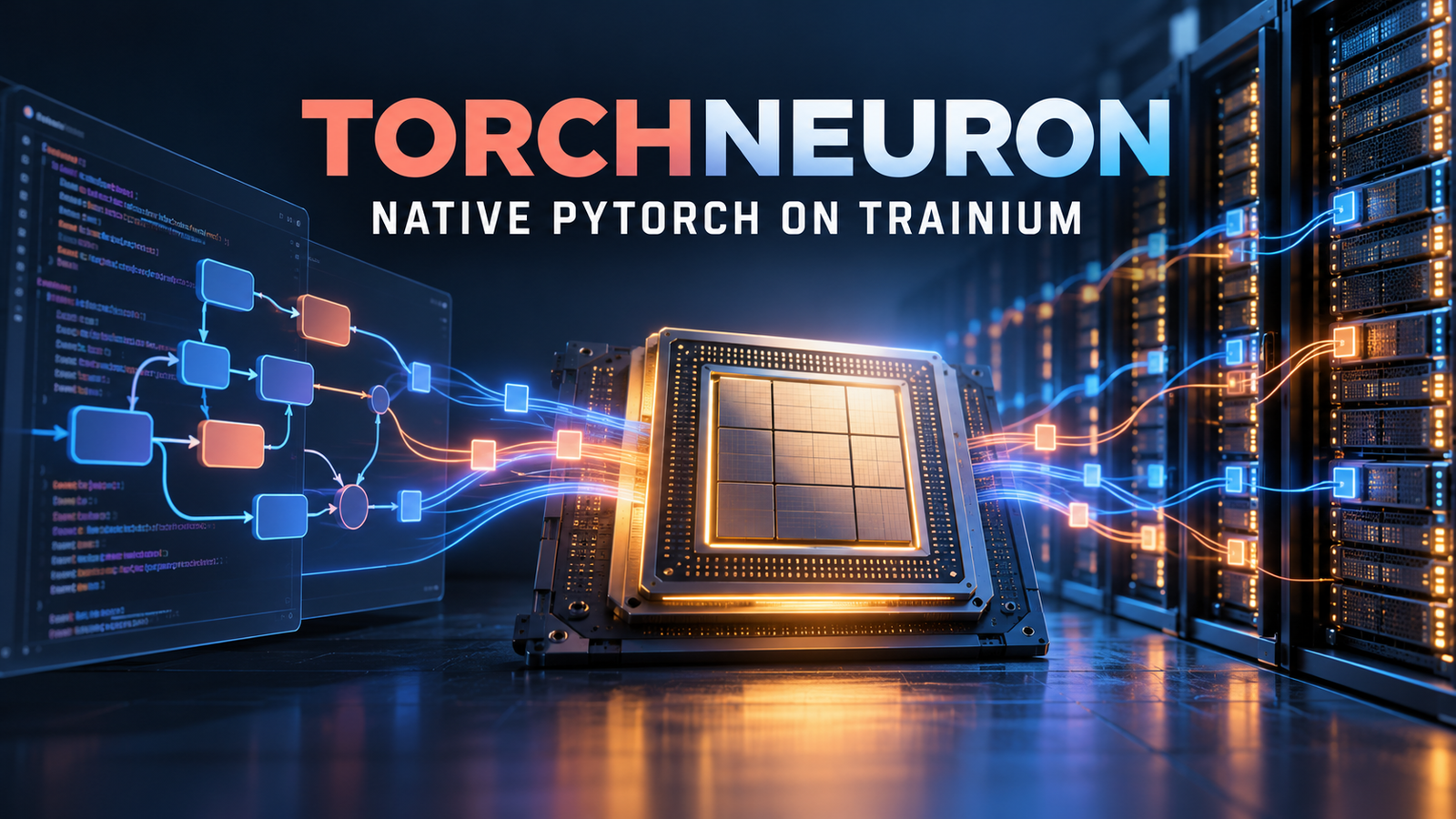

BENGALURU, India — October 19, 2026, 9:10 p.m. IST: Amazon has announced TorchNeuron, an open-source PyTorch backend designed to let existing AI training and inference code run natively on AWS Trainium accelerators with minimal changes. The company says it will release the software under the Apache 2.0 license at PyTorch Conference North America on October 20.
The launch targets one of the hardest parts of adopting non-Nvidia AI hardware: software migration. PyTorch is the standard development environment for many AI teams, but production code often accumulates device-specific assumptions, distributed-training choices and custom kernels. TorchNeuron moves Trainium closer to the familiar PyTorch execution model, including eager execution, torch.compile and standard distributed APIs.
For developers, cloud engineers and platform teams, that could make Trainium easier to evaluate without maintaining a separate model implementation. It does not, however, make hardware migration risk-free. AWS documentation available on Monday still described TorchNeuron as a closed beta, while Amazon’s announcement says the open-source release arrives Tuesday. Teams should treat the current news as an opening of the software path, not proof that every model or production workload will move unchanged.
What Amazon confirmed
Amazon said TorchNeuron will support Trainium2 and Trainium3 and will be released under Apache 2.0. The backend is intended to run PyTorch workloads after a device configuration change rather than a framework rewrite. Amazon also said Hugging Face has added native Trainium support to its development tools and that TorchNeuron integrates with TorchTitan for distributed model training.
The technical design is broader than a compatibility wrapper. AWS’s Neuron documentation describes eager execution through PyTorch’s dispatcher, just-in-time compilation through a Neuron backend for torch.compile, and distributed support for Fully Sharded Data Parallel, Distributed Tensor, Distributed Data Parallel and tensor parallelism. Custom operations can be written through the Neuron Kernel Interface when standard PyTorch operations are not enough.
AWS says its adaptive eager execution can fuse queued operations while preserving execution order and numerical behavior. The compiler path captures PyTorch graphs, lowers them into Neuron’s intermediate representation and produces Trainium instructions. That gives teams a familiar debugging path for early experiments and a compiled path for production optimization.
Amazon also says it tests every build against hundreds of thousands of AI models. That is a useful compatibility signal, but it is not a substitute for application-level validation. Model outputs, latency, throughput, memory pressure and distributed failure behavior still need to be tested on the exact hardware and software versions a team plans to deploy.

Availability needs careful reading
Amazon’s public announcement says TorchNeuron will be open-sourced on October 20. At publication time, the detailed technical page in the AWS Neuron repository still said the backend was available only through a closed beta. The same documentation says the initial release requires compilation on Trainium2 or Trainium3 instances, and that compilation from a non-Trainium machine is planned for a future release.
That timing matters for CI and release engineering. Teams should not assume they can compile artifacts on an existing x86 or GPU-based build runner and deploy them directly to Trainium. Until AWS publishes the final release artifacts and support matrix, a realistic evaluation plan should include Trainium-backed build capacity, pinned Neuron and PyTorch versions, and a clear rollback path.
Reuters reported that more than 30 early customers across robotics, world models and voice AI are using the software. The report framed TorchNeuron as an effort to reduce the software advantage around Nvidia’s CUDA ecosystem. That competitive context is credible, but cost and portability claims should be verified workload by workload rather than inferred from a framework-level integration.
What changes for platform and DevOps teams
The immediate opportunity is a cleaner proof-of-concept path. A platform team can keep a model’s PyTorch definition largely intact, change device placement from CUDA to Neuron where needed, and evaluate eager mode before introducing compilation. Workloads using PyTorch’s accelerator abstraction may require even fewer source changes, according to AWS.
The harder work sits around the model. Container images must carry compatible PyTorch, Neuron runtime and compiler versions. Kubernetes scheduling must account for NeuronCore topology rather than treating Trainium as a generic GPU. Metrics need to cover compilation time, cache reuse, host-to-device transfer, memory utilization, collective communication and tail latency. Model-quality tests should compare outputs against a trusted baseline before any traffic shift.
This is where established LLMOps practices matter: version the model, runtime, compiler and hardware target together; promote a tested artifact between environments; and keep evaluation evidence attached to the release. Teams serving retrieval-based applications should also validate the full RAG pipeline, because embedding models, rerankers and generation models may have different operator coverage and latency profiles.
CI/CD pipelines should run correctness tests on every supported accelerator and reserve expensive performance suites for release candidates or scheduled benchmarks. A small numerical tolerance may be appropriate for some workloads, but it should be defined before testing rather than chosen after results differ. Canary deployments should compare quality, latency and cost per successful request, not raw tokens per second alone.
A meaningful portability step, not hardware neutrality
TorchNeuron reduces the amount of AWS-specific application code developers may need, and Amazon says it is contributing changes upstream to make PyTorch less tied to individual chips. The broader PyTorch conference program reinforces that trend: Intel, Google, IBM and other vendors are presenting native or more portable accelerator backends.
Still, native framework support does not erase differences in memory architecture, collective communications, supported operators or kernel maturity. High-performance workloads may continue to need Neuron-specific tuning through custom kernels, sharding choices or compilation boundaries. Teams that use CUDA extensions or Triton kernels should expect more migration work than teams that stay close to standard PyTorch operations.
The practical takeaway is to evaluate TorchNeuron as a new deployment target, not a drop-in promise. If the October 20 release matches Amazon’s published design, it could materially lower the cost of testing Trainium and give cloud teams more leverage when choosing AI accelerators. Production readiness will depend on the final source release, documented operator coverage and the evidence each team gathers from its own models.
Sources
This report is based on Amazon’s TorchNeuron announcement, the AWS Neuron native PyTorch technical overview, the PyTorch Conference hardware and infrastructure program, and Reuters reporting.

