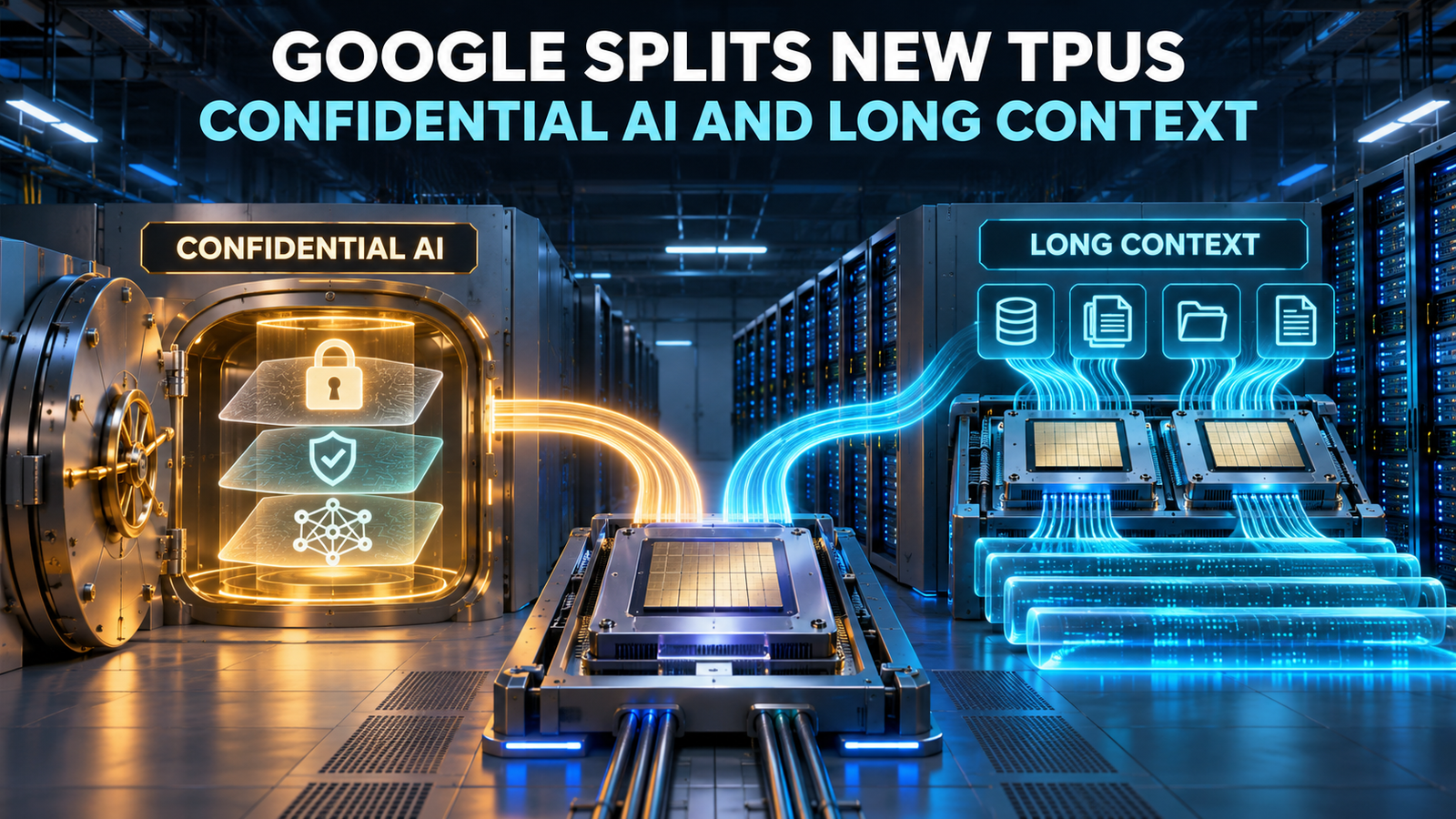

NEW DELHI, November 10, 2026, 5:45 PM IST — Google Cloud has added two specialized systems to its eighth-generation Tensor Processing Unit portfolio, separating hardware for confidential AI processing from hardware built for large context windows and dense agent workloads.
The announcement is more than a chip refresh. TPU 8tx is designed to keep sensitive data and model weights isolated while they are in use, while TPU 8i Max doubles compute and key memory resources within the existing rack footprint. For cloud and platform teams, the split signals that AI infrastructure is becoming workload-specific around security, memory and orchestration rather than competing on peak accelerator performance alone.
What Google announced
Google described TPU 8tx and TPU 8i Max as systems built around existing eighth-generation silicon, not entirely new chips. That distinction matters: the company is changing processor packaging, host CPUs, networking, memory and system software to address emerging workloads on a shorter cycle than a new semiconductor design would allow.
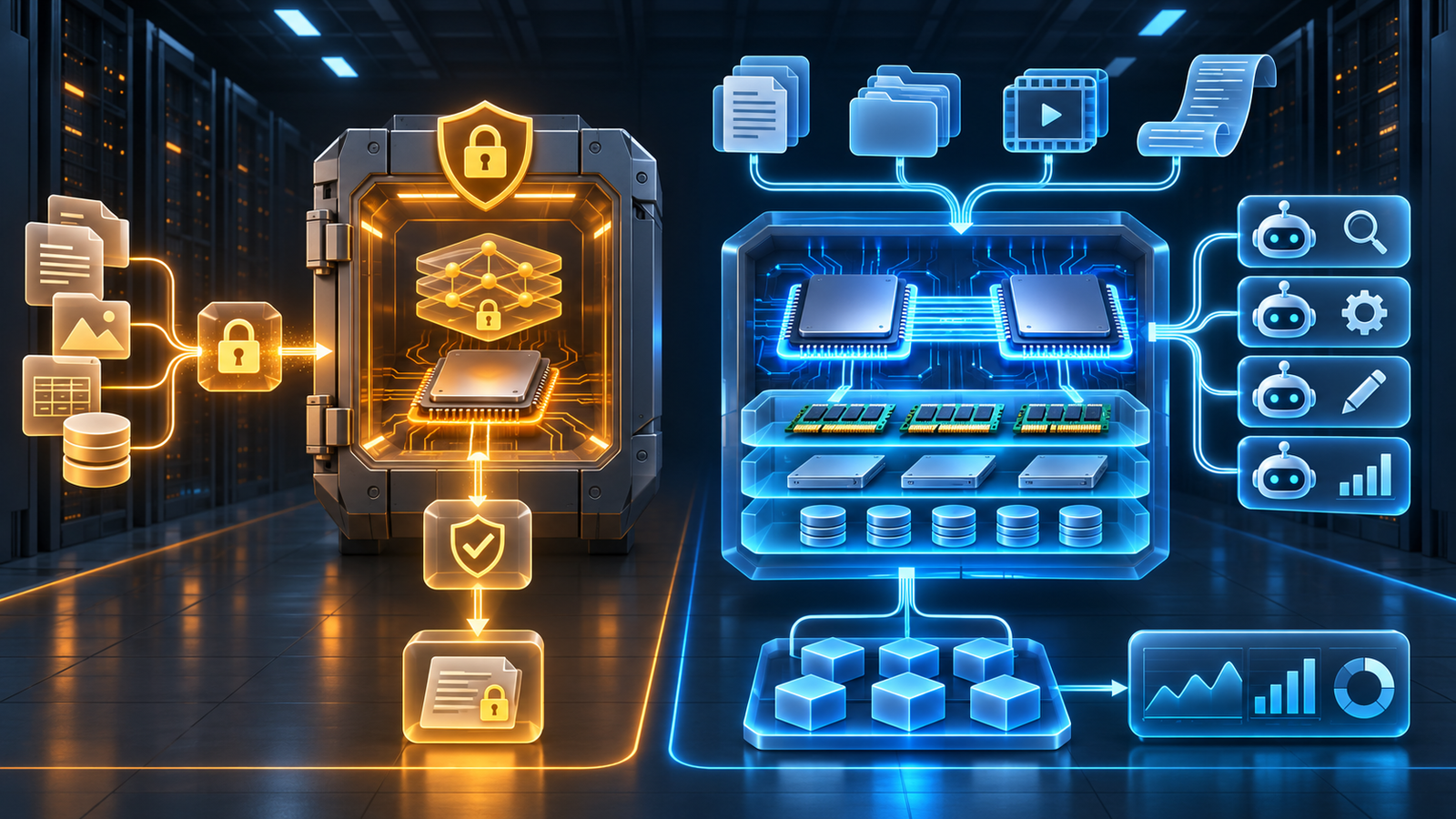
TPU 8tx uses the same underlying silicon as the training-focused TPU 8t, pairs it with fifth-generation AMD EPYC host processors and adds hardware-level confidential computing. Google says the design protects model weights and data while actively processed, targeting regulated enterprises and governments that need to fine-tune models or run agents near sensitive information.
The system also adopts Google’s low-latency Boardfly network. The company claims up to twice-lower latency than TPU 8t with a near-zero performance penalty. These are vendor-reported comparisons, and Google has not yet published customer pricing or broad availability details that would let teams calculate their own cost and performance trade-offs.
TPU 8i Max addresses a different constraint. Google combines two TPU 8i chips in one package, providing twice the compute, SRAM and high-bandwidth memory throughput of TPU 8i in the same rack footprint. It is intended for workloads such as coding agents operating across large repositories, mathematical reasoning, video analysis and drug discovery, where data movement and context storage can limit performance before raw arithmetic does.
Security moves into the accelerator stack
Confidential computing is intended to reduce exposure when data must be decrypted for processing. In a conventional design, encryption can protect data at rest and in transit, but plaintext may still appear in system memory during computation. TPU 8tx extends isolation into the hardware path used for model execution.
That is useful for private fine-tuning, model distillation and reinforcement learning on regulated data, but it is not an end-to-end security guarantee. Platform teams still need to examine key management, attestation, administrator access, logging, model output handling and the control plane surrounding the accelerator. An agent can be isolated at the hardware layer and still receive excessive permissions or expose sensitive information through an approved tool.
Google’s claim that training and inference can occur on one confidential system may reduce data movement between clusters. Teams evaluating it should verify which components fall inside the trusted execution boundary, how evidence is surfaced to auditors and whether recovery, debugging and observability workflows preserve the same protections.
Long-context AI becomes a systems problem
The 8i Max design reflects a wider shift in AI infrastructure. Agents that inspect entire repositories, retain long interaction histories or coordinate across tools spend substantial time moving model state and waiting on external systems. More accelerator compute is useful only when memory, networking and scheduling keep it supplied with work.
Google is pairing the hardware launch with software changes. The company said it is open-sourcing TPU Sync, a model-state layer that tiers key-value caches across accelerator memory, host memory, shared storage and the data-center network. Google claims this can reduce key-value cache transfer latency and time to first token by more than 90 percent. That figure should be treated as a vendor result until workload-specific tests establish how it translates to production.
Google also said Cloud Pathways is generally available on Google Kubernetes Engine for coordinating large TPU systems. Separately, GKE dynamic slicing is now generally available. It creates logical accelerator topologies from pre-provisioned TPU cubes rather than requiring a fixed node pool for every shape.
In Google’s testing, dynamic slicing reduced job startup time by up to five times and recovery time by up to 4.5 times. The practical benefit is operational: smaller workloads can share capacity, while a failing hardware cube can be replaced without rebuilding an entire large slice. The measurements remain configuration-dependent and should not be read as guaranteed improvements for every cluster.
What DevOps and platform teams should evaluate
Teams should begin with workload traces rather than accelerator specifications. Measure prompt and context sizes, cache reuse, tool-wait time, interconnect traffic, job startup latency, failure recovery and useful tokens produced per unit of cost. A memory-dense system may help a coding agent with a large active repository but offer little advantage to a short, stateless inference endpoint.
For confidential workloads, document the complete data path. Verify encryption and attestation boundaries, identity federation, service-account scopes, egress controls and how telemetry is redacted. Hardware isolation should complement, not replace, the access and deployment controls in an LLMOps program.
For Kubernetes operations, evaluate dynamic slicing against quotas, autoscaling policies, maintenance events and disruption budgets. Keep deterministic tests and rollback gates in the CI/CD pipeline, because faster agent infrastructure does not establish that generated changes are correct. Teams building retrieval-heavy systems should also benchmark how a RAG architecture uses context before paying to retain more of it on expensive accelerator memory.
Availability remains the key unknown
Google has defined the intended roles of both systems but has not provided complete public pricing, region coverage or a broad customer availability schedule in the announcement. Those omissions limit immediate procurement decisions. Buyers will also need comparisons against GPU-based confidential computing and other cloud accelerators using their own models, serving stacks and compliance requirements.
The confirmed change is architectural: Google now offers separate eighth-generation TPU systems for training, low-latency reasoning, confidential computing and large-context density. The inference is that accelerator fleets will become more heterogeneous as agents move into regulated and memory-intensive production workloads. Platform teams should prepare for that heterogeneity with portable serving layers, workload-aware scheduling and evidence-based cost models rather than assuming one accelerator class fits every AI service.
Sources
Google Cloud’s TPU 8tx and TPU 8i Max announcement and its GKE dynamic slicing technical announcement; Reuters reporting on the new TPU systems and Google Cloud demand.

