
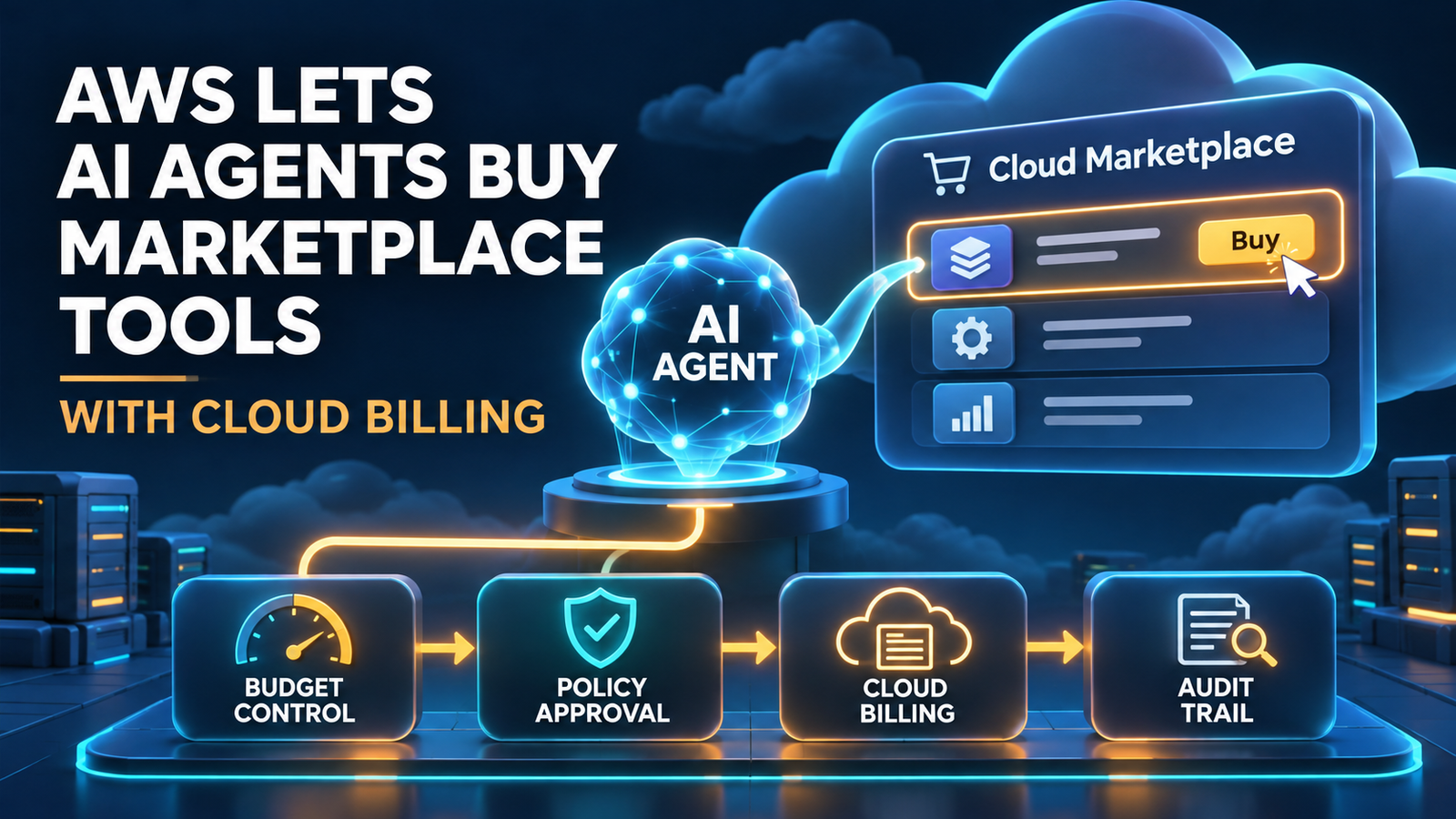

NEW DELHI, November 20, 2026, 9:50 p.m. IST — Amazon Web Services has connected Amazon Bedrock AgentCore payments to AWS Marketplace, allowing AI agents to discover and purchase selected pay-per-request software, data and API services while charging the cost in U.S. dollars to the developer’s existing AWS account.
The November 19 launch moves agent payments closer to the billing and governance systems that cloud teams already operate. It also raises a practical platform-engineering question: how should organizations authorize software purchases made inside an agent run, when the buying decision can happen in seconds and without a separate API key or wallet?
AWS says the integration applies to x402-enabled Marketplace products. Developers enable an AWS Billing connector in AgentCore payments, while an optional AWS Marketplace connector in AgentCore Gateway lets an agent search for compatible products and endpoints. When a seller returns an HTTP 402 payment request, AgentCore checks the session budget and other policies before issuing a short-lived payment token for the agent to retry the request.

What AWS confirmed
The launch adds AWS Billing as a payment option for AgentCore payments. Charges appear as AWS Marketplace line items on the customer’s cloud bill, and AWS says no stablecoin wallet is required. Sellers must register with AWS Marketplace, configure their listings for agentic payments and integrate the AWS Marketplace x402 software development kit.
At launch, AWS Billing supports the x402 exact payment scheme, in which a seller quotes a fixed price for a request. The first purchase from a seller creates a Marketplace agreement for the buyer’s AWS account, and later purchases are metered against it. Payment tokens are valid for about five minutes, according to the AWS technical walkthrough.
Controls are not limited to a model prompt. Platform teams can set a spending cap for each payment session and restrict approved sellers through AgentCore policy. Existing Private Marketplace rules still apply, so an agent cannot buy a product that the organization has excluded. AWS says transactions can be reviewed in CloudTrail and Cost Explorer, with payment observability also available through CloudWatch.
Why this matters for DevOps and cloud teams
The new path can remove credential and procurement friction for short-lived tool calls. AWS gives examples such as a research agent purchasing one web search or a coding agent calling a paid guardrail service. Instead of maintaining a permanent subscription and API secret for every possible tool, a workload can discover an approved service and pay only when it needs a request.
That convenience changes the operational boundary. A tool call may now create a commercial agreement and a billable event, not merely an application trace. Teams adopting the feature should treat payment policy as part of agent authorization: define low session limits, maintain seller allowlists, separate development and production payment managers, and alert on unexpected sellers, prices or purchase rates.
Cost attribution also needs finer labels than a shared cloud account. The useful unit is the agent task, linked to its payment session, workload identity, deployment and business owner. Without that mapping, Cost Explorer can show what was charged but may not explain which automated decision caused it. The same concern applies to LLMOps observability, where model calls, tool actions and human approvals need a single trace.
For retrieval systems, the Marketplace connector could let an agent source live or specialized data on demand rather than relying only on a fixed corpus. Teams should still validate provenance, licensing and data-handling terms before purchased results enter a retrieval-augmented generation pipeline. A successful payment confirms authorization and settlement; it does not establish that the data is accurate or safe to use.
From crypto rails to the AWS bill
AgentCore payments became generally available in August with support for pay-per-use APIs, MCP servers and content through protocols including x402 and the Machine Payment Protocol. The earlier release included wallet integrations and infrastructure-enforced limits. The Marketplace update adds a familiar enterprise settlement path: purchases are billed in dollars through the AWS account rather than requiring a dedicated crypto wallet.
This is an incremental expansion, not evidence that autonomous procurement is ready for unrestricted use. The catalog is limited to participating x402-enabled sellers, and AWS has not published broad evidence on how reliably agents choose the best product or detect a poor-value quote. Human review remains appropriate for new sellers, higher limits and recurring usage patterns.
The near-term value is narrower and more concrete. AWS has made a paid tool call look like a governed cloud transaction, with an identity, a budget, an allowlist and an audit trail. For platform teams, the key work now is to ensure those controls are enforced outside the model and connected to the same incident, cost and change-management processes used for other production infrastructure.
Sources
AWS detailed the launch in its official availability announcement and a separate technical walkthrough. Current implementation details are documented in the AgentCore payment guide and the AWS Marketplace buyer documentation.

