
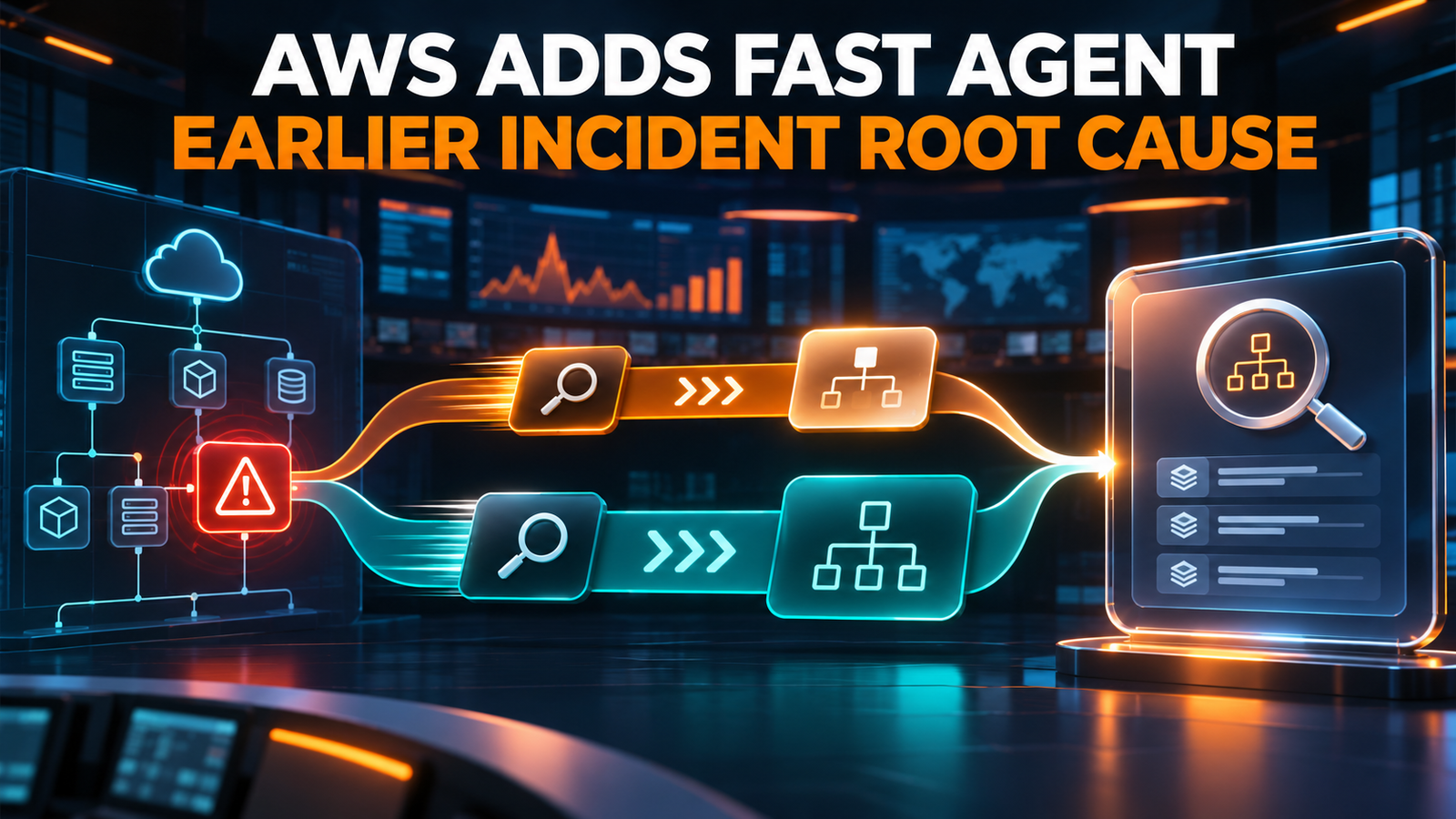

AWS DevOps Agent now runs a narrow parallel investigation to surface a preliminary cause sooner, but the faster path adds billable agent time and does not replace the full incident review.
NEW DELHI, Nov. 27, 2026, 5:07 p.m. IST — Amazon Web Services has added a Fast agent to AWS DevOps Agent, giving on-call teams an earlier hypothesis about the cause of a production incident while the service’s full investigation continues in parallel.
The feature began appearing in AWS documentation on Thursday and is enabled by default for every Agent Space, including spaces created before the update. It is a meaningful change for teams already using the service: incident responders may get useful direction sooner, but they must treat the result as provisional and account for the extra investigation time on their AWS bill.
A shorter path to an early hypothesis
According to AWS’s incident-response documentation, the Fast agent starts whenever a new investigation begins. It examines the same incident as the main investigation but uses a narrower set of tools and stops when it can explain the symptoms.
The first finding appears in the cause section of the Summary tab with a Preliminary label. The full investigation receives that report once and compares it with the broader evidence it collects. AWS explicitly says the final root cause can differ and will replace the preliminary finding when available.
That distinction matters during an outage. An early hypothesis can help an operator decide where to look next, but it is not a completed root-cause analysis. The Fast agent also does not propose a mitigation. AWS reserves mitigation proposals for the broader investigation flow, where an operator can review and refine a recommended action before applying it.

Parallel speed also changes the cost model
The Fast agent’s runtime is counted as investigation time in addition to the main investigation’s runtime. AWS currently lists incident investigations at $0.0083 per agent-second, with other connected services such as CloudWatch Logs Insights billed separately. The final cost therefore depends on how long both paths remain active and which data services they query.
AWS says the Fast agent runs from the start of an investigation until it reports a cause or the investigation ends. It does not run when someone sends a follow-up message to an investigation that is already active. Administrators can disable it per Agent Space from the Configuration tab, and changing that setting requires the aidevops:UpdateAgentSpace permission. Turning it off affects new investigations, not one already in progress.
The default-on rollout makes cost baselining important. Platform teams should compare investigation duration, agent time and total incident-query spend before and after the change rather than assuming that a faster first answer lowers the total bill. Teams that use broad alert automation should also confirm that existing correlation and skip rules continue to prevent duplicate investigations.
Why the update matters for SRE teams
AWS DevOps Agent correlates telemetry, code and deployment data across AWS, multicloud and on-premises systems. Earlier this month, AWS added live summaries and improved investigation latency; the new Fast agent separates the first plausible explanation from the deeper evidence-gathering path.
This is a familiar reliability trade-off: reduce time to the first useful signal without confusing speed with certainty. For developers and SREs, the practical value will depend less on how quickly a cause appears than on whether it is accurate enough to guide safe triage without anchoring responders on the wrong explanation.
Teams piloting the feature should record three times for each incident: the first preliminary cause, the final cause and the validated recovery. They should also track how often the preliminary and final causes disagree. That creates an operational measure of usefulness instead of relying on a single vendor metric.
The rollout also reinforces established LLMOps practices: log the model-assisted decision path, preserve human ownership of production changes and evaluate the system against real incident classes. Release data from CI/CD systems can provide useful context, but access should remain read-only until teams have tested permissions, audit trails and rollback procedures.
What remains unconfirmed
AWS has not published a separate accuracy benchmark, typical time-to-preliminary-cause figure or expected cost increase for the Fast agent. The company also does not document the exact reduced tool set used by the fast path. Those gaps make local testing necessary before teams change paging or escalation policies around the early result.
For now, the safest operating model is to use the preliminary cause as a prioritized lead, not an authorization signal. High-impact mitigations should still wait for corroborating telemetry, change records and an accountable operator. That is particularly important when an outage spans several services or when the initial symptom is far from the underlying failure.
Sources
AWS documented the Fast agent in its November 26 release history and detailed its behavior, billing and configuration in the AWS DevOps Agent user guide. The service’s scope is described in the product overview. Current rates and additional-service charges come from the AWS pricing page.

