
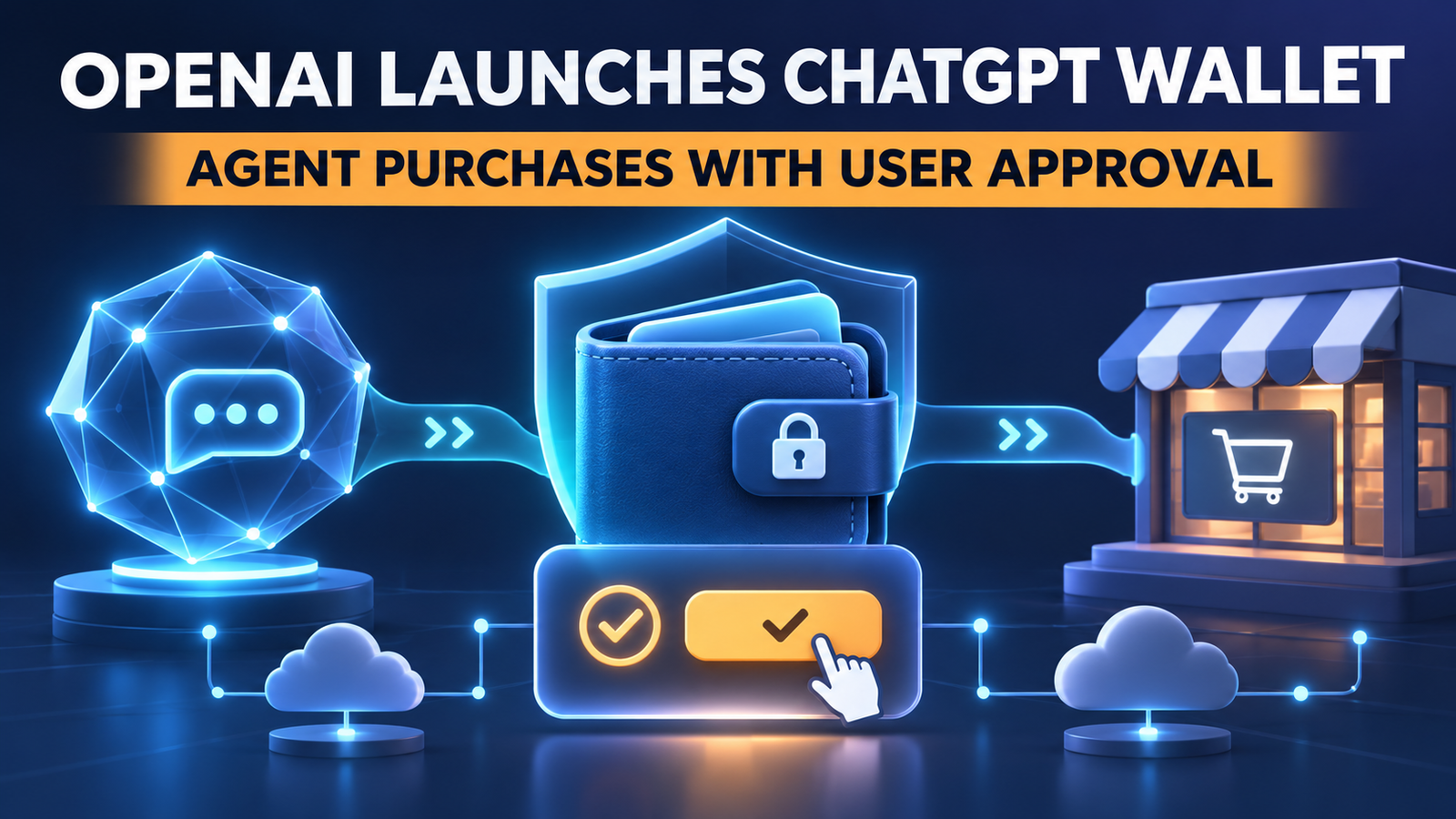

NEW DELHI, November 14, 2026, 10:05 p.m. IST — OpenAI has launched ChatGPT Wallet, giving its cloud-based agents a way to complete purchases through existing merchant checkout pages after a user reviews and approves each transaction.
The product began rolling out Friday to adult ChatGPT Pro subscribers in the United States using eligible US-issued cards. Initial access is through dots, OpenAI’s persistent agent product. American Express, Mastercard and Visa are supporting the launch, while payment and fraud vendors including Adyen, Checkout.com, Stripe, Forter, Riskified, Sardine and Signifyd are working with OpenAI on compatibility.
For developers and platform teams, the important change is not a new payment API. OpenAI says Wallet can use existing checkout pages and payment forms without a Wallet-specific integration. The operational work instead sits at the edge: reliably distinguishing verified agent traffic from unwanted bots, preserving checkout state, interpreting new risk signals and keeping the same authorization and audit controls that apply to human buyers.
What OpenAI confirmed
A user adds a card to ChatGPT Wallet and must review the items, total and selected card before every purchase. Approval includes a security check such as a fingerprint scan or Face ID. The payment network then creates a token containing substitute payment credentials, so neither the merchant nor the purchasing agent receives the user’s actual card details.
The merchant remains the seller of record in the practical sense: it controls pricing, fulfillment, returns and customer service, and its checkout processes the payment. OpenAI’s merchant documentation also says businesses continue to make fraud decisions. A token is authorized only for the approved transaction and must not be stored or reused for a separate purchase.
OpenAI described broader delegation—such as pre-approved spending limits, purchase categories or time windows—as a future direction. That is not part of the initial availability described in Friday’s announcement. The current flow requires a human review and security check for each purchase.

Agent traffic becomes an edge-security concern
The launch creates an immediate configuration question for teams running content delivery networks, web application firewalls and bot-management systems. A checkout can fail if a legitimate cloud browser is treated like automated abuse. Loosening bot controls globally would create the opposite problem.
OpenAI’s guidance uses Web Bot Auth to identify supported cloud-browser requests. Signed requests carry HTTP message-signature fields and identify the signing agent as ChatGPT. Akamai, Cloudflare, HUMAN and Vercel can recognize this traffic through existing bot directories or detection rules; other edge stacks can validate the signatures against OpenAI’s published keys using the HTTP Message Signatures standard.
Platform teams should treat that verification as an identity signal, not as authorization to bypass normal application security. Existing account permissions, page-level access rules, inventory validation, rate limits and checkout controls still apply. OpenAI explicitly separates these user-directed browser visits from its search crawlers, so a crawler allowlist is not an adequate substitute.
The same distinction matters for teams building agent integrations. A browser can follow the merchant’s current interface, while a plugin can expose structured actions such as product lookup, cart management or booking. OpenAI says plugin checkout interaction with ChatGPT Wallet is still being developed, so teams should not assume a browser flow and an MCP-based commerce flow have identical payment support.
Fraud systems may need careful retuning
Traditional fraud models often use IP reputation, browser details and behavior that looks human. A legitimate agent operating from cloud infrastructure can trigger those rules. OpenAI says it is rolling out a standard Forwarded HTTP header mechanism to relay relevant user signals, and advises merchants using third-party risk providers to confirm that their configurations interpret those signals correctly.
That is a reason for measured testing rather than blanket exemptions. Teams should compare approval rates, false declines, account-takeover alerts, chargebacks and order cancellations for verified agent sessions against ordinary checkout traffic. Logs should preserve the verified agent identity, user approval event, merchant session, payment token reference and order outcome without recording sensitive payment data.
Site reliability teams also need to test failure recovery. A purchase path now spans an agent session, the merchant frontend, authentication, inventory, fraud screening, a payment processor and the card network. Expired carts, price changes, authentication challenges and partial outages should fail closed and return the user to a clear review step rather than silently retrying a materially changed order.
What developers should do now
US merchants expecting early ChatGPT Wallet traffic can start with a narrow staging review: verify signed browser requests at the CDN or firewall, keep bot exceptions limited to authenticated signatures, exercise checkout and step-up authentication, and confirm that observability joins edge events to order outcomes. Fraud and payments teams should be involved before changing production thresholds.
Teams building a structured integration should keep product discovery, account identity and purchase approval as separate permissions. OpenAI’s documentation says a ChatGPT identity does not itself approve a purchase. That separation mirrors the broader least-privilege approach platform teams already use for service identities and automation.
The launch also reinforces a familiar LLMOps lesson: agent reliability depends on the systems around the model. Signed requests, short-lived credentials, explicit human approval, deterministic policy and auditable outcomes matter more than a model’s ability to navigate a checkout form. Teams evaluating plugins or other tool-connected agents can apply the same control principles described in GravityDevOps guides to prompt engineering for developers and retrieval-augmented generation: constrain inputs, validate outputs and keep consequential actions behind independent checks.
ChatGPT Wallet is still a limited US rollout, and OpenAI has not published broad adoption or transaction-performance data. Its near-term significance is therefore architectural rather than numerical. It gives platform teams a concrete preview of agent-initiated commerce while leaving the hardest production responsibilities—identity, risk, resilience and accountability—with the businesses operating the checkout.
Sources
OpenAI’s launch announcement; the Commerce Partner Playbook; technical guidance for verified cloud-browser access and accepting Wallet payments; and independent reporting from Reuters and TechCrunch were reviewed for this report. Availability, approval and tokenization claims were cross-checked across the launch post, implementation guidance and independent coverage.


