


Anthropic has made Claude Fable 5.1 broadly available for long-running coding and knowledge work, while cutting prompt-cache read prices by 75%. The release also introduces breaking API behavior that platform teams should test before changing production model aliases.
NEW DELHI, September 2, 2026, 5:03 PM IST — Anthropic has released Claude Fable 5.1 across its API and major cloud platforms, pairing a new frontier model for long-horizon agents with sharply cheaper prompt-cache reads and several migration changes that can break existing tool and conversation pipelines.
The model became available on September 1 through the Claude API, Amazon Bedrock, Google Cloud and Microsoft Foundry. Anthropic kept base pricing at $10 per million input tokens and $50 per million output tokens, but lowered cache reads from $1 to $0.25 per million tokens. Claude Mythos 5.1 uses the same underlying capabilities but remains restricted to vetted organizations.
For developers and platform teams, the cost cut is only half the story. Anthropic’s own migration documentation says Fable 5.1 does not support forced tool selection, binds preserved reasoning blocks to an unchanged conversation prefix, and can drop reasoning when a router falls back to an older model. Those are operational differences, not cosmetic model-version changes.
What Anthropic confirmed
Anthropic describes Fable 5.1 as its most capable generally available model for coding and knowledge work. It has a one-million-token context window, a maximum output of 128,000 tokens and adaptive reasoning that is always enabled. The company positions it for multi-file development, long-running research, browser and desktop operation, and document-heavy enterprise workflows.
The model ID is claude-fable-5-1 in the first-party API and Anthropic-operated platforms. Anthropic’s model reference lists the release as active on the Claude API, Bedrock, Google Cloud, Microsoft Foundry and Claude Platform on AWS. Anthropic says retirement will occur no sooner than September 1, 2027, but that lifecycle commitment does not remove the need to pin and test a specific model version where reproducibility matters.
Anthropic reported improvements in agentic coding, computer use, long-context reasoning and multi-step research. It also published stronger benchmark results and customer evaluations. These remain vendor-reported results; teams should not treat them as proof that Fable 5.1 will improve their own repositories, latency targets or successful-task economics without workload-specific evaluation.
Prompt caching changes the cost equation
The most measurable production change is the cache-read price. Anthropic’s pricing table puts Fable 5.1 cache hits and refreshes at 2.5% of the base input-token rate, compared with 10% for Fable 5 and most other current Claude models. Cache writes remain $12.50 per million tokens for five minutes and $20 per million tokens for one hour.
That discount matters for agents that repeatedly send a large, stable prefix containing system instructions, tool definitions, repository context or accumulated conversation history. Anthropic estimates that the lower cache-read rate can reduce typical workload costs by about 25% and highly agentic workload costs by as much as roughly 45%. Those estimates depend on cache-hit rates and request shape, so FinOps teams should verify effective input, write, read and output costs from real traces.
A useful comparison is successful-task cost rather than token price alone. Fable 5.1 still costs twice as much as Claude Opus 5 for uncached input and output, according to Anthropic’s list prices. A longer or less reliable agent run can erase cache savings, while a model that completes a difficult migration in fewer retries may justify the premium. This is the same operational principle behind mature LLMOps: measure quality, latency, retries and spend together.
Three migration traps need attention
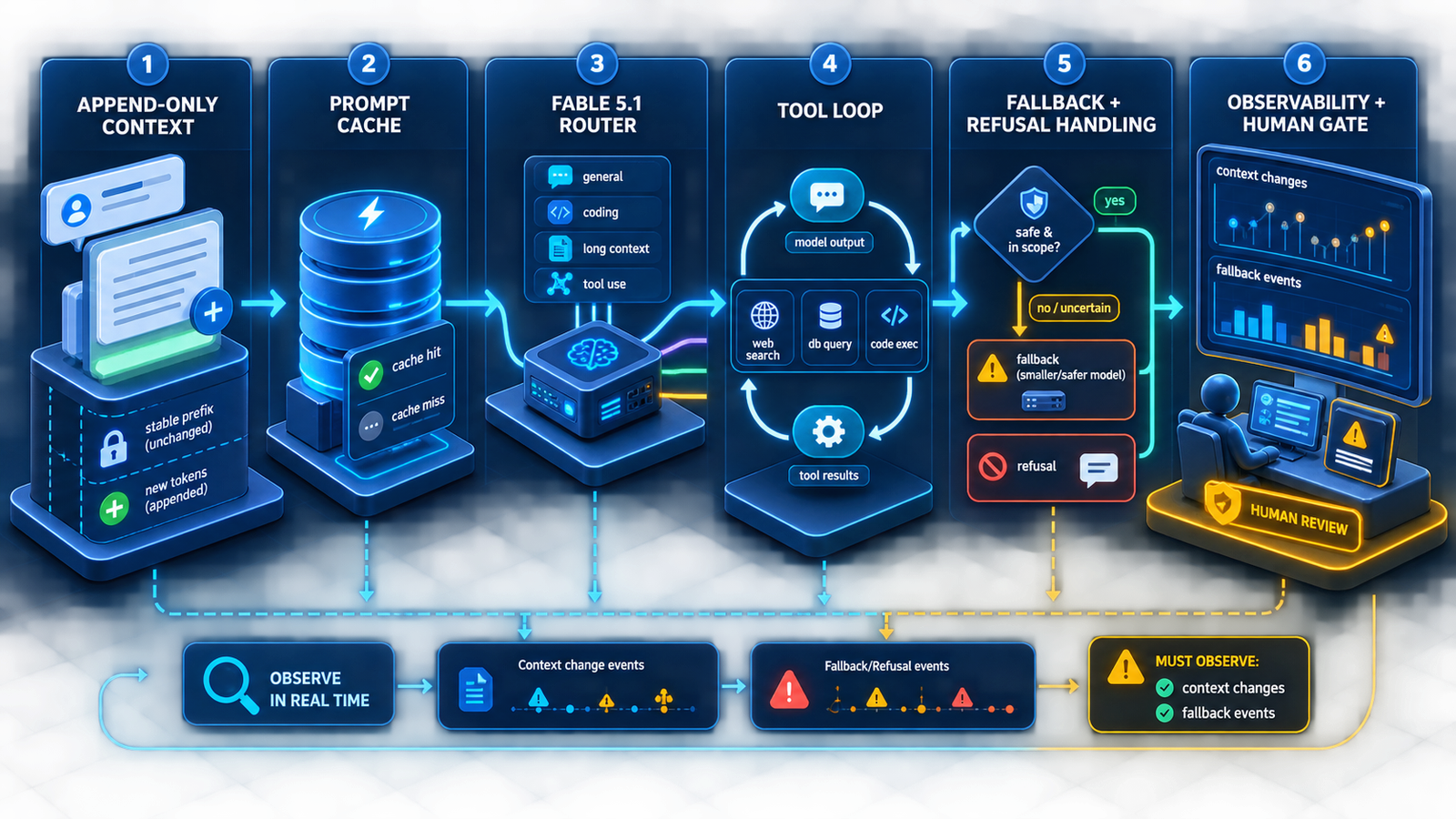
First, Fable 5.1 rejects forced tool choices. Requests that require any tool or name one mandatory tool return an HTTP 400 error. Anthropic advises leaving tool choice on automatic, using strict tool schemas for valid arguments, and stating in the prompt when a tool should be used. Teams with deterministic dispatch logic should test this behavior before replacing a model alias.
Second, the model’s preserved reasoning blocks are sensitive to history edits. Changing earlier messages, system instructions or tool definitions can invalidate later reasoning blocks. Anthropic recommends treating long-running conversations as append-only, using mid-conversation system messages and server-side compaction instead of rewriting prior turns. This can affect home-grown agent orchestrators that reconstruct message arrays on every request.
Third, model routing is not symmetric. Fable 5.1 can read reasoning blocks produced by earlier Claude models, but earlier models cannot read its reasoning blocks. If a router moves a conversation back to an older model, the API can silently drop those blocks unless a beta control is enabled to report the transformation. That makes model choice, fallback events and context transformations important observability fields.
The detailed Fable 5.1 change log also warns that parallel tool calling may be more variable, low-effort runs may search less often, and small text edits may produce whole-file rewrites. Those behavior shifts can add round trips or tokens even when answer quality improves.
Safeguards split the public and restricted models
Claude Fable 5.1 and Mythos 5.1 share the same core capabilities, but Anthropic applies additional cybersecurity and biology controls to the generally available Fable model. The company says flagged cyber requests can fall back to Claude Opus 4.8 and biology requests to Opus 5. API customers must configure fallback behavior and handle a refusal response even when the HTTP status is successful.
Claude Mythos 5.1 is limited to vetted cyberdefenders and life-sciences organizations. Anthropic says Fable’s updated classifiers create fewer benign interventions than the original Fable 5 controls, but those percentages are company measurements. Production teams should still log refusal categories, fallback model IDs, cost credits and task outcomes instead of assuming the safety layer will be invisible.
Axios independently reported the general Fable release, restricted Mythos access and 75% cache-read reduction. Its account also noted Anthropic’s wider enterprise-safeguard changes, reinforcing that model capability, data handling and access control are increasingly being shipped as one release package.
What platform teams should do now
Teams evaluating Fable 5.1 should create a new deployment target instead of moving production traffic immediately. Replay representative coding and agent traces, confirm tool-call behavior, measure prompt-cache hit rates, and test fallback paths with preserved reasoning enabled. Capture total cost, wall-clock time, number of tool turns, refusal rate and task success.
Agent runtimes also need an append-only conversation strategy, explicit reporting of context transformations and a safe response to HTTP 400 migration errors. In CI/CD environments, keep human approval around writes, releases and infrastructure changes; a stronger long-running model does not replace normal deployment controls. GravityDevOps’ guides to prompt engineering for developers and retrieval-augmented generation provide background on stable instructions and managed context.
The practical conclusion is narrower than the launch claims: Fable 5.1 gives teams a new high-end option with unusually cheap cache reuse, but adopting it safely is a model migration. The winning teams will validate agent behavior and successful-task economics before they turn the new model into a default.


