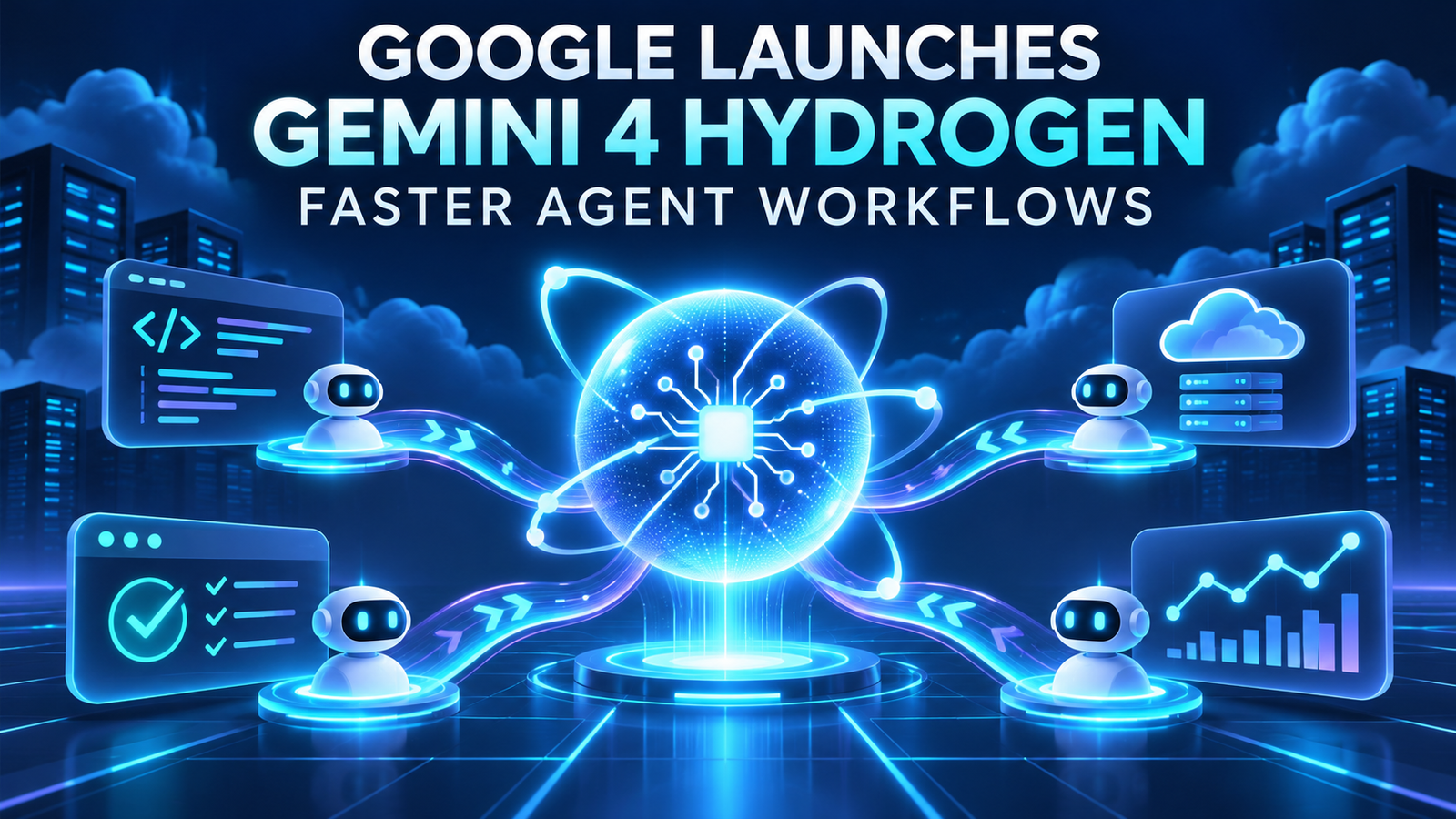

NEW DELHI, November 13, 2026, 5:06 PM IST — Google has released Gemini 4 Hydrogen, a faster member of its Gemini 4 model family aimed at everyday coding, multimodal work and agentic execution, with access through the Gemini API, Google AI Studio and Google’s enterprise agent platform.
The launch matters for engineering teams because Hydrogen is not simply a smaller chat model. Google is positioning it as an execution tier that can handle repository work, tool calls and worker-agent tasks while more expensive frontier models concentrate on planning and difficult reasoning. That split could lower latency and token costs in multi-model systems, but it also creates new routing, evaluation and observability work for platform teams.
A fast execution model with a one-million-token budget
Google said Thursday that Gemini 4 Hydrogen is adapted from Gemini 4 Carbon and supports text, images, audio and video. Its model card lists a unified context limit of 1,048,576 tokens, shared by input, reasoning, function calls and final output. A normal foreground generation is capped at 65,536 output tokens, while longer decodes require supported continuation or background-processing paths.
The model is generally available in Google’s enterprise agent platform under the model ID gemini-4-hydrogen. Google describes the release as short-term GA, meaning customers receive at least 45 days’ notice before retirement. It is also available through Google AI Studio and the Gemini API, while product access extends to Gemini for business, the Gemini app, Search and paid Google AI Pro and Ultra users in Google Antigravity.
API pricing is listed at $1.50 per million input tokens and $7.50 per million output tokens across the full context window. Platform teams should note that billed output includes reasoning tokens, function calls and internal tool instructions. Google Search grounding is billed separately per query, so a nominal per-token comparison will not capture the complete cost of tool-heavy agents.

Four reasoning levels change the migration path
Hydrogen supports four thinking levels: low, medium, high and xhigh. High is the default. Google recommends low for routing, classification and high-throughput summarisation; medium for general coding and document work; high for multi-step tool loops and complex multimodal analysis; and xhigh for the most demanding reasoning and multi-file software tasks.
That configuration differs from earlier Gemini Flash models. Existing integrations that send a numerical thinking budget or a minimal thinking level will receive an HTTP 400 error. Custom temperature, top-p and top-k values are ignored, while unsupported frequency or presence penalties also fail validation. Teams migrating from Gemini 3.8 Flash therefore need compatibility testing, not just a model-name change.
Google also documents strict ordering rules for parallel function calls and their responses. Agent runtimes that compact or rewrite conversation history must account for thought-signature mismatches. These details are operationally important because a model can perform well in an evaluation harness yet still fail inside a production agent if message history, tool-result ordering or token accounting is wrong.
Google reports faster coding and agent performance
Google says Hydrogen completes tasks 2.5 times faster than Gemini 3.8 Flash at the default high setting and scored 57 percent on Terminal-Bench 4.1, compared with 18.2 percent for the earlier model. The company also reports that its Antigravity Orchestrator, which switches between Carbon and Hydrogen, approached Carbon’s task-success rate while using 24 percent less quota and finishing 19 percent faster on Terminal-Bench 4.0.
Those figures should be treated as directional rather than universal. Google’s evaluation disclosure says many Hydrogen results were self-computed with specific harnesses and high reasoning settings, while some competitor figures came from provider reports or public leaderboards. Results also vary by workload: in Google’s table, Claude Sonnet 5.5 led Hydrogen on Terminal-Bench 4.1, the OSWorld computer-use subset and Terminal-Bench Science.
Independent testing cited by VentureBeat found Hydrogen scored 51 on Artificial Analysis’s Intelligence Index at the default high setting, one point above Gemini 4 Argon at high. A one-point aggregate lead does not establish that Hydrogen is better for every workload, but it strengthens the case for testing fast models before automatically routing routine work to a frontier tier.
What DevOps and platform teams should validate
For developers and platform engineers, the immediate opportunity is workload segmentation. Repository search, test execution, summarisation and verification can be assigned to Hydrogen, while architecture changes or ambiguous incidents can escalate to Carbon or another frontier model. This resembles an operational control plane more than a single-model chatbot.
A production pilot should capture end-to-end latency, total billed tokens, tool-call error rates, task success, retry behaviour and the percentage of jobs escalated to a stronger model. Evaluations should use the organisation’s own repositories and runbooks, including failure cases such as unavailable tools, stale context and partial test results. Teams building these systems can apply the same lifecycle discipline described in GravityDevOps’ guide to LLMOps and ground model responses with the retrieval controls covered in the RAG overview.
Security boundaries remain essential. Worker agents should receive scoped credentials, isolated workspaces and explicit approval gates for deployment, data deletion or infrastructure changes. Prompt design still matters, but it should be paired with deterministic policy; GravityDevOps’ prompt engineering guide for developers explains the instruction layer, while runtime controls must enforce what the model is allowed to do.
Safety documentation is not yet complete
Google’s model card acknowledges hallucinations, occasional slowness and timeouts, and greater token use at higher thinking levels. It also reports more unjustified refusals than Gemini 3.8 Flash in an automated internal evaluation, particularly for multimodal prompts.
The company says Hydrogen did not cross its critical capability levels for biological or cybersecurity risk, although it reached alert thresholds in both areas. Google has not yet published the full Hydrogen Safety and Security Report, saying it will arrive in the coming days. Until that document is available, organisations should avoid treating the launch materials as a complete risk assessment.
The practical takeaway is measured rather than dramatic: Gemini 4 Hydrogen gives teams a new fast model with unusually broad context and explicit agent-oriented controls. Its value will depend less on headline benchmark rankings than on whether it reduces cost and latency on real workflows without weakening test quality, access controls or auditability.
Sources
Reporting is based on Google’s Gemini 4 Hydrogen launch announcement, the Google DeepMind model card, the Google Cloud model documentation, the Google Cloud developer guide, Google’s evaluation methodology, and VentureBeat’s independent launch coverage.


