

NEW DELHI, July 13, 2026, 11:12 a.m. IST — Security researchers have disclosed a shared weakness across six widely used AI coding assistants that can let a malicious repository steer an agent into reading or changing files outside its intended workspace.
The issue, named GhostApproval by Wiz, combines an old Unix problem—unsafe handling of symbolic links—with approval screens that may show developers a harmless-looking project path instead of the sensitive file the agent will actually touch. In the most serious demonstrations, the technique could place an attacker’s key in a developer’s SSH configuration and create persistent access to the machine.
The disclosure matters now because coding agents are moving from suggestion tools to operators that read repositories, run commands and modify files. For platform and DevOps teams, that means the security boundary is no longer only the model prompt or the generated code. It also includes the agent runtime, filesystem path resolution and the accuracy of every human approval dialog.
What researchers confirmed
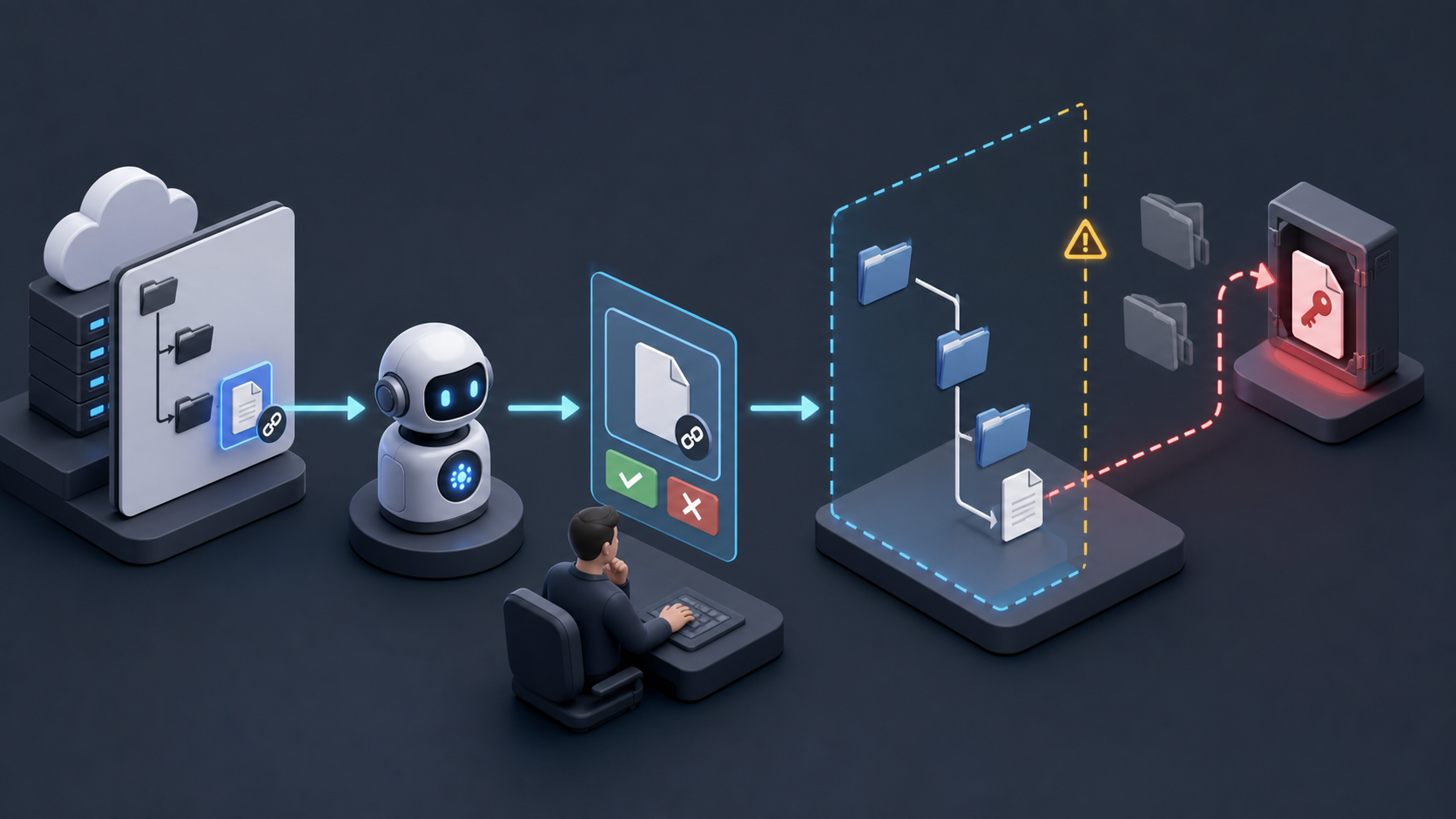
Wiz said it tested Amazon Q Developer, Anthropic Claude Code, Augment, Cursor, Google Antigravity and Windsurf and found variations of the same pattern in all six. A repository can contain a symbolic link that appears to be a local configuration file but resolves to a sensitive location elsewhere on the developer’s system.
If the agent follows repository instructions and writes through that link, the change lands at the resolved destination. Wiz demonstrated the pattern against shell configuration and SSH authorization files. The researchers said some tools displayed only the repository path in their confirmation interface; others performed a write before the developer could approve it.
Independent reporting by ITPro corroborated the affected product list, remediation details and the absence of evidence that the technique had been exploited in the wild at publication time.
Fixes differ by vendor
AWS fixed its affected language server in version 1.69.0 and assigned CVE-2026-12958. AWS told Wiz that the language server normally updates automatically, while customers whose networks block automatic updates should install the latest Amazon Q Developer plugin and reload the IDE.
Cursor fixed its issue in version 3.0 under CVE-2026-50549. Google also deployed a fix for Antigravity and was assessing a CVE, according to the disclosure. Wiz listed remediation for Augment and Windsurf as still in progress when it published the research.
Anthropic disputed Wiz’s original classification because Claude Code asks users to trust a directory and approve a file operation. The company also told the researchers that a symlink warning had already shipped in version 2.1.32 in February, before Wiz filed its report. Wiz nevertheless argued that approval cannot be meaningfully informed when an interface displays the link path but not the sensitive resolved destination. The current disclosure says later Claude Code versions resolve symlinks and warn before sensitive writes.
Those distinctions are important. GhostApproval is not one identical defect with one universal patch. It is a family of failures involving path validation, interface design and the moment at which an agent writes to disk.
Why a normal approval prompt may not be enough
Symbolic links are a standard filesystem feature. They become dangerous when software validates the visible link but performs an operation on a different canonical path. Traditional secure coding guidance has treated this as a known class of weakness for decades.
Agentic tools raise the stakes because they can translate natural-language repository instructions into multi-step actions. A developer may think they are approving a change to a project settings file while the runtime resolves that path to a user-level shell or SSH file. If the dialog omits the resolved target—or the write occurs before the dialog appears—the human-in-the-loop control is weaker than it looks.
This is also why teams should treat untrusted repositories as active input, not inert source code. README files, agent instruction files and tool configuration can influence autonomous behavior before an engineer has reviewed every path.
Practical impact for DevOps and platform teams
Engineering leaders should first inventory agent versions across managed workstations and development containers, then confirm that automatic extension updates are not being blocked by enterprise network policy. Amazon Q Developer users should verify language server version 1.69.0 or later, while Cursor users should be on version 3.0 or later. Teams using Augment or Windsurf should follow vendor advisories closely because Wiz marked their remediation status as incomplete at disclosure.
Version checks are only one layer. Platform teams can reduce exposure by opening unfamiliar repositories inside disposable development containers or ephemeral virtual machines, limiting access to home-directory credentials and cloud tokens, and restricting outbound network access until the project has been reviewed. File monitoring for changes to SSH authorization, shell startup files and credential stores can provide an additional detection point.
Approval policy should also distinguish a visible project path from its canonical target. An agent should resolve links before showing a prompt, clearly flag any destination outside the workspace and never write before explicit authorization. Security tests for internal coding-agent rollouts should include malicious symlinks, deceptive repository instructions and attempts to reach parent directories or mounted secrets.
These controls fit into a broader LLMOps practice: model quality is only one production concern, alongside identity, runtime isolation, logging and incident response. Teams building context-aware assistants with retrieval-augmented generation should apply the same principle to retrieved content—external context must not silently expand an agent’s authority.
The larger lesson for agent deployment
GhostApproval does not show that human approval is useless. It shows that approval is a security control only when it happens before the action and presents the real object of the action. A polished dialog cannot compensate for a runtime that validates one path and writes to another.
For technical decision-makers, the immediate task is patching and containment. The longer-term procurement question is whether a coding agent exposes verifiable controls: canonical-path enforcement, pre-action authorization, audit logs, workspace isolation and clear vendor threat models. Those capabilities should be evaluated with the same rigor as model quality or coding benchmarks.
Sources
Primary technical disclosure: Wiz Research, GhostApproval: A Trust Boundary Gap in AI Coding Assistants. Independent report: ITPro, Flaws in some of the most popular AI coding tools left developers wide open to attack. Background weakness definition: MITRE CWE-61.


