
SEO excerpt: Google Cloud and Box are integrating Gemini Embedding 2 into Box’s Agentic Platform, giving enterprise retrieval systems a shared semantic layer for text, document pages, images, charts, audio and video.
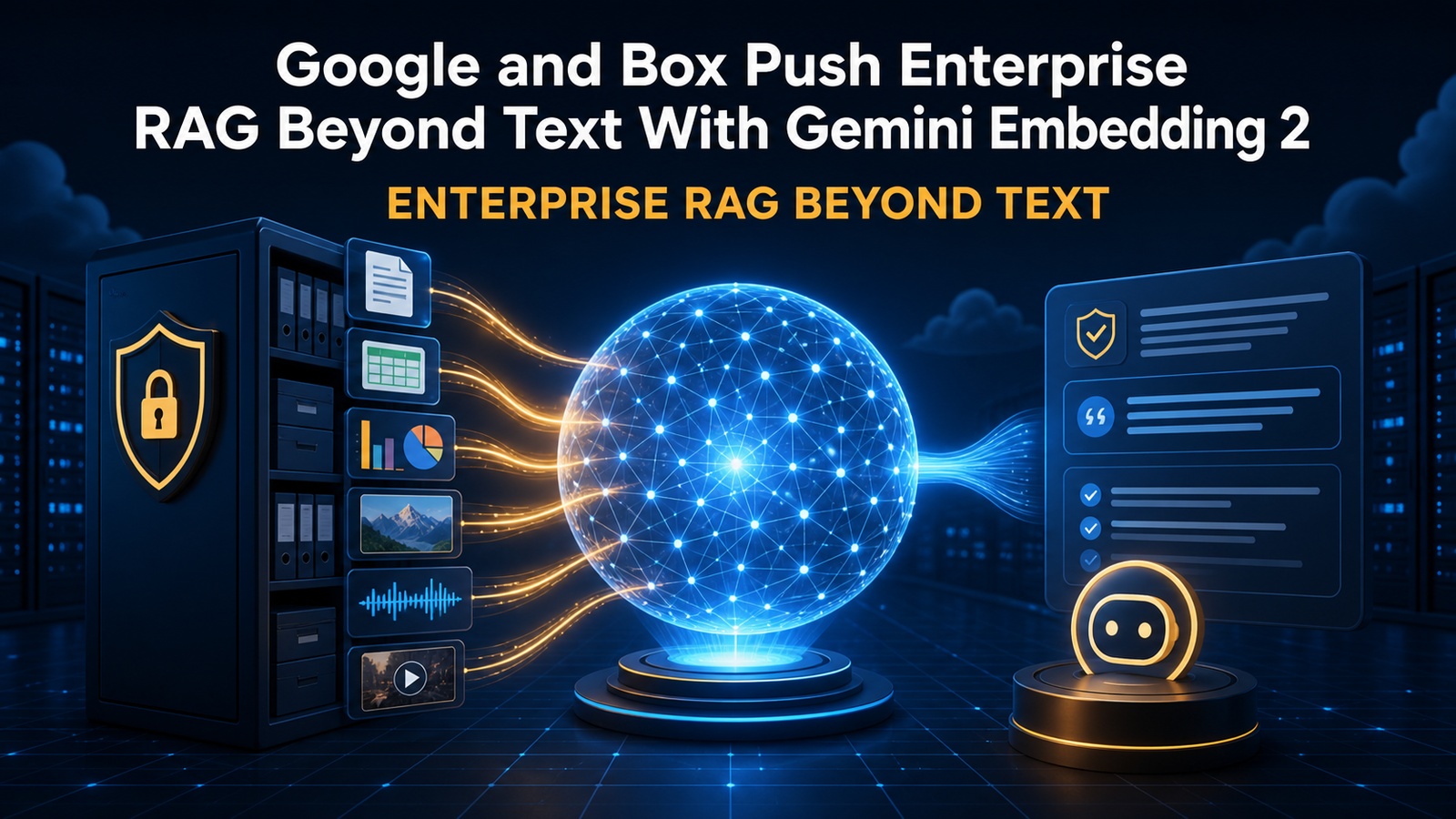
NEW DELHI, August 20, 2026, 11:35 AM IST — Google Cloud and Box are extending enterprise retrieval-augmented generation beyond extracted text, integrating Gemini Embedding 2 into Box’s Agentic Platform so agents can search and connect information across documents, images, tables and charts.
The companies described the work in a joint Google Cloud post published Tuesday. The immediate significance is architectural: enterprise AI systems have often flattened files into text chunks before indexing them, a process that can detach figures from labels, lose page layout and make diagrams effectively invisible. The Box integration is designed to preserve more of that visual and spatial context inside a unified embedding space.
For developers and platform teams, this is less about adding another chatbot and more about changing the retrieval layer beneath AI agents. A single model can represent text, images, audio, video and document pages as vectors that can be compared semantically. That can reduce the number of modality-specific preprocessing pipelines a team must operate, but it also creates new evaluation, access-control and cost questions before multimodal retrieval belongs in production.

What Google and Box confirmed
According to Google Cloud’s announcement, Box plans to use Gemini Embedding 2 across three broad enterprise patterns: analysis of structured financial and operational reports, retrieval across mixed document formats, and reconciliation of conflicting information stored in separate files.
The companies say the model can place rendered spreadsheet tables, document pages, charts, raster images and text in the same semantic space. In practical terms, a natural-language query could locate a chart inside a slide deck or connect a figure in a scanned PDF with a written policy elsewhere in a repository. Box also framed its content platform as the governed layer around those retrieval workflows, where existing permissions and compliance controls remain relevant.
Google’s current model documentation, updated August 19, lists gemini-embedding-2 as generally available. It produces vectors of up to 3,072 dimensions and supports smaller output sizes through Matryoshka Representation Learning. The service is available through standard pay-as-you-go and batch inference, with global, United States and Europe endpoints listed.
The documented limits matter for architecture decisions. Text input is capped at 8,192 tokens. A request can include as many as six images, one PDF of up to six pages, one video of up to 120 seconds without audio or 80 seconds with audio, or one audio file of up to 180 seconds. Provisioned throughput is not supported, according to the model page.
Why multimodal retrieval changes the RAG pipeline
A conventional RAG system typically parses source files, splits extracted text into chunks, creates vectors, stores them in an index and retrieves the nearest matches for a language model. That approach works well when meaning is mostly carried by prose. It becomes brittle when a table’s column headings, a diagram’s arrows or a dashboard’s colour-coded status contains the evidence a user needs.
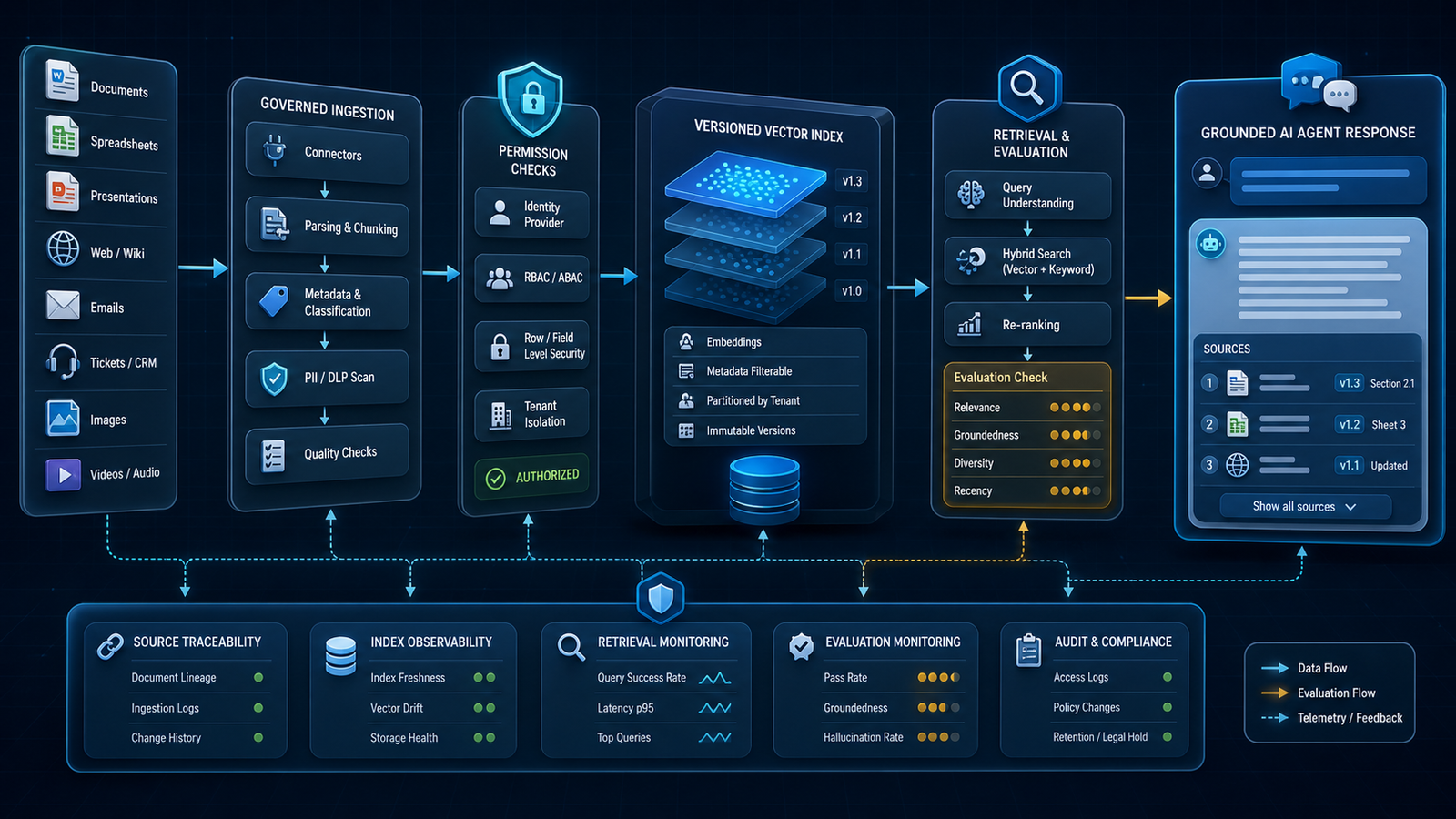
Multimodal embeddings do not eliminate parsing or document engineering. They add another representation of the source material. Teams may choose to index a rendered page alongside its extracted text, retain coordinates linking retrieved vectors back to the source, and use metadata filters to enforce tenant, folder and classification boundaries.
Google first introduced Gemini Embedding 2 in public preview in March. Its launch announcement described a unified space for text, images, video, audio and PDFs, with recommended vector sizes of 3,072, 1,536 or 768 dimensions. The Box announcement is notable because it applies that model to governed enterprise repositories rather than a standalone semantic-search demo.
What platform teams should test before migration
The most important operational question is whether visual retrieval improves useful answers on a team’s own corpus. Platform engineers should build a representative evaluation set containing tables, diagrams, scanned pages and cross-file questions, then compare the new index against the existing text pipeline. Recall, precision, latency and source-page accuracy are more informative than a vendor benchmark taken in isolation.
Vector dimensionality is another practical choice. A 3,072-value vector carries a larger storage and memory footprint than a 768-value alternative, especially when millions of pages or media assets are indexed. Google says smaller dimensions are supported, but each organisation must measure the quality trade-off before reducing index size. Re-embedding an entire repository also deserves a staged rollout, versioned indexes and a rollback plan.
Security boundaries should be applied before retrieval results reach an agent. A common index can create accidental data exposure if document permissions, regional controls or retention states are not represented in metadata and checked at query time. The embedding itself is not an authorisation system. Teams should also log which source objects and pages were retrieved without copying sensitive content into unrestricted observability tools.
For teams already formalising LLMOps, the integration expands the asset inventory that needs lifecycle management. Model version, embedding dimension, preprocessing path, source checksum and access-policy version should travel together. A retrieval regression can otherwise be difficult to distinguish from a generative-model regression.
Confirmed capability, open implementation questions
The confirmed development is the Google Cloud and Box integration and the documented availability of Gemini Embedding 2. The companies have not published customer-wide rollout dates, production benchmark results for the Box implementation or workload-specific pricing in the announcement. They also have not shown that one multimodal index will outperform specialised retrieval systems for every content type.
That uncertainty argues for measured adoption. Multimodal embeddings can simplify a fragmented retrieval stack and recover meaning that text extraction discards. They can also increase ingestion cost, complicate evaluation and tie a large vector index to one model’s representation. A dual-index pilot, in which text and multimodal retrieval run side by side, gives engineering teams evidence before they commit to a full migration.
The broader direction is clear: enterprise agents are being asked to reason over the files people actually use, not just clean text. Google and Box’s latest work gives platform teams a production-oriented example of that shift. The engineering challenge now moves from proving that cross-modal search is possible to proving that it is accurate, permission-aware, observable and economical at repository scale.
Sources
This report draws on the Google Cloud and Box integration announcement, the Google Cloud model documentation, Google’s original Gemini Embedding 2 release post, and Box’s earlier account of its Google Cloud agent integration.


