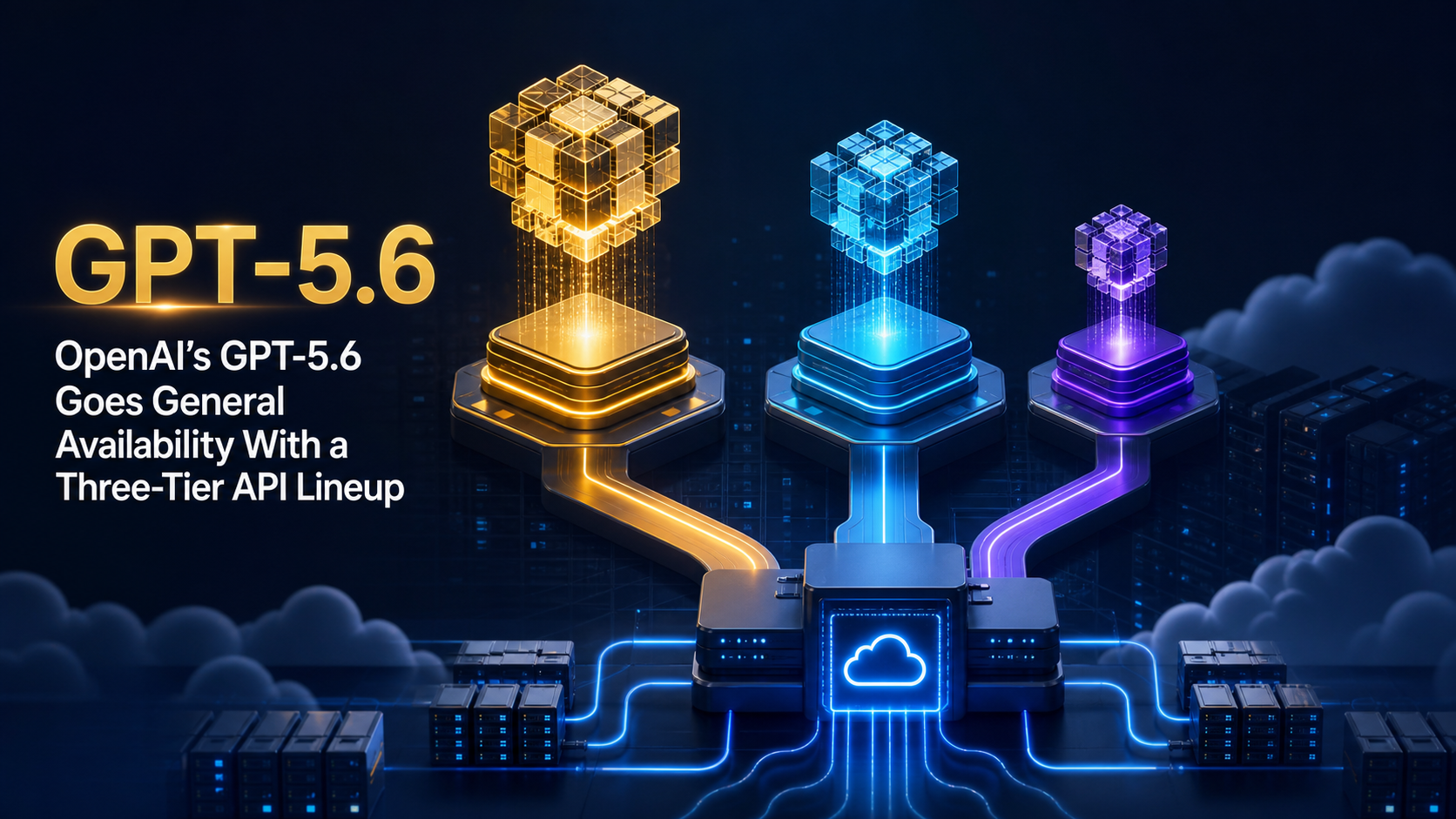

NEW DELHI, July 12, 2026, 12:05 p.m. IST — OpenAI has moved its GPT‑5.6 family into general availability across ChatGPT, Codex and its API, giving developers three production tiers and adding new controls for multi-agent execution, tool orchestration and prompt caching.
The rollout matters to platform and DevOps teams because it is less a single-model upgrade than a new deployment menu. GPT‑5.6 Sol targets the hardest reasoning and agentic workloads, Terra is positioned as the balanced tier, and Luna is intended for latency- and cost-sensitive traffic. Microsoft has also listed GPT‑5.6 Sol in its Foundry model catalog, widening the enterprise deployment path beyond OpenAI’s own API.
What OpenAI confirmed
OpenAI said the three models became available globally on July 9 after a limited preview. In the API, Sol is priced at $5 per million input tokens and $30 per million output tokens; Terra at $2.50 and $15; and Luna at $1 and $6. Those list prices do not by themselves establish the cheapest model for a workload because retries, reasoning effort, tool calls and output length can dominate total cost.
The company also introduced more predictable prompt caching. Cache writes for GPT‑5.6 and later models are billed at 1.25 times the uncached input rate, while cache reads retain a 90% discount. OpenAI says explicit cache breakpoints and a 30-minute minimum cache life are supported. Teams with long, repeated system prompts should measure the full write-read pattern rather than comparing only headline token rates.

Two agent features are especially relevant for engineering teams. Programmatic Tool Calling in the Responses API lets a model coordinate tools and intermediate results through in-memory programs, which OpenAI says is compatible with Zero Data Retention. A multi-agent capability, initially in beta, can run concurrent subagents and combine their work within one request.
Microsoft Foundry adds a managed deployment route
Microsoft’s Foundry catalog lists GPT‑5.6 Sol as an Azure OpenAI model, versioned July 9. Microsoft describes the offering as directly managed through Azure with unified billing, governance and provisioned-throughput portability. Availability can still vary by subscription and region, so engineering teams should confirm quotas, data-zone requirements and feature parity before committing a migration.
The Microsoft listing independently confirms that GPT‑5.6 is moving into managed enterprise channels. It does not prove that latency, caching behavior or every API feature will match OpenAI’s endpoint. Platform teams should treat providers as separate runtime targets and maintain provider-specific performance baselines.
Benchmarks are a starting point, not a release gate
OpenAI reports gains across coding, computer use and cybersecurity, including a 64.6% result for Sol on SWE-Bench Pro and 88.8% on Terminal-Bench 2.1. It also reports that Sol reached 73.5% on ExploitBench, compared with 47.9% for GPT‑5.5 under a comparable output-token budget. These are vendor-published results and should not be read as guarantees for private repositories, internal runbooks or production incident work.
The company says GPT‑5.6 did not cross its “Critical” capability threshold in biology or cybersecurity, while acknowledging stronger capability in both areas. That combination raises the operational stakes: a model that can find and patch more vulnerabilities may help defenders, but it also requires tighter tool permissions, audit trails and containment when connected to live systems.

What developers and platform teams should do now
Teams should avoid replacing an existing default model across all traffic. A safer pattern is to build an evaluation set from real work: failed CI investigations, infrastructure pull requests, log-analysis cases, support escalations and security triage. Compare quality, time to completion, tool-call count, token use and failure modes for all three tiers.
Route only the tasks that benefit from higher capability to Sol, keep routine agent work on Terra where it meets the quality bar, and test Luna for high-volume classification, extraction or short tool-use flows. Put model choice behind configuration or a routing layer so teams can change tiers without rewriting application logic.
For agents with repository, shell or cloud access, preserve least-privilege credentials, human approval for destructive actions, bounded execution time and complete traces. The multi-agent beta can increase throughput, but parallel execution also expands concurrency, rate-limit and blast-radius concerns. Capacity tests should cover fan-out behavior rather than single-request averages.
GravityDevOps readers planning production adoption can use the existing guides to LLMOps, retrieval-augmented generation, prompt engineering for developers and CI/CD tooling as implementation context.
What remains uncertain
Independent evidence about long-running production reliability is still limited because broad access is only days old. Real-world latency under load, regional capacity, cache economics and the operational behavior of the multi-agent beta will need observation. OpenAI’s benchmark and early-customer figures are useful signals, but buyer evaluations should decide whether the new family improves a specific workload.
Sources
This report draws on OpenAI’s GPT‑5.6 release announcement, the OpenAI model release notes, Microsoft’s GPT‑5.6 Sol Foundry catalog entry, and Axios reporting on the transition from limited preview to public rollout.


