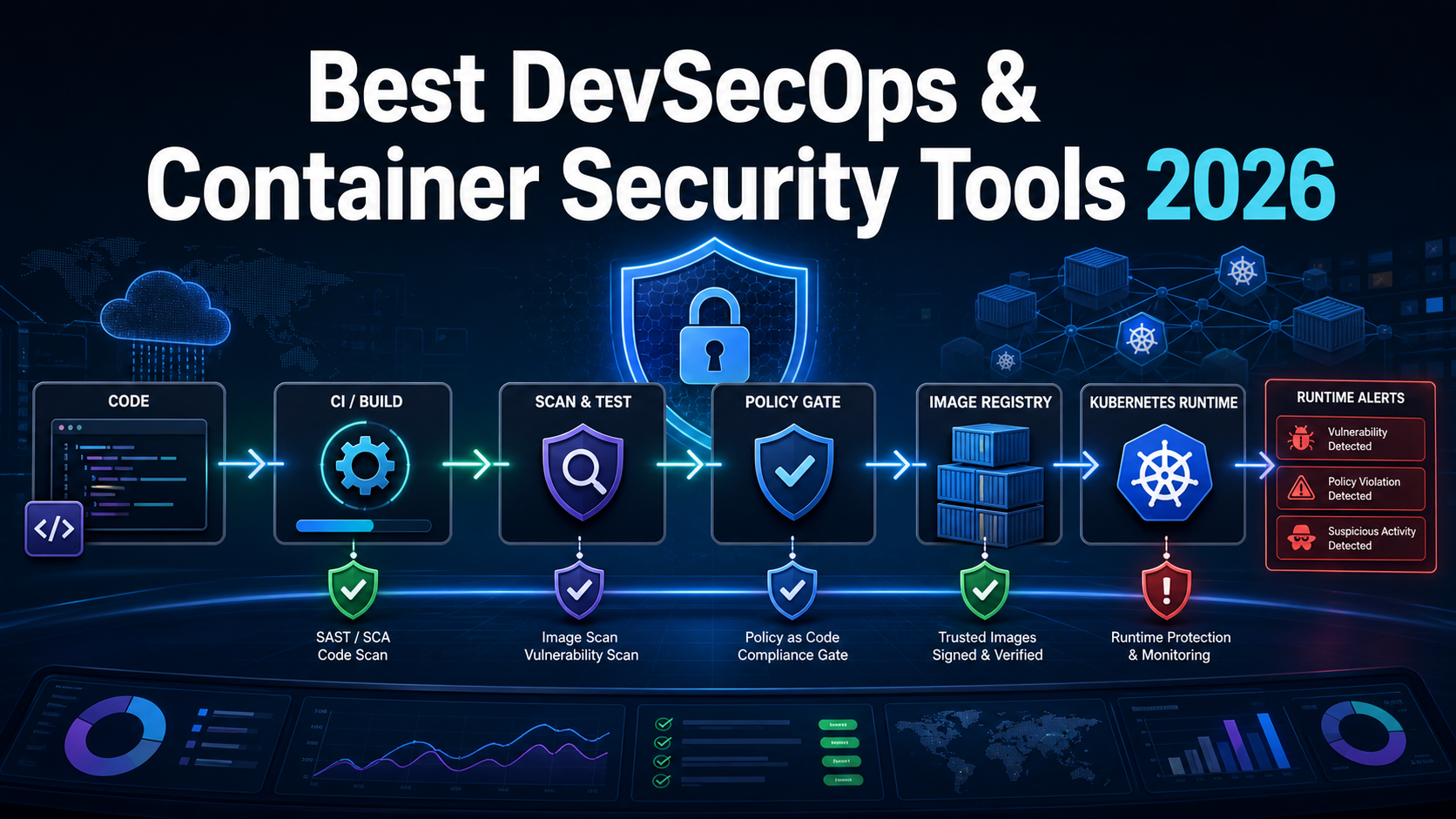

Quick Answer: The best DevSecOps and container security tool in 2026 depends on where your risk is highest. Use Trivy when you need a fast open-source scanner for containers, repositories, IaC and Kubernetes checks. Use Falco when runtime threat detection is the gap. Use Kyverno or OPA Gatekeeper for Kubernetes policy enforcement. Choose a commercial CNAPP or container security platform such as Wiz, Aqua, Sysdig, Prisma Cloud, Snyk, Docker Scout, Anchore, Orca Security, CrowdStrike Falcon Cloud Security, or Microsoft Defender for Cloud when you need broader coverage, prioritization, dashboards, compliance reporting and enterprise support.
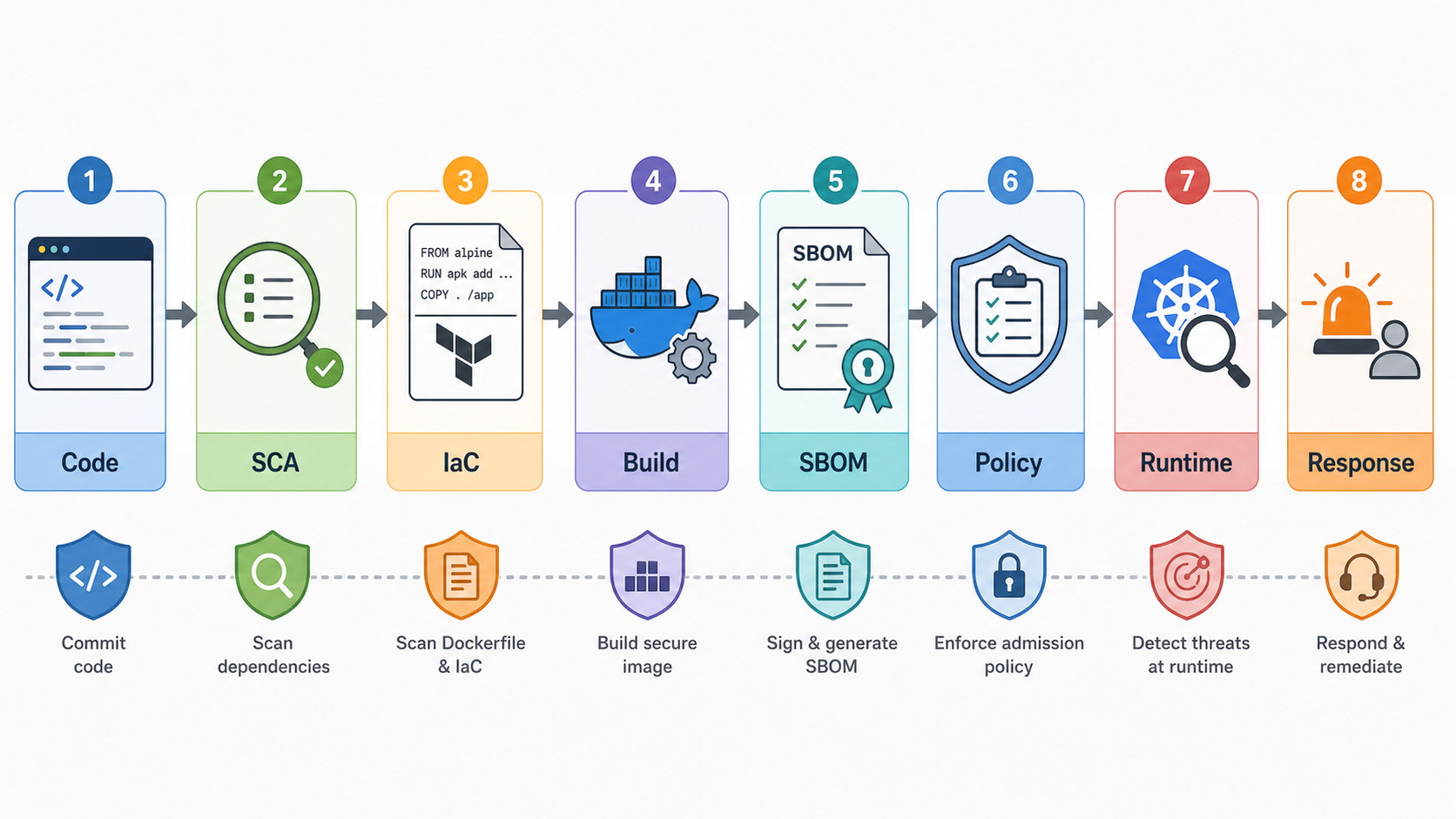
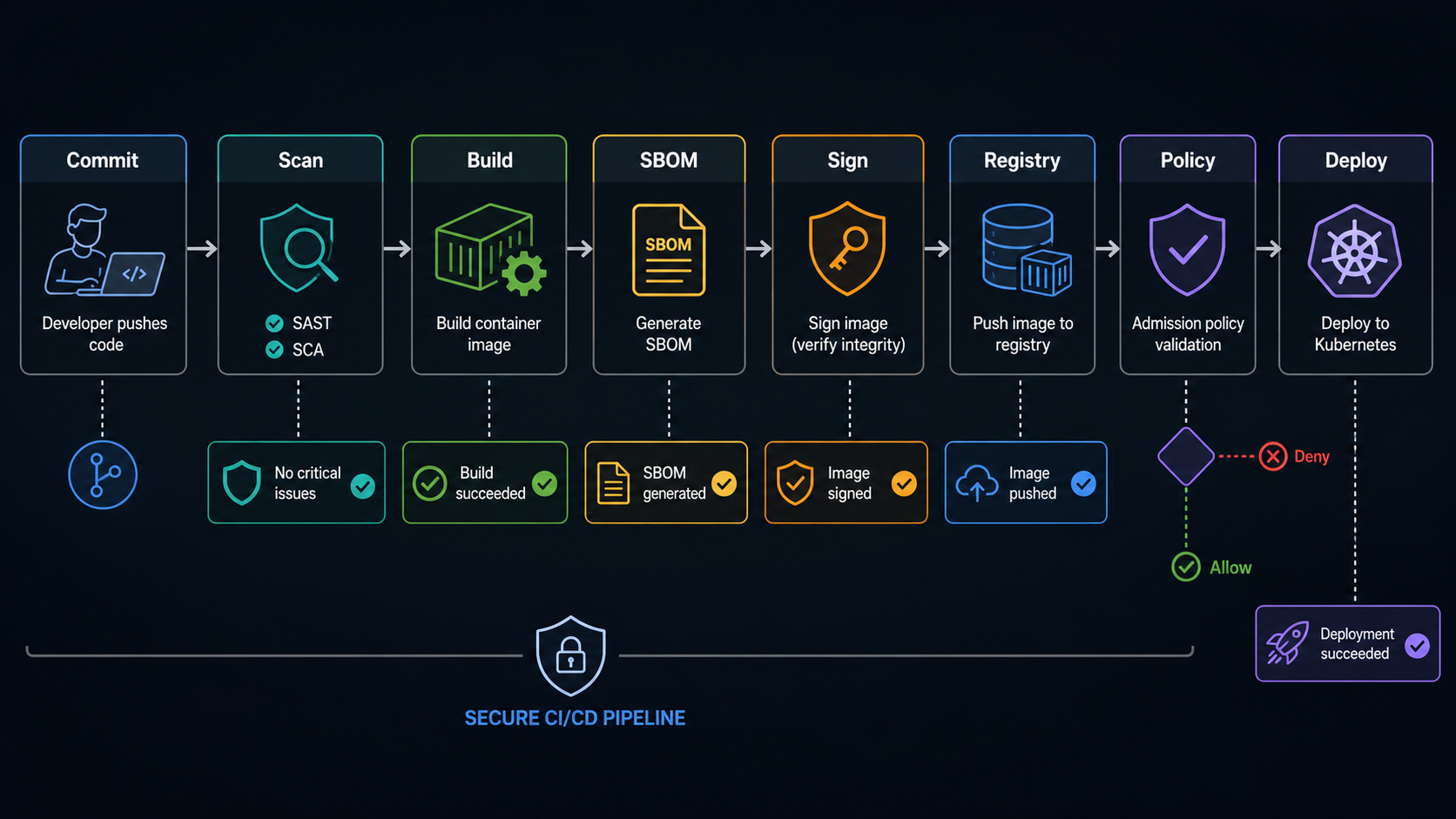
Container security has moved beyond basic image scanning. Modern teams need controls across the whole software delivery path: code, dependencies, Dockerfiles, infrastructure-as-code, image registries, Kubernetes admission, runtime behavior and incident response. Gartner describes CNAPPs as integrated security and compliance capabilities that cover cloud-native infrastructure and applications from code creation to production runtime. That definition matters because many buying decisions in 2026 are no longer about a single scanner; they are about whether your team needs one focused tool or a platform that can connect build-time risk to production exposure.
This guide compares the strongest DevSecOps and container security tools for practical use in 2026. It is written for platform engineers, DevOps teams, SREs, AppSec teams and security leaders who need a shortlist, not a vendor brochure.
What Counts as a DevSecOps Container Security Tool?
A DevSecOps container security tool helps you prevent, detect or respond to security risk in containerized applications. The important distinction is where the tool operates.
- Code and dependency security: SCA, SAST, secret scanning and license checks before an image is built.
- Container image scanning: CVE, malware, misconfiguration and exposed secret checks for container images and registries.
- Supply chain security: SBOM generation, image signing, provenance, trusted base images and artifact verification.
- Kubernetes policy: admission control, Pod Security Standards, network policy, image verification and configuration guardrails.
- Runtime security: abnormal process, file, network, privilege and Kubernetes API behavior detection after deployment.
- CNAPP/CWPP coverage: broader cloud workload, container, serverless, identity, posture and compliance coverage in one platform.
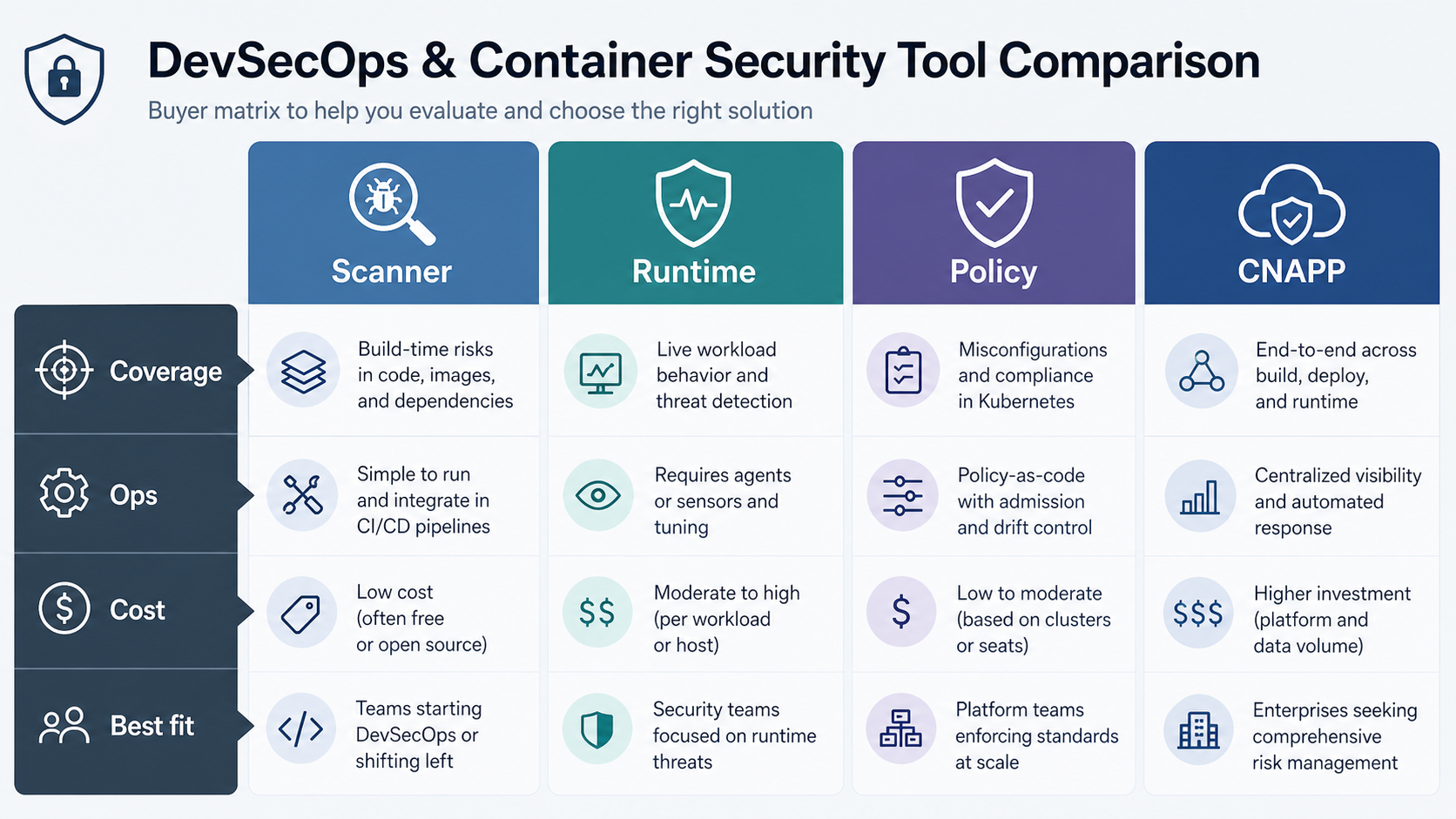
A small team can start with Trivy plus a policy engine and get real protection quickly. A regulated enterprise may need a commercial platform that correlates code, image, cloud account, Kubernetes cluster and runtime context. Both approaches are valid; the wrong choice is buying a broad platform before you know which risks you actually need to manage.
Best DevSecOps and Container Security Tools in 2026
| Tool | Best For | Strengths | Caveats | Typical Buyer |
|---|---|---|---|---|
| Trivy | Open-source scanning | Images, repos, filesystems, IaC, Kubernetes, SBOM and secrets | Needs process around triage and ownership | DevOps, platform and AppSec teams |
| Snyk | Developer-first security | Strong developer workflow, dependency and container scanning | Costs can scale with usage and seats | Engineering-led organizations |
| Aqua Security | Full container and Kubernetes security | Deep runtime, image, Kubernetes and supply chain coverage | Enterprise platform complexity | Security and platform teams |
| Sysdig Secure | Runtime security and cloud detection | Runtime context, Kubernetes visibility and Falco heritage | Requires tuning and operational ownership | Cloud security and SRE teams |
| Wiz | Agentless CNAPP visibility | Cloud graph, exposure context and broad CNAPP adoption | Runtime depth may require architecture review | Cloud security programs |
| Prisma Cloud / Cortex Cloud | Enterprise CNAPP | Broad cloud, workload, compliance and policy coverage | Licensing and module structure need careful review | Large enterprises |
| Falco | Open-source runtime threat detection | Real-time detection across hosts, containers and Kubernetes | Alerts need rules, routing and response playbooks | Platform and detection teams |
| Kyverno | Kubernetes-native policy as code | YAML/CEL policies, admission control, mutation and validation | Kubernetes-focused; not a scanner by itself | Kubernetes platform teams |
| OPA Gatekeeper | Flexible policy enforcement | Powerful Rego-based policy model and broad OPA ecosystem | Higher learning curve than YAML-native policy | Teams already using OPA/Rego |
| Docker Scout | Docker-native image insights | Convenient for Docker workflows and image remediation hints | Best when your workflow already centers on Docker tooling | Developers and smaller teams |
| Anchore Enterprise / Grype | SBOM and image compliance | Good SBOM, policy and compliance use cases | Commercial features matter for enterprise workflow | Compliance-heavy teams |
| Orca Security | Agentless cloud workload protection | Cloud workload visibility and prioritization | Validate container runtime requirements during POC | Cloud security teams |
| CrowdStrike Falcon Cloud Security | Cloud workload and threat operations | Threat detection, cloud posture and security operations alignment | Best fit depends on existing Falcon footprint | Security operations teams |
| Microsoft Defender for Cloud | Azure-first cloud security | Native Azure integration with multicloud/container capabilities | Non-Azure depth should be tested in your environment | Azure-heavy organizations |
1. Trivy
Trivy is usually the best first container security tool for teams that want practical coverage without a long procurement cycle. The official project describes it as an all-in-one scanner for vulnerabilities and misconfigurations across code repositories, binary artifacts, container images and Kubernetes clusters. It is open source under Apache-2.0, easy to run in CI and broad enough for most starting DevSecOps programs.
Best use case: add fast image, dependency, IaC and secret scanning to CI/CD. For example, a GitHub Actions job can scan the Docker image before pushing it to a registry:
trivy image --severity HIGH,CRITICAL --exit-code 1 myapp:2026.07.12
trivy fs --scanners vuln,secret,misconfig .
trivy config ./k8s
Pros: fast adoption, open source, broad target support, useful for developers and platform teams. Cons: it will not automatically solve ownership, exception handling or runtime response. You still need a process for who fixes vulnerabilities and how exceptions expire.
2. Snyk
Snyk is a strong choice when the security program is developer-led. It fits teams that want dependency, container, IaC and code findings close to pull requests and developer workflows. The main advantage is usability: developers can see what changed, why it matters and how to fix it without waiting for a weekly security report.
Best use case: engineering organizations that want security feedback inside pull requests, IDEs and CI. Pricing caveat: commercial SCA and container scanning platforms often price by seats, projects, tests, repositories or usage bands. Confirm how monorepos, ephemeral services and CI scans count before committing.
3. Aqua Security
Aqua is one of the most mature names in container and Kubernetes security. It is worth shortlisting when you need deeper controls across image assurance, runtime protection, Kubernetes posture, secrets, malware detection, vulnerability management and compliance. Aqua also sponsors Trivy, which matters for teams that want a path from open-source scanning to enterprise workflows.
Best use case: regulated Kubernetes environments that need full lifecycle controls. Pros: strong cloud-native focus and runtime depth. Cons: like most enterprise platforms, it requires architecture, rollout planning and ownership across security and platform teams.
4. Sysdig Secure
Sysdig Secure is a strong option for teams that care about runtime context. It is closely associated with Falco, the CNCF graduated runtime security project. If your biggest gap is seeing what workloads actually do after deployment, Sysdig deserves a serious POC.
Best use case: Kubernetes runtime threat detection, cloud workload visibility and response. Caveat: runtime security only works when alerts are connected to ownership, severity, paging rules and response playbooks. Otherwise, it becomes another noisy dashboard.
5. Wiz
Wiz is popular with cloud security teams because it gives broad agentless cloud visibility and prioritization. It is often evaluated as a CNAPP rather than a narrow container scanner. That makes it useful when container risk needs to be understood alongside cloud exposure, identity paths, Kubernetes posture and data risk.
Best use case: cloud security teams that need to prioritize which container or Kubernetes issues are truly exposed. Caveat: evaluate runtime and CI/CD requirements carefully. Agentless visibility is valuable, but some runtime controls may require additional deployment patterns or integrations.
6. Prisma Cloud / Cortex Cloud
Prisma Cloud, now commonly discussed in Palo Alto Networks’ broader Cortex Cloud direction, is a heavyweight enterprise choice. It can make sense when the organization already uses Palo Alto security products or wants broad CNAPP, cloud posture, workload and compliance coverage.
Best use case: large enterprises standardizing cloud-native security across many teams and cloud accounts. Pricing and licensing caveat: understand which modules you are buying, how workloads are counted and whether container security is included in the package you expect.
7. Falco
Falco is the best-known open-source runtime security tool for cloud-native environments. The project describes itself as runtime security across hosts, containers, Kubernetes and cloud environments, using kernel events and plugins to detect abnormal behavior, threats and compliance violations in real time.
Best use case: detect behavior that scanners cannot see, such as a shell spawned in a container, unexpected file writes, suspicious network activity or unusual Kubernetes API behavior. Pros: open source, CNCF graduated, eBPF-powered, deployable with Helm. Cons: rules require tuning, and alert routing must be integrated with your SIEM, Slack, PagerDuty or incident workflow.
8. Kyverno
Kyverno is a Kubernetes-native policy engine that uses familiar YAML and CEL-based policies. The CNCF project page notes that Kyverno moved to Graduated maturity on March 16, 2026, which strengthens its case for platform teams standardizing Kubernetes policy as code.
Best use case: enforce standards at admission time: no privileged containers, required resource limits, signed images only, approved registries, required labels and namespace guardrails. Kyverno is also approachable for teams that do not want to introduce Rego immediately.
apiVersion: kyverno.io/v1
kind: ClusterPolicy
metadata:
  name: require-non-root
spec:
  validationFailureAction: Enforce
  rules:
  - name: containers-must-run-as-non-root
    match:
      any:
      - resources:
          kinds:
          - Pod
    validate:
      message: "Containers must run as non-root."
      pattern:
        spec:
          securityContext:
            runAsNonRoot: true
9. OPA Gatekeeper
OPA Gatekeeper remains a strong policy choice when your organization already uses Open Policy Agent or wants Rego’s flexibility. It is especially useful when policy logic must apply beyond Kubernetes or when platform teams already have Rego expertise.
Best use case: complex policy-as-code programs with reusable policy libraries. Caveat: Rego is powerful, but it has a learning curve. For teams that want simpler Kubernetes-native policy, Kyverno may be faster to adopt.
10. Docker Scout
Docker Scout is useful for teams already using Docker Desktop, Docker Hub and Docker-native workflows. It helps developers understand vulnerabilities in images, base image updates and remediation paths without leaving the Docker ecosystem.
Best use case: smaller teams and developer workflows centered on Docker. Caveat: if you run a multi-cloud Kubernetes platform with many registries, evaluate whether Docker Scout is enough by itself or whether it should complement broader platform controls.
11. Anchore Enterprise and Grype
Anchore is strong for image analysis, SBOM workflows and compliance-driven container programs. Grype, Anchore’s open-source vulnerability scanner, is often used alongside Syft for SBOM generation. This combination is practical when you want transparent open-source tooling and a commercial upgrade path.
Best use case: SBOM-first security programs and compliance reporting. Caveat: as with Trivy, open-source scanning needs triage, ownership and policy decisions around what blocks a release.
12. Orca Security, CrowdStrike Falcon Cloud Security and Microsoft Defender for Cloud
These platforms belong on the shortlist when container security is part of a broader cloud workload protection or CNAPP initiative. Orca is known for agentless cloud workload context. CrowdStrike fits organizations that want cloud security tied to threat operations. Microsoft Defender for Cloud is a natural candidate for Azure-heavy organizations that want native integration and centralized cloud security posture.
Best use case: cloud security teams that want container risk connected to cloud accounts, identity, network exposure, data sensitivity and runtime signals. Caveat: do not assume broad CNAPP automatically means best container runtime depth. Validate container-specific coverage in your POC.
Open Source Stack vs Commercial Platform
| Approach | Use When | Pros | Trade-offs |
|---|---|---|---|
| Open-source stack: Trivy + Kyverno + Falco + Cosign | You have platform engineering capacity and want control | Low license cost, transparent, composable, strong cloud-native community | Requires integration, dashboards, tuning, exception workflow and ownership |
| Developer-first commercial: Snyk, Docker Scout, Anchore Enterprise | You want security inside developer and CI workflows | Faster adoption, better remediation UX, vendor support | May not cover all runtime or cloud exposure needs |
| Enterprise container platform: Aqua, Sysdig | You need deeper Kubernetes/runtime controls | Stronger container specialization, runtime and compliance capabilities | Rollout complexity and licensing require careful planning |
| CNAPP: Wiz, Prisma/Cortex, Orca, CrowdStrike, Defender for Cloud | You need cloud-wide risk context, posture and governance | Broad visibility, prioritization and executive reporting | Container-specific details vary; POC is mandatory |
How to Choose the Right Tool
1. Start With the Risk You Cannot See Today
If you do not scan images before deployment, start with Trivy, Grype, Snyk or Docker Scout. If you already scan but cannot control what enters Kubernetes, add Kyverno or Gatekeeper. If you have no runtime visibility, evaluate Falco, Sysdig, Aqua or a CNAPP with runtime coverage.
2. Measure Signal, Not Finding Count
A tool that finds 20,000 CVEs but cannot identify the exposed, reachable and owned ones may slow the team down. During a POC, measure how quickly the tool answers these questions:
- Which production images contain critical vulnerabilities?
- Which findings are reachable or exposed?
- Who owns the service?
- Which base image or dependency update fixes the issue?
- Can we create a temporary exception with an expiry date?
- Can the tool block only unacceptable risk instead of every theoretical issue?
3. Validate CI/CD Integration
The best security tool is weak if developers bypass it. For container security, test your actual CI system: GitHub Actions, GitLab CI, Jenkins, Argo CD, Azure DevOps or another platform. If your team is comparing CI/CD tools, see our related guide: Best CI/CD Tools in 2026 Compared.
4. Understand Pricing and Licensing
DevSecOps pricing can be confusing because vendors count different things. Before signing, ask how the product handles:
- Developer seats vs security/admin seats
- Repositories, projects, applications or services
- Container image scans and registry rescans
- Kubernetes clusters, nodes, workloads, hosts or cloud accounts
- CI/CD scan volume and API limits
- Runtime agents, sensors or agentless snapshots
- Data retention, compliance reports and premium integrations
For revenue-sensitive buying decisions, model the cost against your actual environment: number of repos, images per day, clusters, cloud accounts and developers. A platform that looks expensive may save operational time, but a per-workload model can also surprise fast-growing teams.
Recommended Tool Combinations
For a Small Startup
Start with Trivy in CI, Docker Scout if the team already uses Docker heavily, and Kyverno for simple Kubernetes admission policies. Add Falco only when someone owns alert response. This keeps cost low while creating real security gates.
For a Kubernetes Platform Team
Use Trivy or Snyk for pre-deploy scanning, Kyverno or Gatekeeper for admission control, Cosign for signing, and Falco or Sysdig for runtime detection. If you operate many clusters, compare Aqua, Sysdig and Wiz for centralized visibility.
For a Regulated Enterprise
Shortlist Aqua, Sysdig, Prisma/Cortex, Wiz, Orca, CrowdStrike and Microsoft Defender for Cloud. Require proof of RBAC, audit evidence, policy exceptions, SIEM integration, ticketing integration, cloud account coverage and workload-level reporting. Do not buy on dashboard screenshots; run the tool against real clusters and real pipelines.
Beginner Tutorial: Add Container Scanning to CI
If you are just starting, add one blocking scan and one reporting scan. The blocking scan should stop only critical issues at first. The reporting scan can collect medium and high findings without breaking every build.
name: container-security

on:
  pull_request:
  push:
    branches: [main]

jobs:
  scan:
    runs-on: ubuntu-latest
    steps:
      - uses: actions/checkout@v4
      - name: Build image
        run: docker build -t myapp:${{ github.sha }} .
      - name: Scan image with Trivy
        uses: aquasecurity/trivy-action@master
        with:
          image-ref: myapp:${{ github.sha }}
          severity: CRITICAL,HIGH
          exit-code: "1"
          ignore-unfixed: true
Common mistakes to avoid: blocking all medium findings on day one, ignoring base image updates, scanning only the final image but not Dockerfiles or Kubernetes manifests, allowing permanent exceptions and failing to assign findings to service owners.
Final Recommendation
For most teams in 2026, the best starting point is Trivy for scanning, Kyverno for Kubernetes policy and Falco for runtime detection. That open-source stack gives real coverage across build, deploy and runtime. If your organization needs enterprise dashboards, compliance evidence, prioritization, support and cloud-wide context, evaluate Aqua, Sysdig, Wiz, Prisma/Cortex, Snyk, Orca, CrowdStrike and Microsoft Defender for Cloud through a production-grade POC.
Do not ask “which tool has the longest feature list?” Ask “which tool reduces the most real risk for our delivery model?” A Kubernetes-heavy SaaS company, an Azure enterprise and a small Docker-based startup should not all buy the same stack.
Internal Link Suggestions
- Best CI/CD Tools in 2026 Compared for choosing the pipeline where scans and policy gates run.
- What Is Generative AI? A Beginner’s Guide for understanding AI-generated code risk and why secure review gates matter.
FAQ
What is the best container security tool in 2026?
Trivy is the best starting point for many teams because it is open source, practical and broad. Enterprises should also evaluate Aqua, Sysdig, Wiz, Prisma/Cortex, Snyk and Microsoft Defender for Cloud depending on runtime, CNAPP and compliance needs.
Is Trivy enough for container security?
Trivy is enough for initial scanning, but it is not a complete security program by itself. Add policy enforcement, image signing, exception management, runtime detection and incident response as your environment matures.
What is the difference between DevSecOps and container security?
DevSecOps is the broader practice of integrating security into software delivery. Container security is one part of that practice, focused on container images, registries, Kubernetes, runtime behavior and supply chain controls.
Should I choose Kyverno or OPA Gatekeeper?
Choose Kyverno if you want Kubernetes-native YAML/CEL policies and faster adoption by platform teams. Choose OPA Gatekeeper if your organization already uses Rego or needs a more general policy model across systems.
Do I need runtime security if I already scan images?
Yes, for production Kubernetes and high-risk workloads. Image scanning finds known issues before deployment, while runtime security detects behavior that appears only after the application is running.
What should a DevSecOps POC include?
A good POC should test CI integration, registry scanning, Kubernetes admission policy, runtime detection, ownership mapping, exception workflows, reporting, SIEM/ticketing integration and pricing against real repositories and clusters.


