
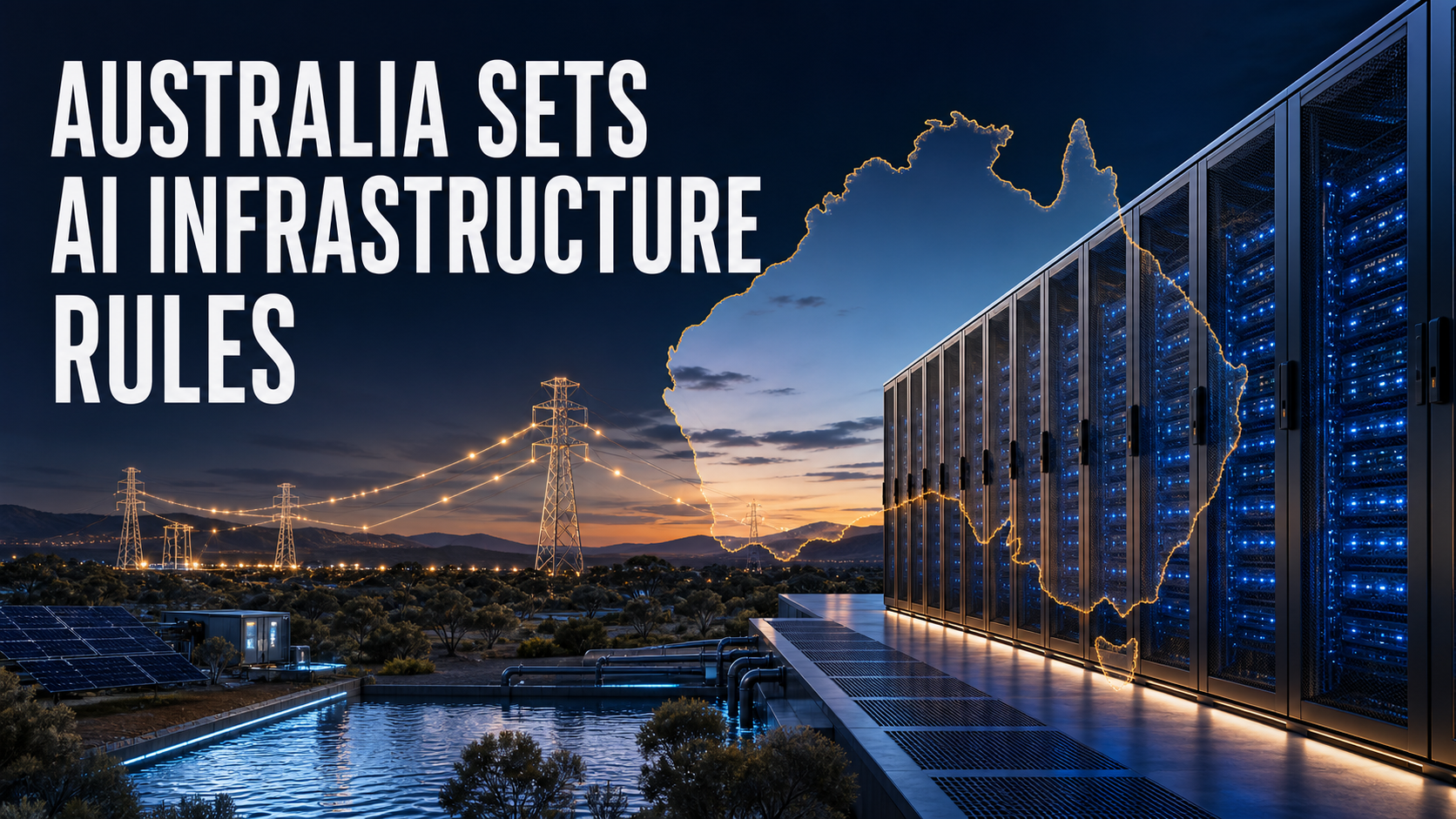

Australia plans national rules requiring large AI data centres to underwrite new power, cover grid costs and minimise water use, while a new Office of AI coordinates policy. The standards still need state agreement and legislation.
NEW DELHI, July 15, 2026, 6:31 p.m. IST — Australia has moved to put the physical costs of artificial intelligence infrastructure into law, announcing proposed national standards that would require large data centres to support new electricity supply, pay their share of grid connections and operate under tighter water-efficiency rules.
The Albanese government also established an Office of AI inside the Department of the Prime Minister and Cabinet, effective Wednesday, to coordinate implementation. It said the framework will protect Australian creative work from being used for AI training without the creator’s control.
The announcement matters beyond Australia because it treats AI governance as an infrastructure issue as well as a model-safety issue. For cloud providers, data-centre operators and platform teams, the proposal points toward a future in which compute capacity, energy sourcing, water use, workload flexibility and data sovereignty are reviewed together rather than in separate policy tracks.
What Australia confirmed
In a joint government announcement, Prime Minister Anthony Albanese and two industry ministers said the planned Australian Standards for AI will create clear rules for large data centres. The stated obligations include underwriting new power supply, paying the full share of connection costs, reducing power use when needed to support grid stability and operating as water-efficiently as possible.
The federal government said it will work with states and territories on appropriate locations for large facilities and consult local communities. National Cabinet is expected to consider the approach in August, with legislation planned for early 2027.
That timetable is important: the Office of AI exists now, but most of the announced operating requirements are proposals, not yet enforceable national law. The exact thresholds for a “large” data centre, reporting rules, penalties and verification methods have not been published.
From voluntary expectations to legal obligations
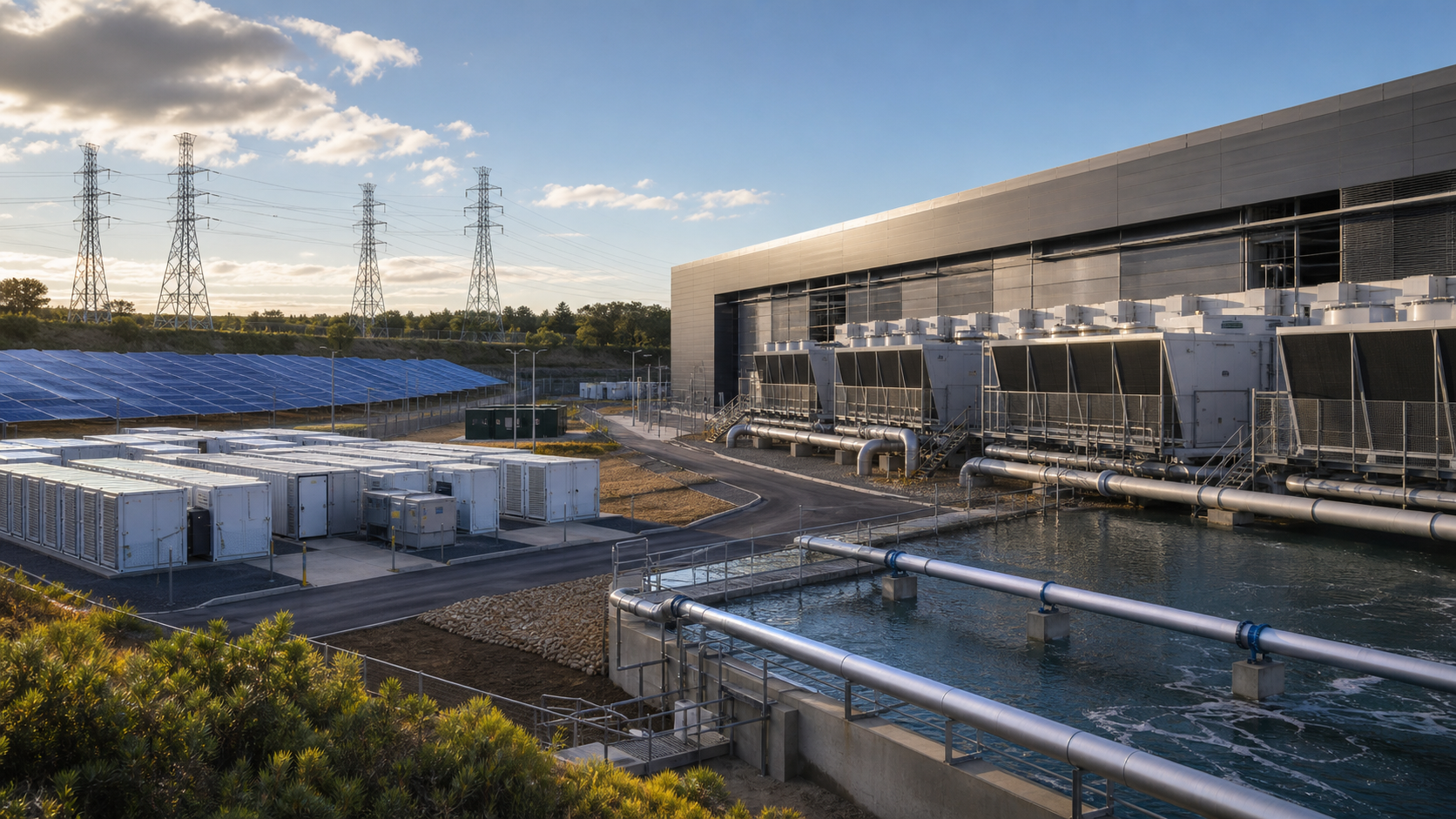
The proposal builds on data-centre expectations published in March. Those expectations call for new clean generation or storage, payment of transmission and distribution costs, efficient cooling, transparent water reporting, resilience planning and investment in local skills and research.
The March document applies to new or expanded hyperscale, colocation and large AI-compute facilities, while excluding small edge and on-site enterprise data centres. Wednesday’s announcement did not confirm whether that scope will carry into the legislation unchanged.
ABC News reported that the standards are intended to be consistent and mandatory, but also noted that the government has not yet released detailed AI-specific legislation, funding, workplace rules or consumer measures. The government says broader consumer-safety priorities will follow in the coming weeks.
What cloud and platform teams should watch
For engineers running workloads in Australia, there is no immediate application-level compliance change. The first effects are more likely to fall on hyperscalers, colocation providers, neoclouds and organisations planning large private AI clusters.
Even so, platform and FinOps teams should watch four areas as the standards take shape:
- Capacity and pricing: new generation, storage, grid connections and water infrastructure could become explicit inputs to region expansion and long-term compute pricing.
- Workload flexibility: the government wants large facilities to reduce demand when the grid needs support. Providers may respond with stronger incentives for interruptible training, batch inference and carbon-aware scheduling.
- Observability: auditable power, water and workload telemetry may become part of infrastructure assurance. Teams should expect more demand for traceable utilisation and efficiency data rather than marketing-level sustainability claims.
- Resilience and sovereignty: site approval, physical security, data location and supply continuity are being framed as national-interest questions. Multi-region design and provider portability remain useful risk controls.
The policy direction reinforces a point familiar to teams practising LLMOps: model quality is only one layer of a production AI system. Reliable operations also depend on capacity planning, observability, governance and cost control. Teams evaluating architectures such as retrieval-augmented generation should include infrastructure location and provider constraints in design reviews, especially for regulated data.
Copyright is part of the same framework
The government also said Australian writers, artists and journalists should retain control over whether and on what terms their work is used to train AI. Albanese said companies should not use Australian books, music, art or news without the creator’s control, including control of price and value.
The principle is clear, but the enforcement mechanism is not. The announcement did not publish licensing rules, exceptions or a new copyright bill. Developers building data-ingestion or training pipelines should therefore distinguish the confirmed policy position from future legal obligations and continue to record dataset provenance, licences, consent and deletion paths.
Balanced outlook
The framework could give operators one national approval path and clearer investment requirements. It could also raise project costs or slow poorly prepared proposals if energy, water and community-impact plans are incomplete. Whether it improves both infrastructure delivery and public confidence will depend on definitions, enforcement and coordination across Australia’s federal, state and territory governments.
For DevOps and cloud leaders, the practical signal is stronger than the immediate rule change: AI infrastructure is becoming a regulated system boundary. Architecture decisions may increasingly need to account for the electricity and water behind an endpoint, not only latency, price and model capability.
Sources: Australian government media release; Department of Industry data-centre expectations; ABC News; The Straits Times.


