

NEW DELHI, July 26, 2026, 1:20 PM IST — Fifty technology companies, research groups and investors have backed a joint call for U.S. policymakers to preserve access to open-weight artificial intelligence models, bringing normally competing cloud, model and infrastructure vendors into an unusually broad policy coalition.
The signatories to “Open Weights and American AI Leadership” now include OpenAI, Google, Nvidia, Microsoft, Meta, AMD, GitHub, Cloudflare, Cisco, IBM, Hugging Face and the Linux Foundation. The letter, dated July 24, asks policymakers to avoid broad restrictions that could limit the ability to download, inspect, modify and run model weights on infrastructure controlled by developers or their organizations.
The document is not a new law, technical standard or product launch. Its significance lies in the breadth of the current signatory list and the specific policy positions it puts on the record as governments weigh how to manage increasingly capable downloadable models. For developers, platform teams and cloud buyers, the outcome of that debate could affect model availability, self-hosting options, security testing and the economics of production AI.
A coalition spanning the AI stack
The live signatory list spans model developers, chipmakers, cloud and inference providers, security vendors, developer platforms and venture firms. Alongside the largest AI companies are Mistral, Cohere, AI21, Ollama, Nous Research, Fireworks AI, Baseten, Replit, ServiceNow, Palo Alto Networks, CrowdStrike, Mozilla, Palantir, Perplexity and Y Combinator.
That composition matters because open-weight models touch several layers of the production stack. Model developers distribute weights; chip and server vendors provide the compute; inference platforms package deployment; security teams test and monitor workloads; and application teams adapt models to business data and processes. The coalition is therefore broader than a model-lab campaign, even though its members have different commercial incentives.
The letter argues that open weights can let organizations match models to tasks and costs, reserve expensive frontier APIs for the hardest work, and run smaller specialized systems elsewhere. It also frames portability as a way to reduce lock-in by allowing organizations to keep control of their data, adaptations and deployment environment.
Those claims are consistent with the operational reasons many teams evaluate self-hosted models, but they should not be read as proof that open-weight deployments are always cheaper or safer. Total cost depends on utilization, hardware, serving efficiency, observability, staff expertise and the lifecycle cost of patching and evaluation. GravityDevOps’ guide to LLMOps covers the operational discipline needed after a model moves beyond experimentation.
Security is central to the argument—and the uncertainty
The coalition acknowledges a basic risk: once weights are released, the original developer cannot reliably recall them, and modified copies can be difficult to trace. It nevertheless argues that defenders need access to capable models for testing, simulation and incident response, and that broader scrutiny can help researchers discover weaknesses.
This is an advocacy position, not a settled safety conclusion. Open weights can improve transparency and enable on-premises analysis, but they also remove provider-side usage controls and can make downstream governance harder. Closed services create a different risk profile, including vendor concentration, opaque changes and dependency on a remote control plane. Security teams should evaluate those trade-offs per workload rather than treating either distribution model as inherently safe.
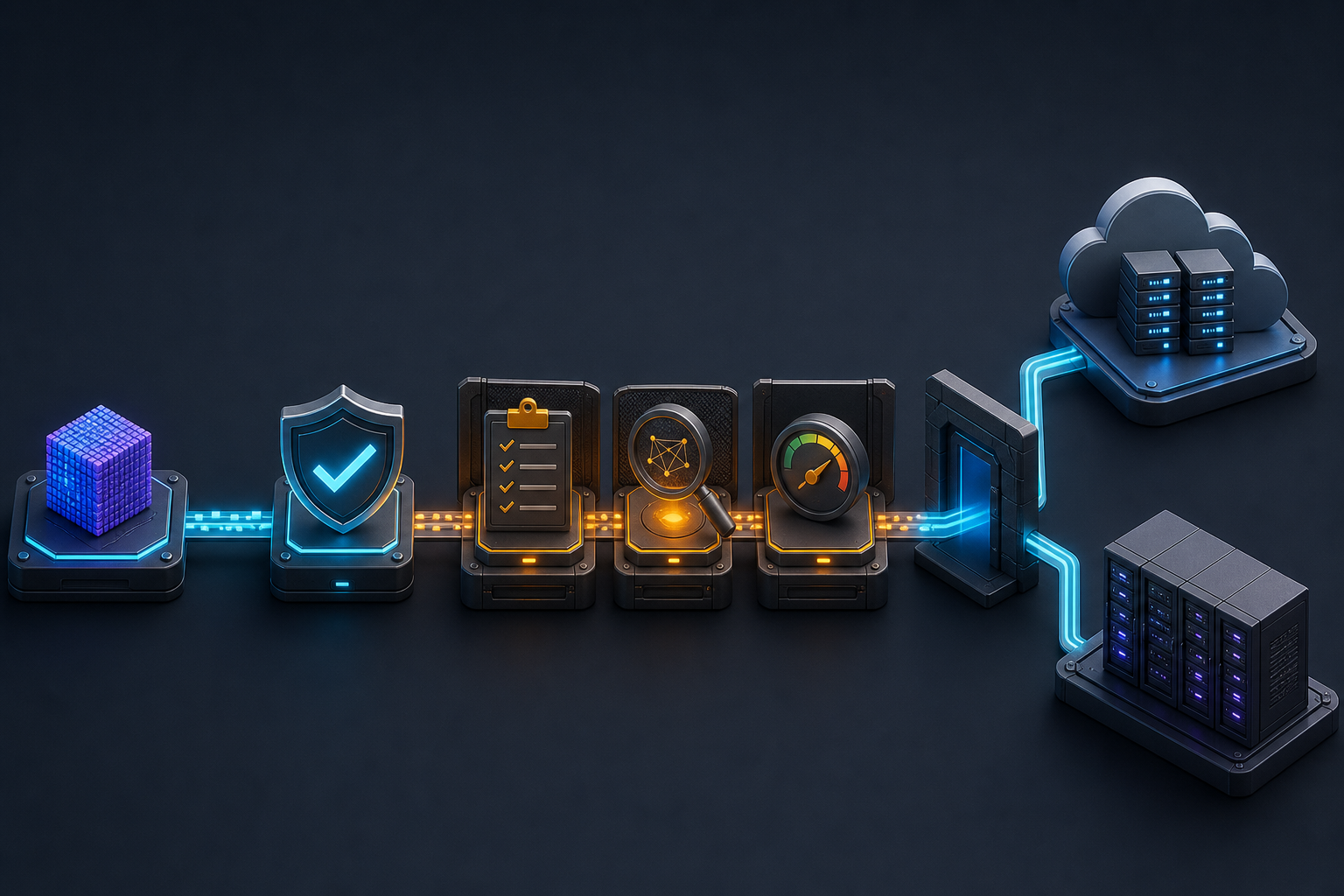
For platform engineering, that means model provenance and artifact control should resemble software supply-chain management. Teams need verified sources, immutable digests, license review, vulnerability and behavior evaluations, controlled promotion between environments, and a rollback plan. The model is only one dependency: tokenizers, runtimes, adapters, quantization files, containers and prompt or retrieval layers all expand the operational surface.
The letter draws a line around model distillation
The signatories also ask policymakers not to equate distillation with unlawful extraction. Distillation uses outputs from one model to train, improve or evaluate another. The letter describes it as a widely used development technique and argues that suspected theft from closed systems should be handled through targeted legal and commercial mechanisms instead of sweeping technical restrictions.
That distinction is likely to remain contested. Whether a particular training process is permitted can depend on contracts, licenses, access controls, jurisdiction and how data was obtained. The letter does not resolve those questions, and engineering teams should not treat industry support for distillation as legal clearance for a specific workflow.
For developers, the immediate practical rule is simpler: document the origin and permitted use of training and evaluation data, model outputs, adapters and derived artifacts. Procurement and legal review should happen before a model or dataset becomes embedded in a production pipeline, not after deployment.
What DevOps and cloud teams should watch
No immediate migration is required because the letter itself changes no product availability or compliance obligation. The near-term signal is strategic: major vendors are publicly supporting a mixed ecosystem in which hosted frontier APIs and downloadable models coexist.
Teams planning AI platforms should preserve that optionality. A practical architecture separates application logic from a single model endpoint, uses repeatable evaluations before routing traffic, and keeps observability consistent across hosted and self-managed inference. Retrieval quality, latency, failure behavior, data residency and unit economics should be measured with the same workload rather than compared through headline benchmarks alone. Readers building retrieval-backed systems can use GravityDevOps’ RAG overview for the surrounding application architecture.
Platform owners should also track whether policymakers translate the coalition’s proposals into concrete programs, such as shared evaluation infrastructure or expanded compute access for researchers and startups. Until then, the letter is best understood as a coordinated attempt to shape the rules, not evidence that restrictions have been withdrawn or that a new open-model policy has been adopted.
What remains unresolved
The coalition’s breadth does not erase the members’ competing interests. Chipmakers benefit when more organizations run models; cloud and inference providers benefit from serving them; model labs may want both distribution reach and protection against unauthorized extraction. Those incentives do not invalidate the arguments, but they are important context when evaluating the policy recommendations.
The core question for technical decision-makers is therefore not “open or closed” in the abstract. It is which mix delivers acceptable control, security, performance and cost for each workload—and whether teams can switch when policy, pricing or capability changes.
For now, the confirmed development is the coalition itself: 50 organizations have attached their names to a detailed defense of open-weight AI. The policy impact remains uncertain, but the alignment gives developers and enterprise buyers a clearer view of where much of the infrastructure industry wants the market to go.
Sources
The primary source is the July 24 joint statement, “Open Weights and American AI Leadership”, hosted by Microsoft, with the same three-page document available from Nvidia. Contemporary coverage from Tom’s Hardware documented the coalition’s initial 25-member list; the live primary document now shows 50 signatories.


