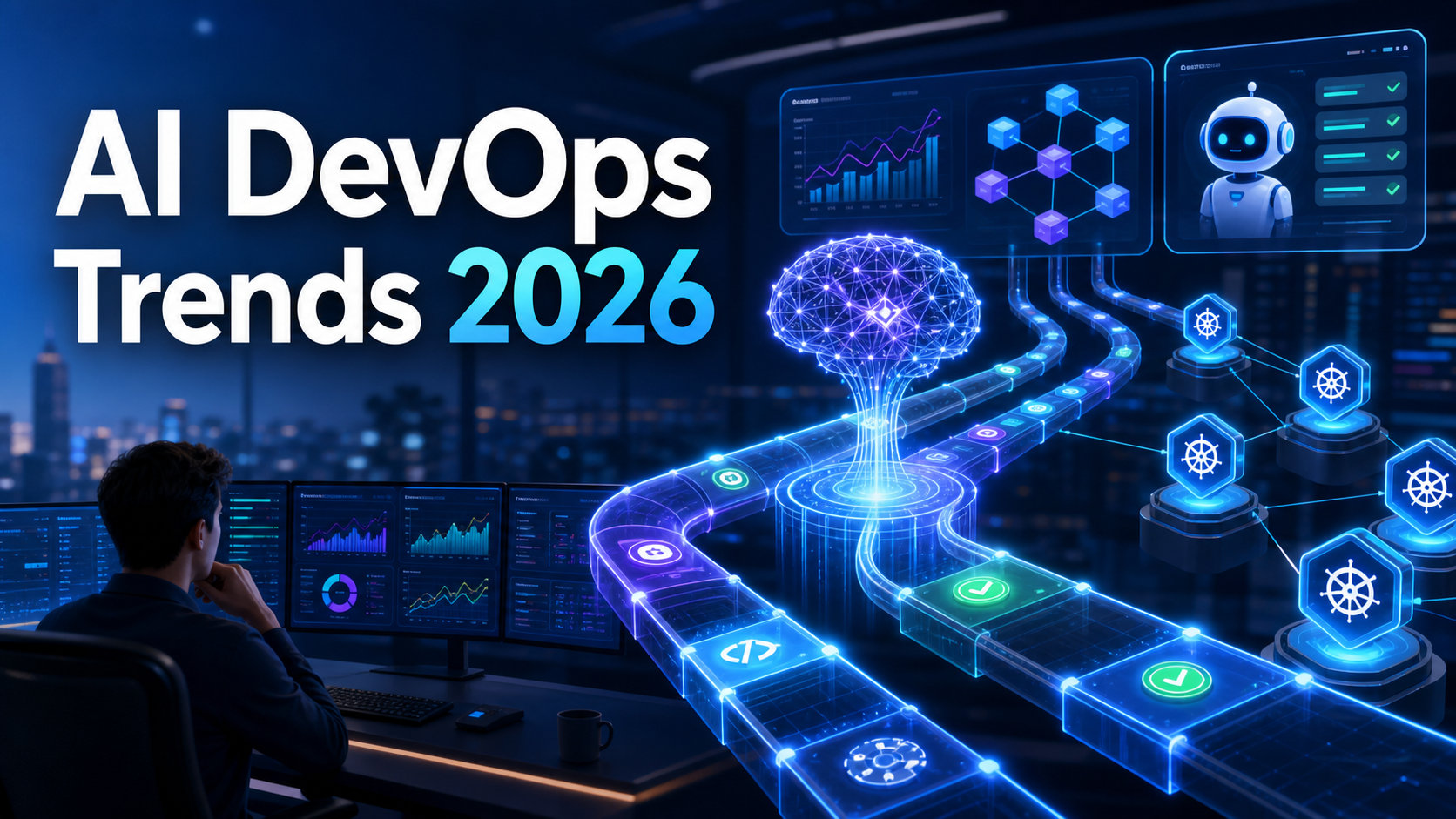

Quick Answer: Google Trends signals around AI coding tools, agentic AI, AIOps, OpenTelemetry, and DevOps automation point to one practical theme for 2026: teams are no longer asking whether AI belongs in DevOps, but where it can safely improve delivery, incident response, and platform workflows. The best opportunities are AI-assisted CI/CD, human-reviewed coding agents, AIOps for noisy operations data, platform engineering for repeatable AI workflows, and observability that feeds reliable feedback back into the pipeline.
AI and DevOps are moving from separate conversations into one operating model. Developers are using AI coding tools to draft changes, platform teams are building internal portals and golden paths, SREs are using machine learning to reduce alert noise, and security teams are trying to keep all of it auditable. A Google Trends-informed content scan reinforces that the demand is practical: people search for tools, definitions, examples, workflows, and safe implementation patterns more than abstract promises.
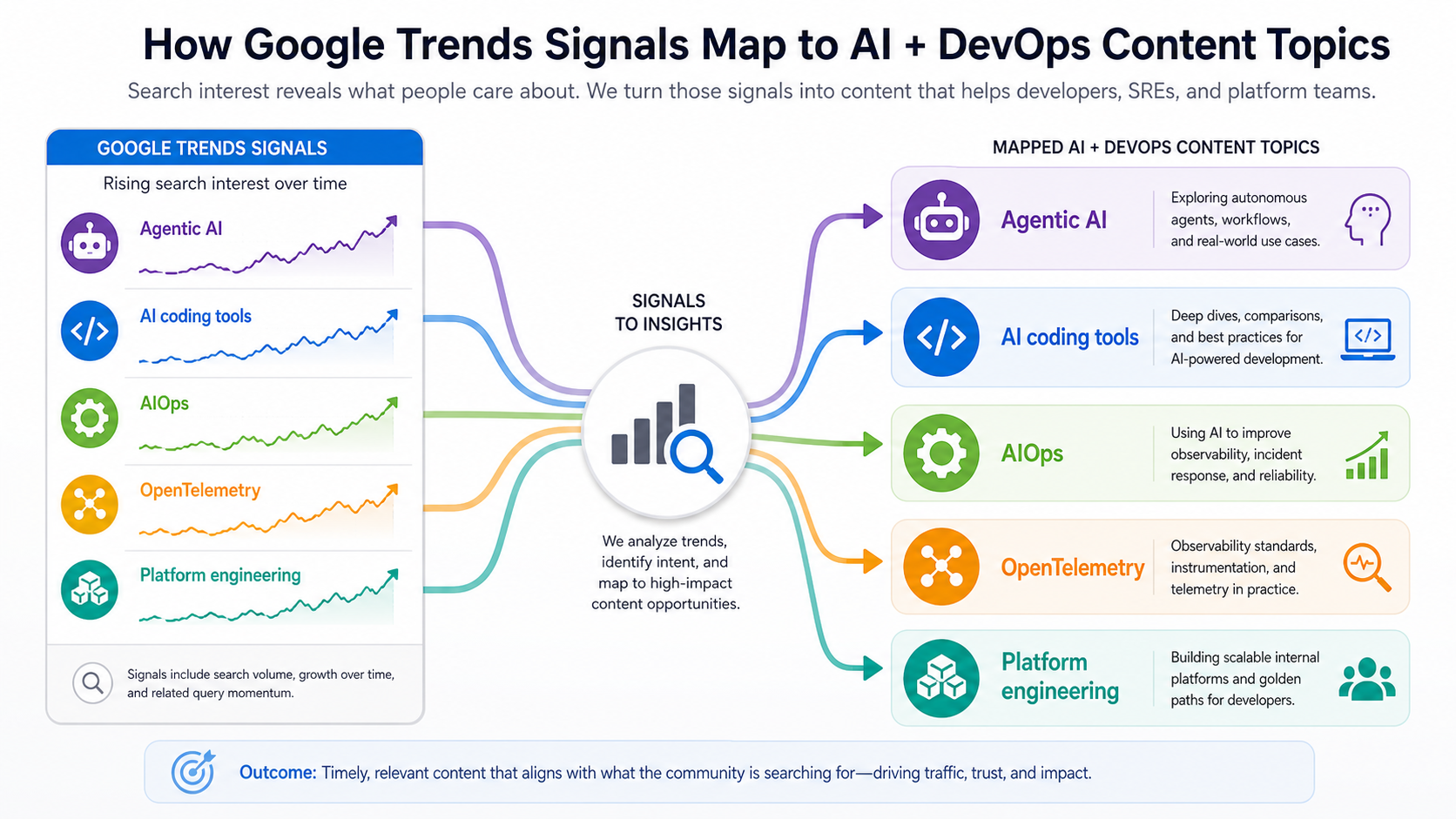
For this article, I used Google Trends and related-query research to compare AI + DevOps topics over the last 12 months in the United States. Direct trend data should be treated as directional rather than a market-size estimate because Google Trends normalizes interest on a 0-100 scale and can fluctuate by region, date range, and spelling. The useful signal is not that one keyword is permanently bigger than another. The useful signal is that developer intent clusters around agentic AI, AI coding tools, DevOps automation, observability, and platform engineering.
That aligns with broader industry evidence. Google Cloud’s AI Agent Trends 2026 report frames agentic workflows as a core enterprise pattern. DORA’s platform engineering guidance warns that AI amplifies existing engineering strengths and dysfunctions, which means weak delivery systems do not become strong just because a coding assistant writes code faster. CNCF also announced OpenTelemetry graduation in 2026, confirming that open observability standards are now central to modern cloud-native operations.
What Google Trends Suggests About AI and DevOps Demand
The strongest search intent is not a single phrase like “AI DevOps.” It is a set of adjacent searches that reveal what practitioners are trying to solve. In the query set I tested, “agentic AI” and “OpenTelemetry” showed stronger normalized interest than narrow phrases such as “AI CI/CD” or “DevOps automation.” Related queries for AI coding tools included “ai tools for coding,” “best coding ai tools,” “Cursor AI,” “Claude Code,” “GitHub Copilot,” and “Codex.” Related queries for agentic AI centered on “what is agentic ai,” “agentic ai tools,” “agentic ai systems,” and “agentic ai platforms.”
Top AI DevOps Topics to Watch in 2026
| Topic | Search Intent | Why It Matters for DevOps | Best Content Angle |
|---|---|---|---|
| Agentic AI for DevOps | Definitions, tools, examples | Agents can open PRs, inspect logs, update runbooks, and coordinate workflow steps. | Explain safe agent workflows with approval gates. |
| AI coding tools | Best tools, coding assistants, comparisons | Code generation affects PR quality, testing, review load, and CI failures. | Compare use cases, limits, review practices, and team policies. |
| AIOps | Incident automation, anomaly detection, alert reduction | Operations teams need faster root-cause analysis without blindly auto-remediating production. | Show alert correlation, SLO impact, and escalation design. |
| OpenTelemetry | Instrumentation, logs, traces, metrics | AI operations need clean telemetry before models can produce reliable incident insights. | Write hands-on instrumentation and collector tutorials. |
| Platform engineering | Internal developer platforms, golden paths | AI accelerates work only when teams have repeatable delivery paths. | Connect AI adoption to portals, templates, guardrails, and self-service. |
1. Agentic AI Will Enter DevOps Workflows Carefully
Agentic AI is attractive because DevOps work is full of connected steps: inspect a failing workflow, read the logs, identify the changed file, propose a fix, run tests, create a pull request, and notify the owner. That looks like a natural agent workflow. The problem is that DevOps changes also touch production systems, credentials, deployment policies, and customer reliability.
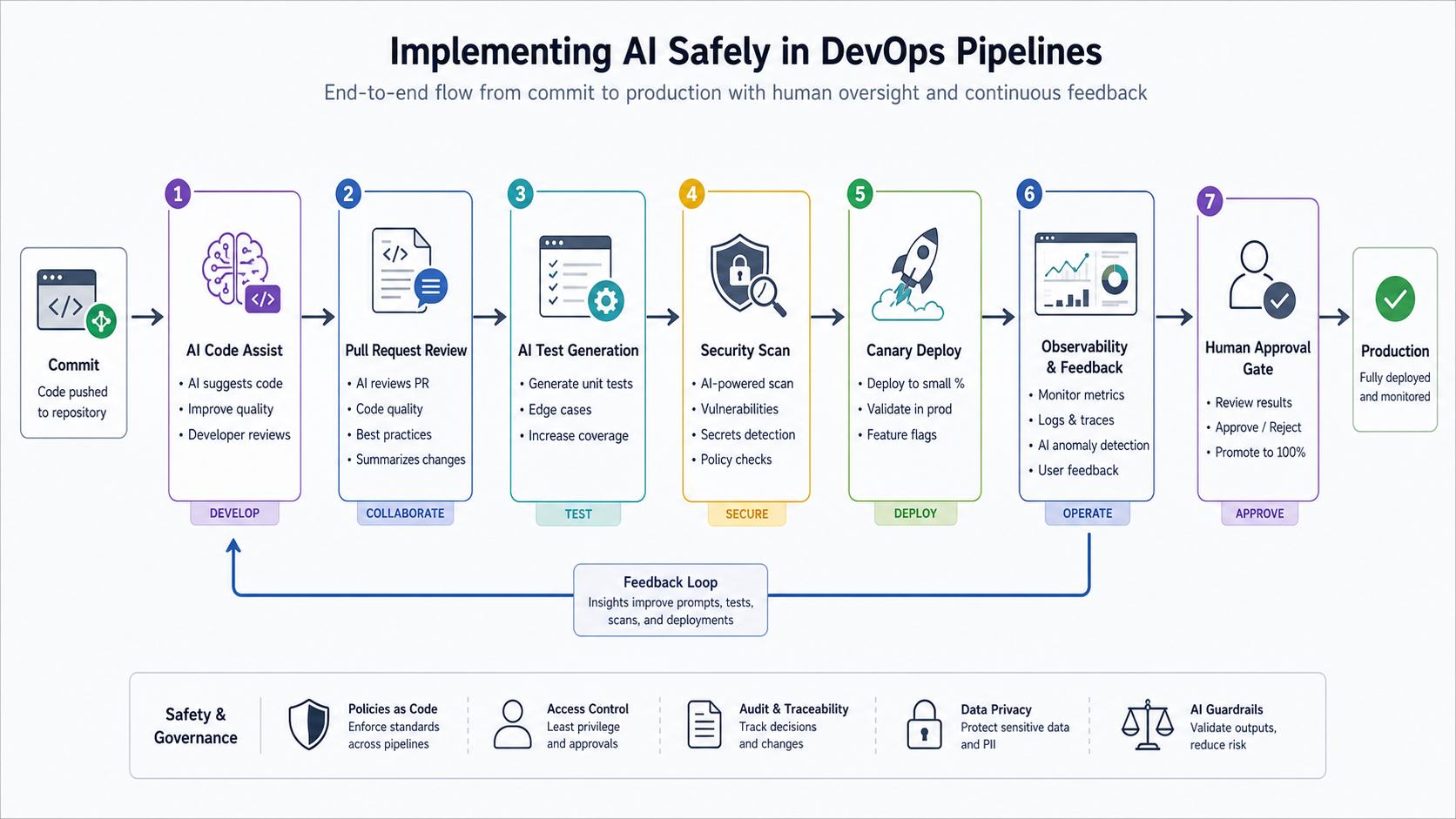
The practical pattern for 2026 is supervised automation. Let an agent gather context, draft a diagnosis, generate a patch, update a runbook, or prepare a rollback plan. Keep humans in control of production promotion, access changes, infrastructure deletion, and policy exceptions. This is especially important when agents modify CI/CD YAML, Kubernetes manifests, Terraform modules, secrets handling, or release permissions.
2. AI Coding Tools Need CI/CD Guardrails
AI coding assistants are already part of everyday development, but DevOps teams should measure them by delivery outcomes, not demo speed. The useful questions are simple: Do AI-assisted changes pass tests? Do they increase review burden? Do they introduce brittle pipeline scripts? Do they improve documentation? Do they reduce toil without hiding risk?
A strong team policy starts with normal engineering controls. Require small pull requests, clear test evidence, secret scanning, dependency review, and CODEOWNERS approval for infrastructure and pipeline files. Ask developers to label AI-assisted changes when useful for internal learning, especially in critical repositories. Avoid blanket bans unless your compliance environment requires them; uncontrolled shadow usage is harder to govern than clear rules.
Here is a simple CI policy idea for AI-assisted DevOps changes:
name: guarded-devops-change
on: [pull_request]
jobs:
  validate:
    runs-on: ubuntu-latest
    steps:
      - uses: actions/checkout@v4
      - name: Scan secrets
        run: gitleaks detect --source . --no-git
      - name: Validate Kubernetes manifests
        run: kubeconform -strict ./k8s
      - name: Validate Terraform
        run: terraform -chdir=infra validate
      - name: Require owner review for pipeline changes
        run: ./scripts/check-codeowners.sh .github/workflows infra k8s
The point is not that every repository needs these exact tools. The point is that AI-generated delivery changes need the same or stronger verification than human-written changes because they can look plausible while missing local context.
3. AIOps Is Most Useful When It Reduces Noise
AIOps often gets marketed as autonomous remediation, but the more reliable early win is noise reduction. Most operations teams do not need a model to restart services randomly. They need help grouping duplicate alerts, connecting symptoms to recent deploys, identifying likely blast radius, and turning messy telemetry into a prioritized incident narrative.
Start with one painful incident class: noisy Kubernetes alerts, recurring latency spikes, failed deployments, or database saturation. Collect the inputs that humans already inspect: service name, deploy time, error budget burn, log patterns, dependency health, and recent infrastructure changes. Then use AI to summarize and rank hypotheses. Keep remediation as a suggested action until the team has enough evidence to automate a narrow, reversible fix.
Common mistakes include feeding low-quality telemetry into expensive AI tools, skipping ownership metadata, and letting alert summaries replace root-cause analysis. If labels, service names, traces, and deployment events are inconsistent, AIOps will produce confident noise. Good incident automation begins with clean observability.
4. OpenTelemetry Becomes the Data Layer for AI Operations
OpenTelemetry matters because AI-assisted operations need reliable context. Logs alone are not enough. Metrics tell you that something changed, traces show where latency or failure appears, and logs explain specific events. A standard instrumentation layer lets teams switch backends, enrich signals consistently, and build incident assistants that understand service relationships.
For a beginner project, instrument one service with traces and metrics before buying another observability product. Add service name, environment, version, endpoint, dependency, and deployment metadata. Then confirm that a failed request can be traced across services. Only after that should you build AI summaries or anomaly workflows on top. AI cannot infer what your telemetry never captured.
5. Platform Engineering Turns AI From Individual Productivity Into Team Productivity
DORA’s warning that AI amplifies existing systems is important. If every team deploys differently, stores secrets differently, and owns inconsistent pipelines, AI will accelerate inconsistency. Platform engineering gives AI a safer operating surface: approved templates, self-service workflows, environment standards, policy checks, and golden paths.
A useful internal developer platform for AI-era DevOps should include repository templates, CI/CD workflow templates, infrastructure modules, observability defaults, security policy checks, and clear ownership metadata. Then AI assistants can generate changes that fit the platform instead of inventing a new delivery pattern for every service.
Selection Criteria: Where Should You Apply AI First?
Choose AI DevOps use cases by risk, repeatability, and evidence. A good first use case is frequent, time-consuming, well-documented, and easy to verify. A poor first use case is rare, high-impact, poorly understood, and hard to roll back.
| Use Case | Start Now? | Why | Guardrail |
|---|---|---|---|
| PR summaries | Yes | Low risk and easy to review. | Never replace reviewer accountability. |
| Test generation | Yes | Useful for edge cases and regression coverage. | Require tests to fail before the fix where possible. |
| Incident summaries | Yes | Reduces time spent gathering context. | Show sources and timestamps. |
| Pipeline YAML edits | Carefully | Helpful but can break delivery. | Require owner review and dry-run validation. |
| Auto-remediation in production | Later | High blast radius if wrong. | Start with reversible, scoped actions only. |
Pricing and Licensing Caveats
AI DevOps tools often look inexpensive at the seat level and expensive at scale. Pricing may depend on developer seats, model usage, indexed repositories, telemetry volume, log ingestion, workflow minutes, or enterprise security features. Before buying, check whether your plan includes SSO, audit logs, private code handling, retention controls, data residency, policy management, and support for self-hosted or regulated environments.
Practical Beginner Roadmap
- Pick one measurable pain point: slow PR reviews, flaky CI, noisy alerts, or repeated incident handoffs.
- Write down the current human workflow step by step.
- Add AI only to the step where context gathering or drafting consumes time.
- Keep approval gates for security, infrastructure, and production changes.
- Measure before and after: lead time, failed deployment rate, review time, alert volume, and MTTR.
- Document what worked as a golden path in your internal platform.
Common Mistakes to Avoid
- Automating unclear processes: AI will not fix a deployment process that humans cannot explain.
- Skipping telemetry hygiene: AIOps depends on labels, ownership, timestamps, and service maps.
- Trusting generated YAML blindly: CI/CD and infrastructure files deserve extra review.
- Buying before piloting: Tool demos rarely show your real repositories, alerts, or compliance rules.
- Ignoring developer experience: If AI creates more review work than it saves, adoption will stall.
Recommended Internal Links
Readers who are new to AI should start with What Is Generative AI? A Beginner’s Guide. Readers comparing delivery tooling should continue to Best CI/CD Tools 2026 Compared. This post should also link naturally to GravityDevOps articles on AI agents, GitOps with Argo CD, Prometheus and Grafana monitoring, Kubernetes monitoring tools, MLOps platforms, and the DevOps roadmap.
FAQ
What are the biggest AI DevOps trends in 2026?
The biggest AI DevOps trends are agentic AI workflows, AI coding assistants, AIOps for incident response, OpenTelemetry-based observability, platform engineering, and safer CI/CD automation with human approval gates.
Is AI replacing DevOps engineers?
No. AI is changing DevOps work by automating drafting, summarization, testing help, and operational analysis. Engineers are still needed for architecture, reliability decisions, security review, platform design, and production accountability.
What is the safest first AI DevOps project?
The safest first project is usually a read-only assistant for pull request summaries, test suggestions, runbook search, or incident summaries. Avoid starting with unsupervised production remediation.
How does Google Trends help choose DevOps topics?
Google Trends helps reveal relative search interest and related queries. For DevOps publishing, it is best used to identify intent clusters such as tutorials, comparisons, definitions, and implementation guides rather than exact market demand.
Why does OpenTelemetry matter for AI operations?
OpenTelemetry provides a standard way to collect traces, metrics, and logs. AI operations tools need this reliable telemetry context to summarize incidents, detect anomalies, and connect failures to services and deployments.


