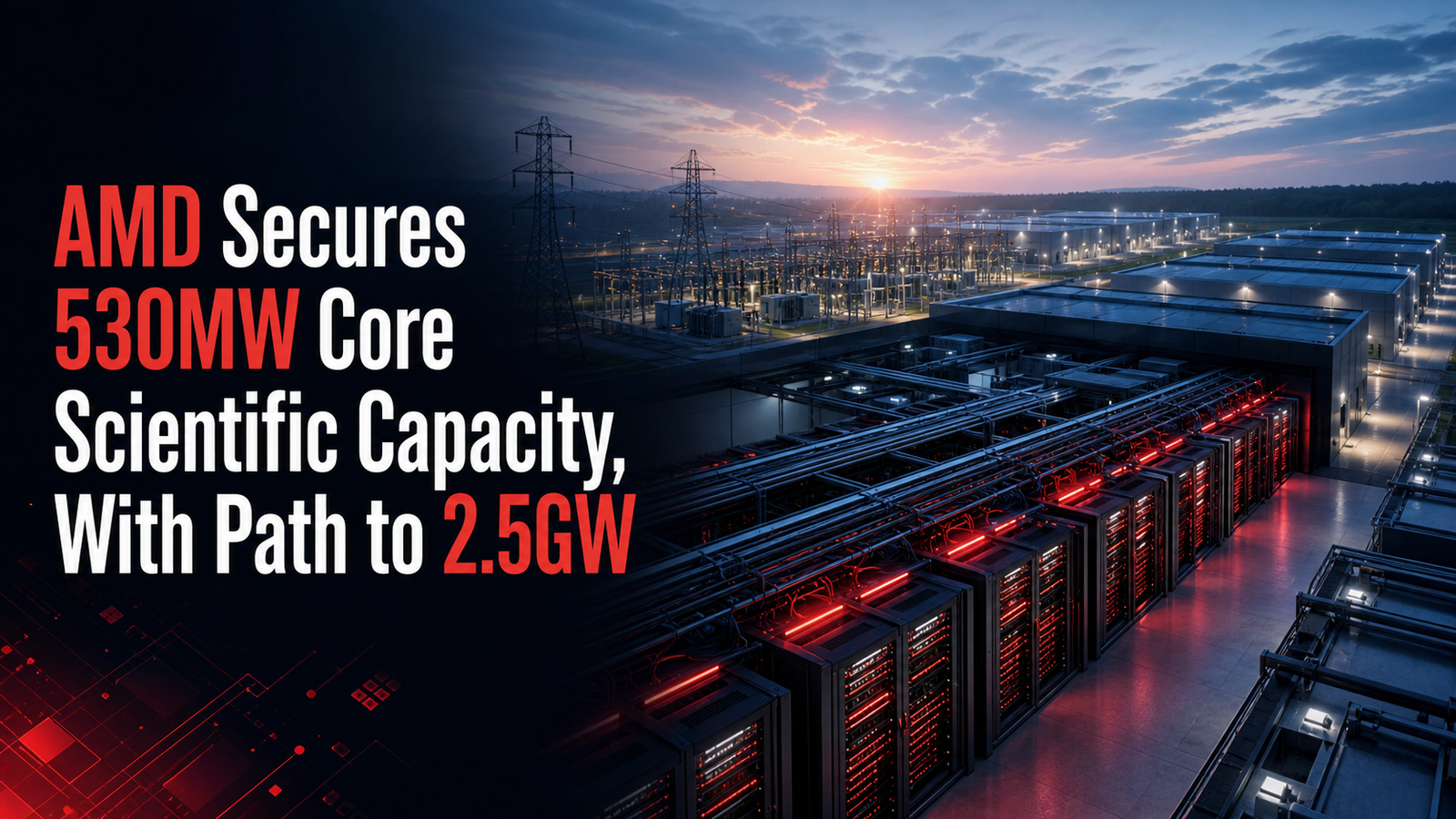

NEW DELHI, July 29, 2026, 11:25 a.m. IST — AMD has secured an initial block of more than 500 megawatts of U.S. data-centre capacity from Core Scientific for customer deployments of its AI systems, giving the chipmaker a long-term infrastructure route for bringing Instinct accelerators, EPYC processors and its ROCm software stack online at larger scale.
The agreement begins with roughly 530 MW across five sites under 15-year contracts, according to Core Scientific’s second-quarter results. It also gives AMD a path to reserve additional capacity, taking the potential relationship to 2.5 gigawatts. Initial infrastructure is expected to become available in 2027.
The distinction between the committed first phase and the larger headline figure matters. The 530 MW is the anchor deployment described by Core Scientific; the balance is an expansion opportunity, not capacity already delivered. Core Scientific said the initial contracts represent more than $14 billion in potential base contracted revenue, a forward-looking estimate that depends on construction, financing and delivery.
For developers, platform teams and cloud buyers, the announcement is another sign that AI competition is moving beyond accelerator specifications. Power, land, cooling, networking and deployment-ready facilities are becoming part of the product roadmap. A capable GPU is useful only when operators can secure a site, energise it and run the surrounding software reliably.
What the companies confirmed
In a joint announcement published by Nasdaq, AMD and Core Scientific said they will collaborate on physical infrastructure design and deployments using AMD Instinct GPUs, EPYC CPUs and ROCm software. AMD has secured more than 500 MW of U.S. capacity beginning in 2027, with an option to expand the relationship to as much as 2.5 GW.
Reuters separately reported the 2.5 GW ceiling after the announcement. Core Scientific’s quarterly results add the contractual detail: about 530 MW across five sites, 15-year agreements and more than $14 billion of potential base revenue.
AMD will also receive warrants to buy Core Scientific shares at market-based prices if specified commercial conditions are met. The companies did not disclose the end customers, exact accelerator quantities, pricing for compute services, site-by-site delivery schedule or who will operate the customer-facing cloud layer.
Those omissions limit what can be concluded today. This is a capacity and infrastructure agreement, not an announcement that 2.5 GW of AMD compute is already installed or generally available. Customers will still need deployment contracts, validated system configurations and service-level commitments before workloads can move into production.
Why power capacity is now part of the AI stack
Large AI clusters are constrained by more than chip supply. Each deployment also requires utility power, substations, high-density cooling, fibre connectivity, rack integration and a software environment that can schedule accelerators across many nodes. The time needed to build that foundation can be longer than the useful market life of a single accelerator generation.
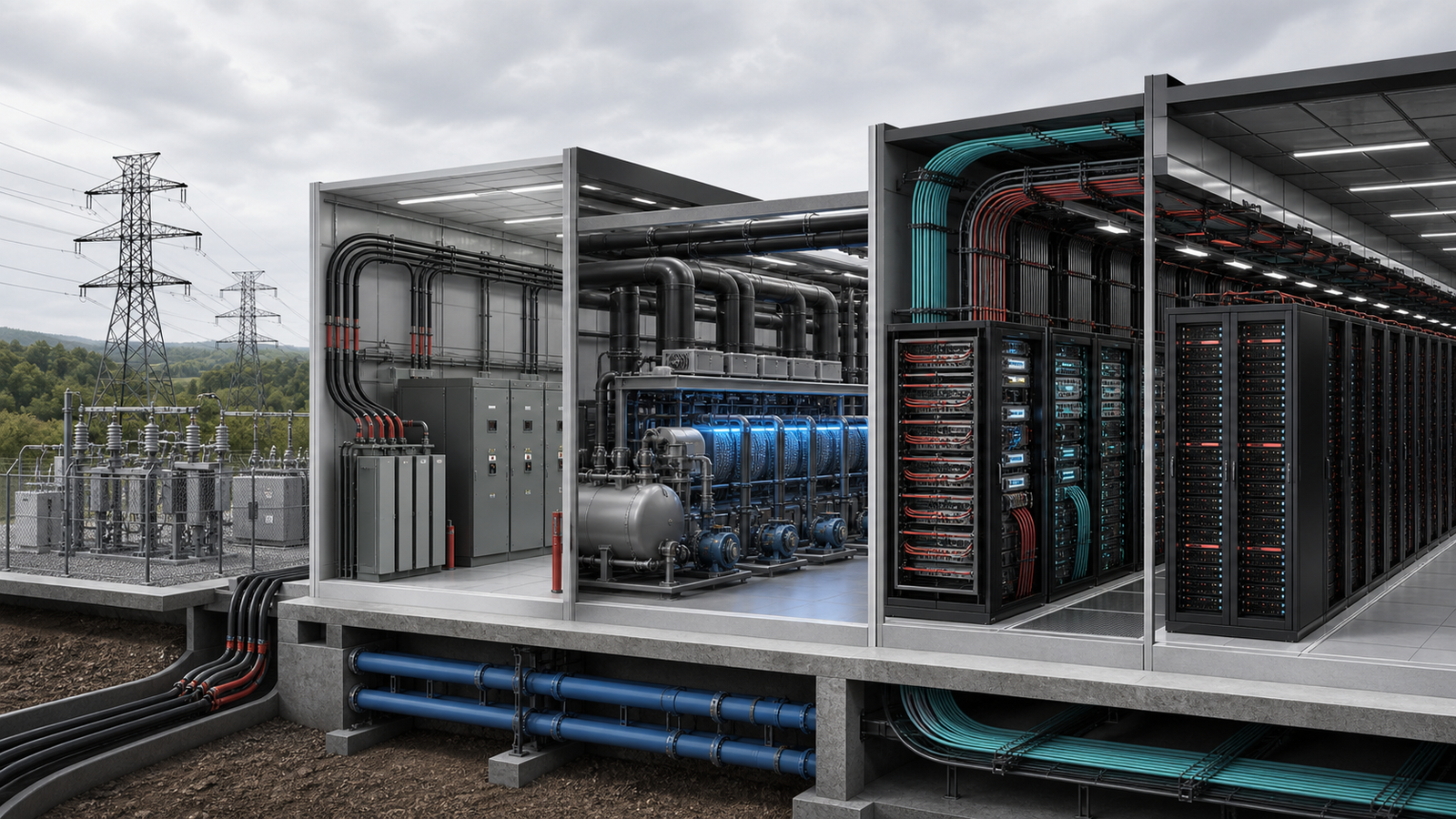
By reserving capacity through Core Scientific, AMD is attempting to shorten the gap between selling silicon and giving customers somewhere to run it. Core Scientific brings a portfolio of U.S. sites and experience converting high-power facilities from digital-asset mining toward high-density colocation for AI workloads.
The model also reflects a broader change in the AI infrastructure market. Chip vendors, cloud providers and data-centre operators are increasingly coordinating roadmaps because rack density, cooling and network topology must be designed together. The operational unit is shifting from an individual accelerator to an integrated cluster, and increasingly to an entire powered campus.
What developers and platform teams should watch
The agreement could widen access to AMD-based AI capacity, but teams should treat the 2027 start as a planning signal rather than immediate supply. Organisations evaluating future deployments can use the lead time to test workload portability and identify dependencies that assume NVIDIA’s CUDA environment.
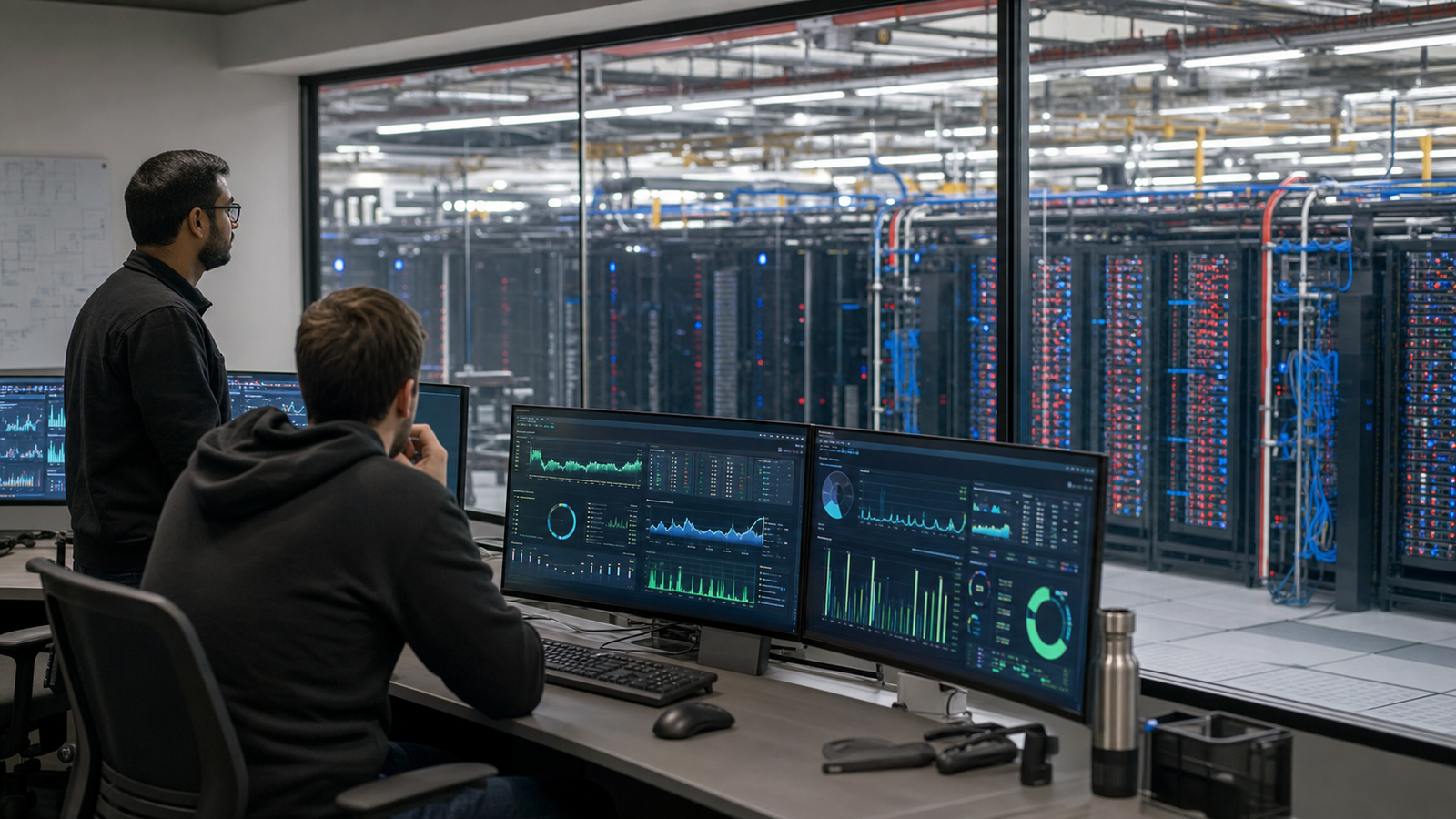
ROCm support has improved across major frameworks, but production readiness is workload-specific. Platform teams should validate container images, kernels, collective-communication libraries, model serving runtimes and observability agents on the exact Instinct generation they expect to use. Performance claims from one model or precision mode should not be extrapolated to a different serving workload.
Capacity procurement should also be evaluated at the service level. Useful questions include whether a contract covers critical IT load or total facility power, how much redundancy is included, which network fabric is available, how maintenance is handled and whether reserved capacity can be shifted between hardware generations.
For teams building internal AI platforms, the practical work remains familiar: version models and prompts, monitor latency and error budgets, trace data lineage, test failure recovery and control deployment changes. GravityDevOps’ guides to LLMOps, retrieval-augmented generation and CI/CD tooling cover the operational layers that sit above accelerator capacity.
A significant commitment, with execution risk
The first 530 MW would be a material footprint if delivered, and the 15-year term signals that both parties expect demand for AI compute to persist across several hardware cycles. It may also give AMD customers another route to capacity outside the largest public clouds.
But gigawatts are not a performance benchmark. They do not reveal usable accelerator hours, model throughput, energy efficiency, availability or total cost per successful task. Construction schedules can change, utility interconnections can slip and future expansion requires customers, capital and equipment.
Core Scientific explicitly describes the revenue and expansion figures as forward-looking. Its quarterly filing also highlights risks around financing, construction, electrical supply, long-lead equipment and customer demand. Those caveats are central to assessing the deal, not boilerplate to be ignored.
Timeline and next signals
The companies announced the partnership on July 28 in the United States. Core Scientific expects the first AMD-linked capacity to begin coming online in 2027. The next meaningful milestones will be named customer deployments, site delivery dates, confirmed system configurations and evidence that the facilities can operate the promised high-density clusters at production reliability.
Until then, the confirmed news is narrower but still important: AMD has moved to secure a large, long-duration infrastructure base for customers, while Core Scientific has tied a substantial portion of its AI-colocation growth to the AMD ecosystem. The deal shows that the AI platform contest is increasingly being decided in power queues and data-centre construction schedules as well as in model benchmarks.
Sources
Primary and corroborating sources: AMD and Core Scientific joint announcement; Core Scientific second-quarter results; and Reuters coverage of the agreement.


