


Amazon’s latest quarterly results show AWS demand accelerating while the company raises infrastructure spending, giving cloud and platform teams a fresh signal that AI capacity remains both a growth engine and a constraint.
NEW DELHI — 1 August 2026, 11:23 a.m. IST: Amazon said AWS sales rose 37% year over year in its second quarter, the cloud unit’s fastest growth in 18 quarters, as the company’s artificial intelligence and chip businesses each moved above a $25 billion annual revenue run rate.
The results sharpen an important point for developers, DevOps engineers and technical decision-makers: enterprise AI demand is no longer visible only in model launches and pilot projects. It is appearing in hyperscaler revenue, custom-silicon commitments, new managed services and a larger bill for data centres, memory, networking and power.
Amazon’s headline number is growth, but the more consequential detail is capacity. The company now expects about $220 billion in cash capital expenditure this year, up from an earlier estimate of about $200 billion. Chief executive Andy Jassy told investors that higher memory costs account for much of the increase and said available capacity will still fall short of demand this year. He also indicated that the imbalance could continue into next year.
What Amazon confirmed
In its official second-quarter release, Amazon reported AWS revenue of $42.2 billion, up 37% from the same period a year earlier. AWS operating income rose to $16.6 billion from $10.2 billion.
Amazon said the annual revenue run rate for both its AWS AI business and its chips business exceeded $25 billion, with each growing at a triple-digit percentage. Those are company-reported measures, not independently audited market-share figures, but they show how quickly accelerator infrastructure and managed AI consumption are becoming material businesses.
The company also reported a trailing 12-month free-cash-flow outflow of $7.6 billion, compared with an $18.2 billion inflow a year earlier. Amazon attributed the swing primarily to a $66.1 billion year-over-year increase in property and equipment purchases, with AI investment the main driver.
The Associated Press separately reported that Amazon lifted its planned technology spending by about 10% and that Jassy expects capacity constraints to persist despite the higher outlay. Axios highlighted the same trade-off: faster AWS and AI growth alongside negative free cash flow as infrastructure investment rises.
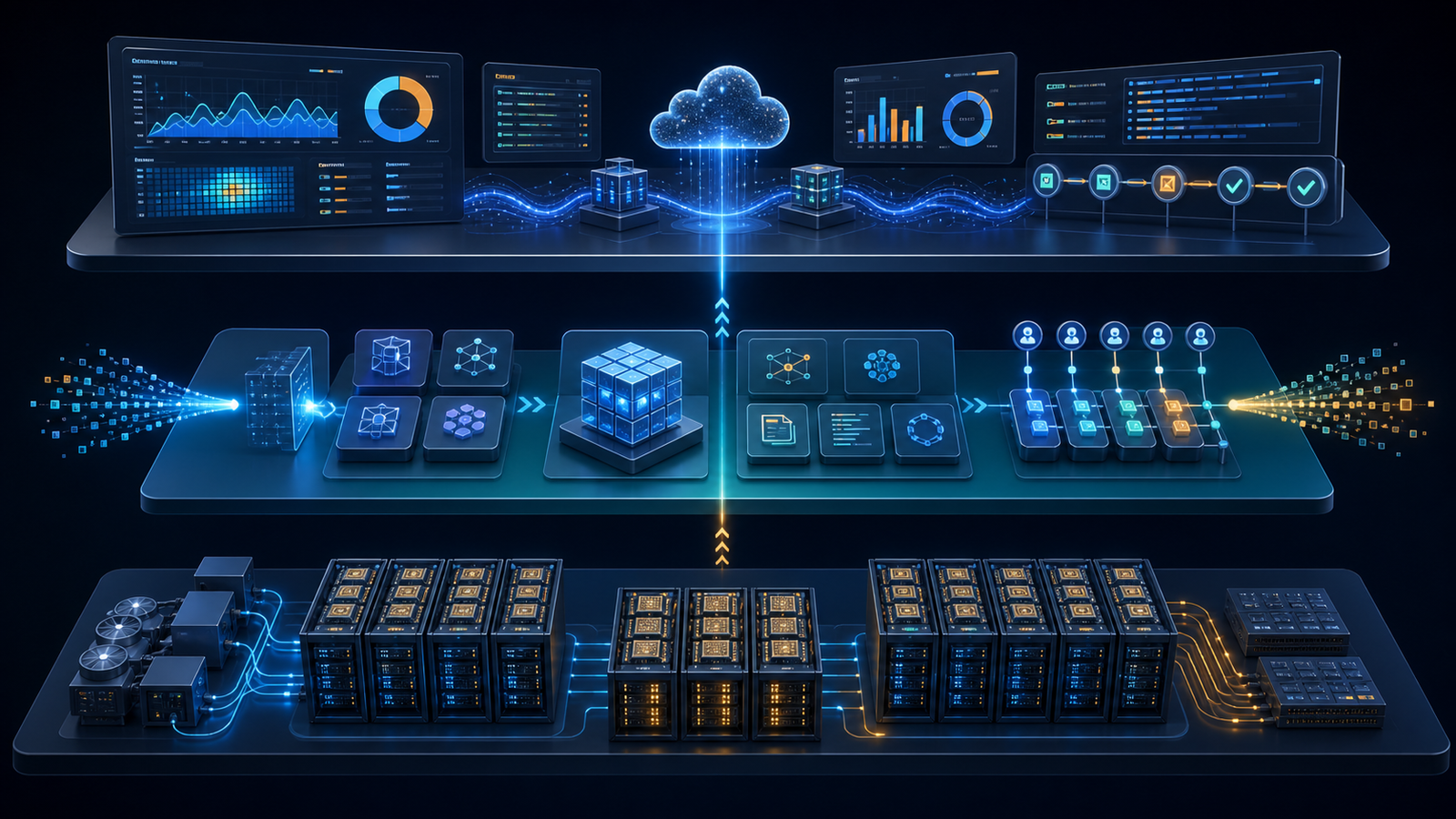
The platform story behind the numbers
Amazon’s product disclosures show where the spending is being directed. The company said Anthropic and OpenAI have made multi-year, multi-gigawatt commitments involving its Trainium accelerators. It also said Amazon Bedrock added more than 10 managed foundation models and that customers spent more on Bedrock in the quarter than in all previous quarters combined.
For operations teams, the update extends beyond model access. Amazon listed new Bedrock AgentCore capabilities, longer-running Lambda MicroVM sessions for agent loops, faster OpenSearch Serverless scaling and a log analytics engine intended for the higher telemetry volumes generated by agentic workloads. AWS also added release-management functions to its DevOps Agent for readiness reviews and pre-production testing.
These claims come from Amazon and should be tested against each team’s own workloads. They nevertheless point to a broader shift: AI platforms are being assembled as operational stacks, not single APIs. Compute, model routing, identity, sandboxing, observability, deployment controls and cost governance increasingly have to be designed together.
What developers and DevOps teams should take from it
First, capacity planning should remain multi-dimensional. A reserved accelerator is useful only if the surrounding memory, networking, storage, regional quotas and model-serving software can support the workload. Teams with production launch dates should validate quotas and regional availability early and retain a fallback path where architecture permits.
Second, cloud cost controls need to move closer to the AI request. Infrastructure teams should track cost per successful task, token and cache efficiency, tool-call fan-out, retrieval load, retry rates and observability volume. A lower model price can be erased by long-running agents, redundant calls or unbounded logs.
Third, managed platforms reduce integration work but do not remove portability risk. Keeping prompts, evaluations, retrieval pipelines and policy checks loosely coupled from one model endpoint can make it easier to compare providers or shift traffic during capacity events. GravityDevOps readers building that foundation can review our guides to LLMOps, retrieval-augmented generation and CI/CD tool selection.
Finally, Amazon’s spending plan is not proof that every enterprise AI project will generate a return. It is evidence that a leading cloud provider sees sustained demand and is paying heavily to meet it. Technical leaders still need workload-level evaluation, security boundaries, service-level objectives and a credible unit-economics model before scaling.
Context and what remains uncertain
Amazon’s report follows strong cloud results from other hyperscalers, reinforcing the view that AI workloads are helping lift overall cloud consumption. Yet the scale of capital spending also keeps pressure on cash flow and raises questions about utilisation, component prices and the timing of returns.
The clearest near-term implication is operational rather than financial: teams should expect rapid service development alongside uneven capacity, changing instance economics and tighter scrutiny of AI budgets. Amazon has confirmed the demand and the investment. Whether that spending produces durable cost advantages for customers will depend on delivery, competition and how efficiently real workloads use the infrastructure.
Sources
Primary source: Amazon second-quarter results. Independent reporting: Associated Press and Axios.


