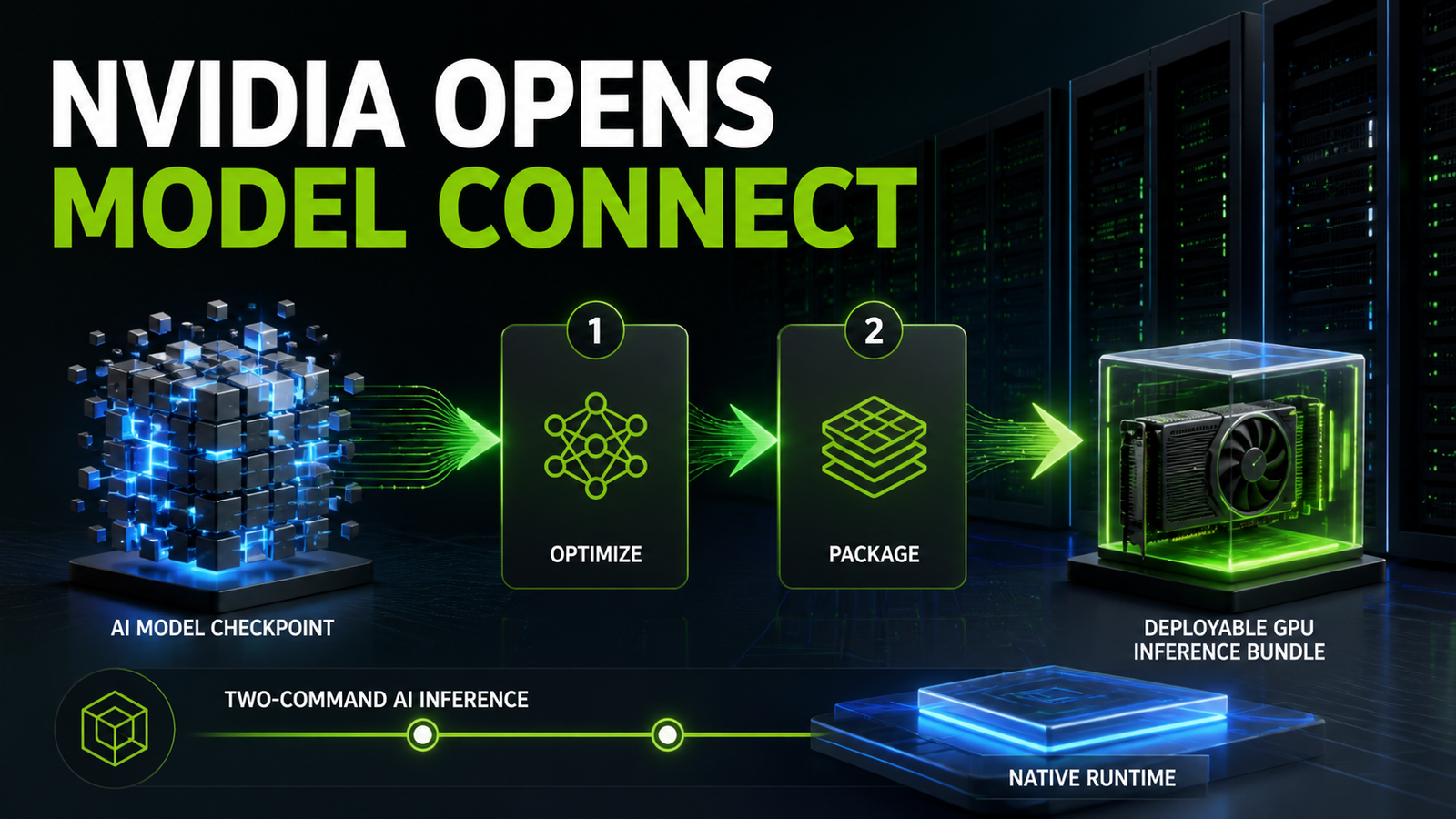

SEO excerpt: NVIDIA has made TensorRT Model Connect publicly available, offering a two-command path from supported Hugging Face checkpoints to deployable TensorRT bundles and native C++ inference.
NEW DELHI, August 19, 2026, 10:02 PM IST — NVIDIA has opened TensorRT Model Connect, an Apache-2.0-licensed reference project designed to shorten the path from supported Hugging Face or local model checkpoints to native TensorRT inference. The project builds a deployable bundle and runs it through task-oriented C++ APIs, removing the intermediate ONNX export step for supported configurations.
The release matters because model conversion remains a fragile part of many production AI pipelines. Teams often have to reconcile framework versions, export graphs, custom operators, precision settings and GPU-specific builds before a model reaches a serving environment. TensorRT Model Connect packages more of that work behind a consistent build-and-run workflow, potentially reducing integration effort for teams standardising on NVIDIA GPUs.
What NVIDIA has released
According to the public NVIDIA repository, developers can take a supported checkpoint, build a versioned bundle and then run that bundle from either the command-line interface or a native C++ application. NVIDIA describes the bundle as the hand-off point between Python-based model construction and the native runtime.
The project spans more than text generation. Its documentation lists task contracts for speech transcription, embeddings, segmentation, forecasting, image and video generation, and other model families. NVIDIA’s current documentation reports 79 Python family plugins and 209 end-to-end model manifests, while warning that those inventory counts do not prove every model will run successfully on every GPU or software combination.
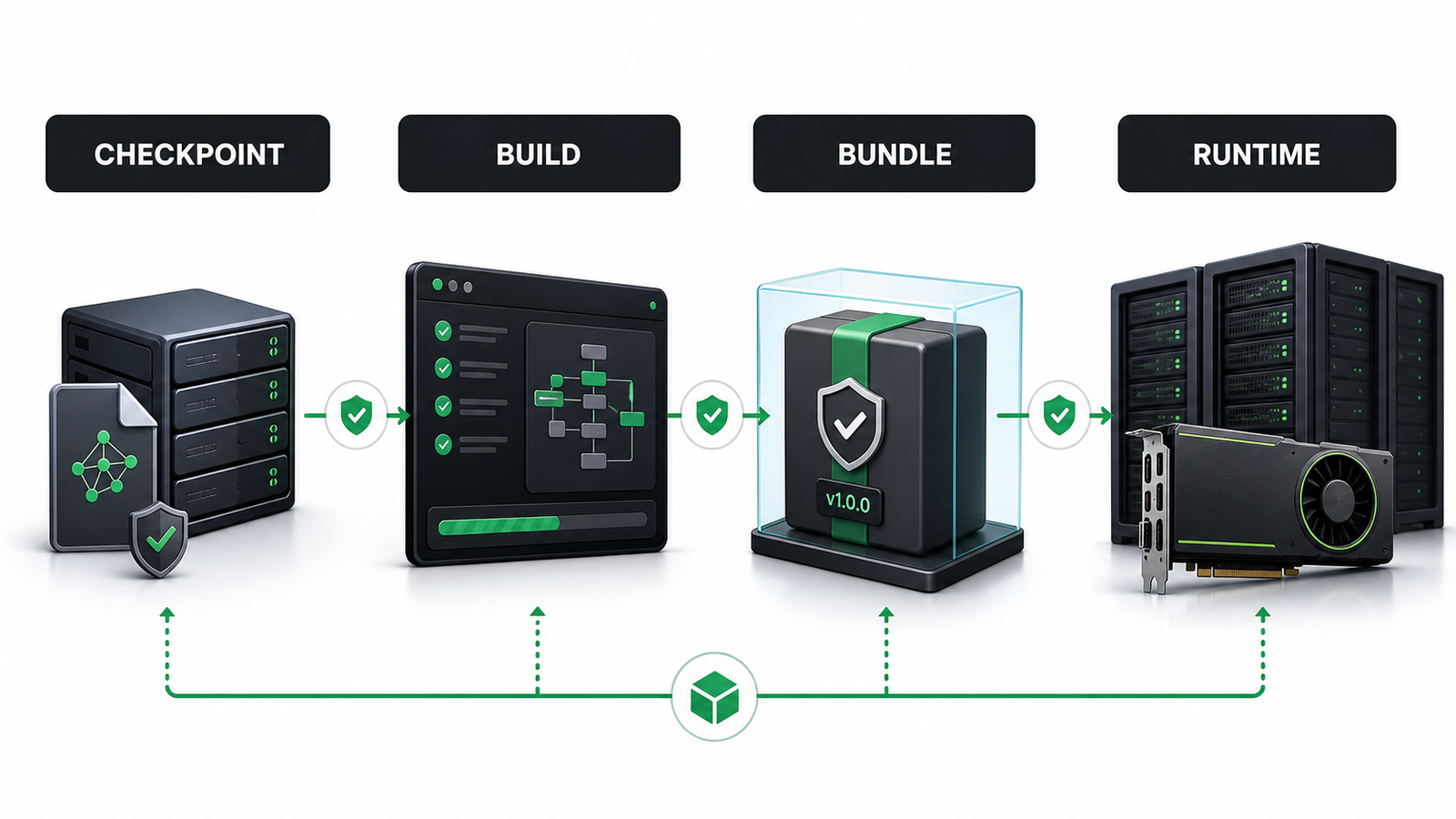
That distinction is important. The supported-model matrix ties support to exact checkpoint identifiers, profiles, precision settings and build configurations. Fine-tuned variants from the same family are described as best-effort compatible unless NVIDIA has verified the exact checkpoint.
Why the ONNX-free path matters
ONNX is widely used as an interchange format, but export is not always a neutral step. Dynamic shapes, custom kernels, preprocessing logic and rapidly changing model architectures can create gaps between a training checkpoint and an optimised runtime. A direct build path does not eliminate model qualification work, but it can remove one conversion boundary and give platform teams a more explicit artifact to promote through environments.
The need is visible in NVIDIA’s own developer forum. In February, a team deploying a fine-tuned Canary speech model asked for a supported production route after encountering format-conversion limits. An NVIDIA engineer later described Model Connect as a direct PyTorch-to-C++ path and said it would provide speech-specific APIs. The repository now lists the Canary 1B v2 checkpoint in its support matrix.
This is also a narrower tool than a complete serving platform. NVIDIA says Model Connect is intended for quickly exploring models and evaluating broad coverage. For performance-priority LLM and vision-language deployment on NVIDIA edge platforms, the company directs users toward TensorRT Edge-LLM. Large-scale scheduling, autoscaling, traffic management and fleet observability remain separate platform concerns.
What changes for DevOps and platform teams
The immediate opportunity is to treat the generated bundle as a release artifact rather than rebuilding a model inside every serving environment. A platform team can pin the checkpoint revision, builder image, CUDA and TensorRT versions, GPU target, precision profile and validation data, then record those inputs alongside the bundle in its artifact registry.
However, the bundle should not bypass existing promotion controls. NVIDIA explicitly says users are responsible for trusting checkpoints, bundles, native libraries and the local build environment. That makes provenance, software bills of materials, vulnerability scanning and signature verification relevant to the model pipeline as well as the application container.
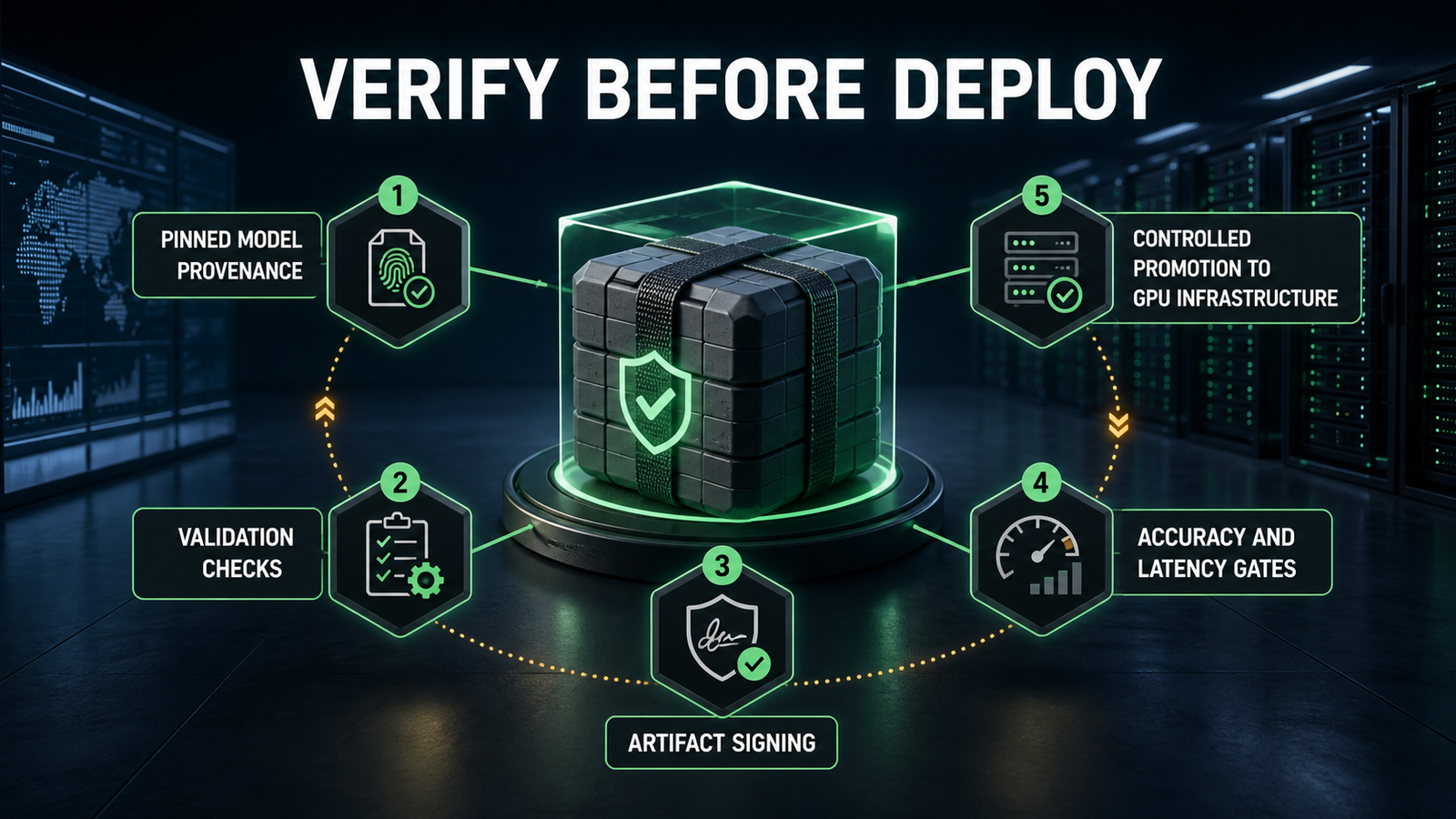
Teams adopting the project should add accuracy and latency gates to CI/CD rather than relying on NVIDIA’s published traffic-light results. The project’s July 29 comparison covers specific single-process profiles on GB300 hardware and excludes build time, loading, compilation and warm-up from inference latency. Those results are useful qualification evidence, but they are not a promise about another GPU, workload or request pattern.
A practical evaluation should compare end-to-end service behaviour: cold-start time, steady-state throughput, tail latency, memory use, output parity, failure recovery and the time required to add an unsupported model. Platform owners should also test whether a built artifact can be reproduced from pinned sources. GravityDevOps readers planning that release process can pair the new tool with established LLMOps lifecycle controls and CI/CD tooling.
Balanced outlook
TensorRT Model Connect addresses a real integration cost: moving a fast-changing model ecosystem into native GPU runtimes. Its breadth and task-oriented APIs could make TensorRT evaluation accessible to teams that previously avoided custom conversion work.
But it is early infrastructure, not a universal compatibility layer. The public repository has active fixes and validation work, the support matrix is exacting, and some optimised runtime dispatch targets are still marked as coming soon. Teams should begin with one supported checkpoint on representative hardware, preserve a known-good serving path and expand only after correctness and operational behaviour are measured.
For organisations already running retrieval-augmented systems, the inference layer is only one part of reliability. Data freshness, retrieval quality and evaluation remain separate responsibilities; GravityDevOps has additional background on retrieval-augmented generation and prompt engineering for developers.
Sources
This report is based on NVIDIA’s TensorRT Model Connect repository, the project’s official documentation, its model-support matrix, and an NVIDIA Developer Forum discussion documenting the earlier private-preview path. Availability and capabilities were checked on August 19, 2026.


