

The future of AI coding tools is likely to center on delegated, verifiable work across the software lifecycle. Developers will increasingly need to define tasks, supply reliable context, constrain execution and assess evidence. The pace of that shift and its effect on employment, cost and software quality remain uncertain.
This outlook separates capabilities documented today from plausible developments and unresolved questions. It is an analysis of primary sources checked November 10, 2026, not a promise about future releases, salaries, productivity gains or a date when software development becomes autonomous.
What is already documented
Current coding tools extend beyond line completion. GitHub documents assistive interactions, agents that research repositories and prepare changes, custom instructions and external tools in its Copilot overview. The exact capabilities depend on client, plan and organization policy. This establishes that delegated work is an available product category; it does not show that every task can be delegated reliably.
Security products already combine structured findings with generated remediation. GitHub’s Autofix documentation distinguishes proposed fixes from agentic workflows and requires review. The progression illustrates a broader pattern: the model becomes one part of a process that gathers evidence, creates a patch and runs checks.
Commercial models also reflect more execution. Copilot’s plans page describes credits for agent features alongside subscription access. As work grows from short suggestions into repeated tool calls and test runs, teams need to understand consumption as well as seat counts.
For a practical map of current categories, use the AI coding tools pillar. The directions below are our interpretation of documented capabilities and engineering constraints, rather than announced commitments by every vendor.
Five likely directions for AI coding tools
1. More work will be assigned as bounded tasks
Instead of asking for one function, a developer may assign a bug investigation, test improvement or small migration with explicit acceptance criteria. The tool can inspect files, propose a plan, edit, run checks and return a review package. The important unit becomes a verifiable change with a clear owner.
This direction depends on task quality. An agent cannot resolve conflicting business requirements merely by making more tool calls. Teams that document contracts and keep changes small will have more delegable work than teams relying entirely on undocumented institutional knowledge.
2. Verification will become a larger product surface
If producing patches becomes easier, checking them becomes more valuable. Expect continued investment in test generation, change analysis, review assistance and evidence summaries. The strongest systems should show what changed, which checks ran and what remains uncertain.
Generated tests introduce a circularity problem when the same model invents the implementation and its expected behavior. Independent requirements, mutation checks and human review remain useful even if generation improves. Our unit-testing guide explains that verification boundary in practice.
3. Context quality will compete with model quality
Repositories contain source, tests, build definitions, tickets, decisions and operational evidence. A tool must select the right pieces, recognize stale information and avoid crossing access boundaries. More raw context can also introduce distraction, secrets or malicious instructions.
Useful improvements would include better provenance, narrower retrieval and clearer explanations of what evidence informed a change. This is a likely competitive direction, not a claim that any current tool has solved organizational knowledge or can index every monorepo accurately.
4. Execution controls will become normal platform work
Agents need environments, identities, network policies, dependency access and logs. Those are familiar platform responsibilities with new failure modes. A future coding environment may make isolated execution and scoped credentials as routine as creating a branch.
Today’s controls have limits. GitHub’s agent firewall documentation describes processes and environments outside its coverage. This supports a defense-in-depth approach: permissions, sandboxing, secret handling and approval should reinforce each other.
5. Tool economics will track accepted outcomes more closely
Longer tasks can consume more inference, test compute and reviewer attention. Teams will likely compare cost per accepted change and cost per resolved incident alongside subscription price. Vendors may package usage differently, but the operational question remains whether the result is worth its full cost.
More parallel agents can also produce integration conflicts and review overload. Increasing concurrency is useful only while the delivery system can absorb the extra work. Capacity planning should include reviewers and CI, not just model access.
How developer work could change
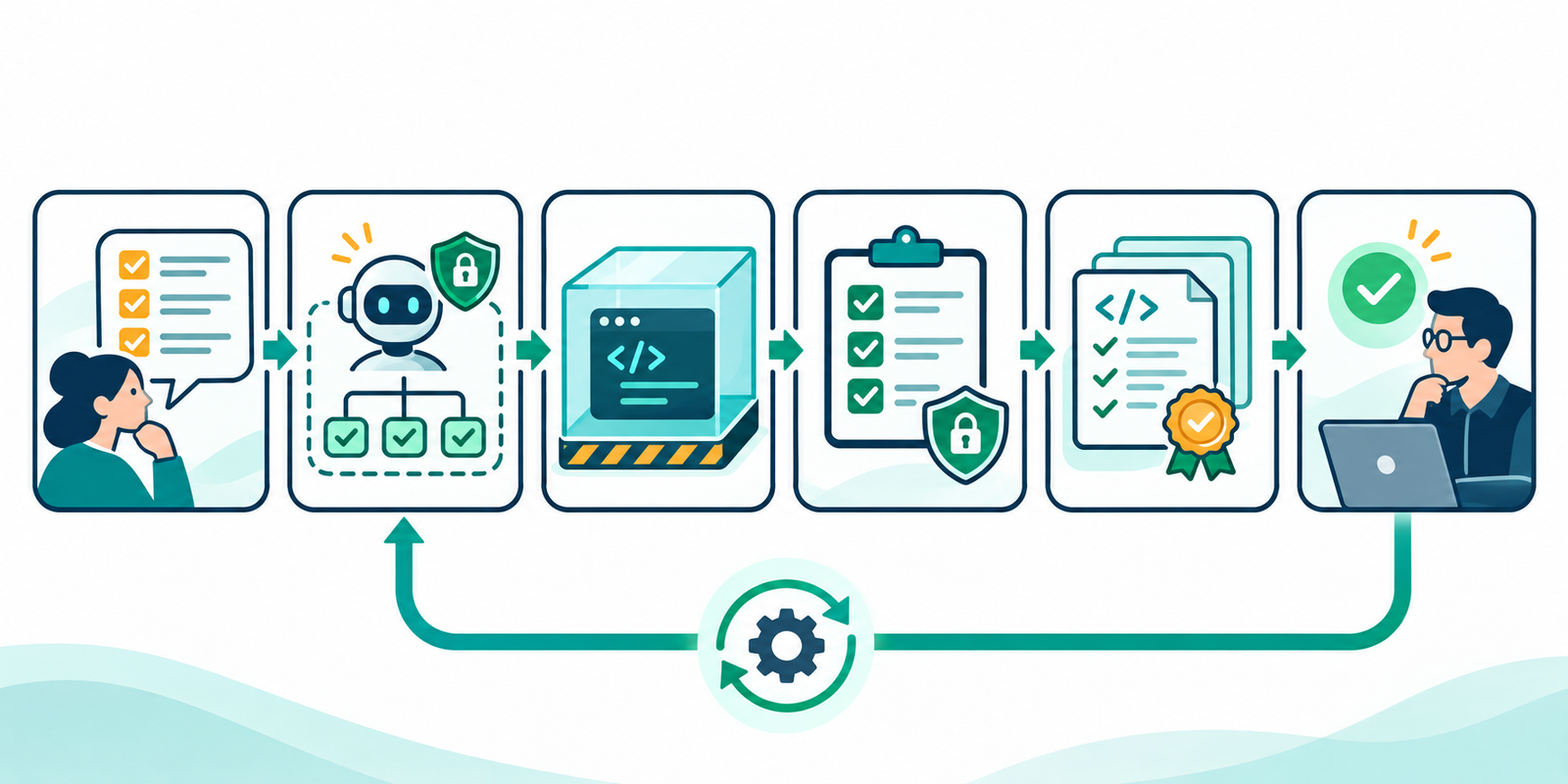
Consider a compatibility fix. A developer defines the affected API, supported clients and unacceptable behavior changes. An agent locates callers and drafts a patch. Automated checks establish whether it compiles and meets known contracts. A reviewer checks the business assumption and residual risk before a staged release.
The developer’s effort shifts toward defining the problem and evaluating the result, but implementation knowledge remains essential. Without understanding the code, a reviewer cannot distinguish a convincing explanation from a subtle regression. Expertise changes how assistance is used; it does not become unnecessary.
Junior developers still need opportunities to read code, build small features, investigate failures and receive feedback. If agents absorb every introductory task, teams must deliberately preserve learning paths. Senior developers need to teach reasoning and review rather than merely allocate generated output.
Product managers and domain experts may contribute more directly to executable specifications and examples. That can reduce ambiguity, but it also makes requirement quality visible. A poorly specified feature can now generate a larger amount of plausible implementation before the misunderstanding is discovered.
Three plausible adoption scenarios
| Scenario | What would enable it | What teams should watch |
|---|---|---|
| Steady augmentation | Useful assistance with continued human implementation and review | Task-level benefit, skill retention and manageable cost |
| Broader bounded delegation | Reliable context, isolated execution, strong tests and clear contracts | Accepted changes, review capacity and rollback frequency |
| Uneven or constrained adoption | Privacy constraints, weak tests, integration friction or poor economics | Policy failures, hidden usage and increasing rework |
These scenarios can coexist inside one company. A well-tested internal service may support delegated maintenance while a safety-critical system retains a stricter process. The relevant forecast is often about a workflow and risk class, not an entire profession.
Avoid treating a successful demonstration as evidence that the broad-delegation scenario is inevitable. Demonstrations may use cleaner tasks, more generous budgets or stronger tests than everyday production work. Inspect the operating conditions before copying the conclusion.
Skills and investments to prioritize now
- Requirement writing: define inputs, outputs, boundaries, failure behavior and acceptance examples.
- Code investigation: verify dependencies, callers and runtime evidence instead of accepting summaries uncritically.
- Testing: maintain fast, reliable checks with meaningful assertions and representative integration coverage.
- Review: inspect behavior, security, licensing and operational effects in the complete diff.
- Platform controls: provide reproducible environments, scoped credentials, audit records and reliable revocation.
- Measurement: track accepted outcomes, rework, escaped defects and total cost with stable definitions.
These investments remain useful if model progress is slower than expected. They also make future agents easier to evaluate. For rollout mechanics, use the team selection framework; for permissions and prompt injection, use the agent security guide.
Signals worth watching
Look for independent evaluations on realistic repositories, transparent failure analysis, reproducible task definitions and evidence of sustained delivery improvements. Benchmarks are useful for a bounded capability, but they may omit maintenance, review burden and operational consequences.
METR’s 2026 productivity-study update describes selection and measurement problems as tools and usage patterns changed. Its uncertainty is a reminder to check methodology before repeating a headline number. A claim about the future needs stronger evidence than an old study used without its limitations.
The DORA AI-assisted development report directs attention toward organizational capabilities and delivery systems. For practical planning, watch whether your own feedback loops improve: clearer requirements, faster reliable checks, less rework and stable operations.
Review the outlook when products change their execution model, data terms or pricing, and when new controlled evidence appears. Keep investments reversible and preserve a working path without the agent. The future is easier to navigate when teams can test new capabilities without surrendering control of delivery.
A useful quarterly exercise is to revisit one previously unsuitable task. Keep its acceptance tests and risk limits fixed, try the current supported tool configuration, and compare the complete result with the earlier attempt. This reveals improvements that matter to your organization without assuming that every new model name represents a proportional gain. Retain failed attempts and unresolved questions so institutional memory includes the boundaries of the technology as well as its successes.
Frequently asked questions
Will AI replace software developers?
Current evidence does not establish a date or a universal employment outcome. Tools can automate parts of the work, while requirements, accountability, maintenance and domain decisions still require responsible owners.
Will everyone manage a fleet of coding agents?
Some workflows may benefit from parallel delegated tasks. Others are constrained by dependencies, review capacity, privacy or cost. Concurrency should follow measured value and safe operating limits.
What should developers learn first?
Strengthen programming fundamentals, testing, code reading, requirement definition and review. Then practice bounded delegation with explicit evidence and stop conditions.
Should teams wait for better models?
Teams can run small reversible pilots now and invest in tests and reproducible environments. Avoid large commitments based solely on speculative future capabilities.


