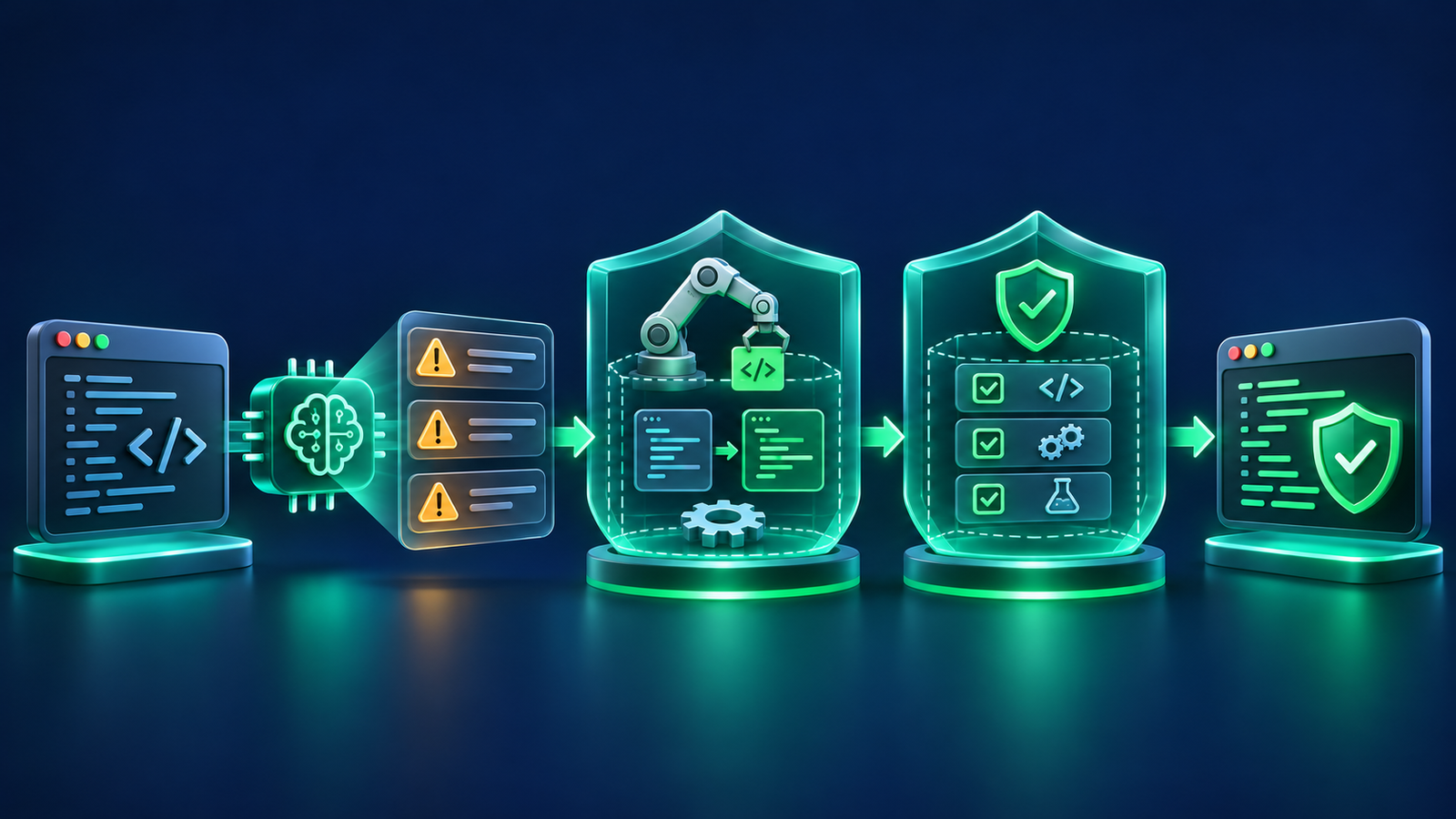

The most useful AI DevSecOps tools connect a credible security finding to a reviewable fix. Start with the scanner that understands your code and delivery system, then evaluate its AI explanation, triage and remediation features. Keep deterministic security gates, independent tests and human approval in the release path.
This guide compares GitHub CodeQL with Copilot Autofix, Semgrep and Snyk Code for application-security workflows. It also explains where coding agents and test generators fit. The comparison is based on official US-facing documentation checked November 10, 2026; it is not a hands-on benchmark or a claim that one product finds every vulnerability.
AI DevSecOps tools: shortlist and selection method
Use four questions to narrow the field: which languages and build systems need coverage, where findings should appear, what code leaves your environment, and who may change it. A natural-language explanation is useful only when the underlying finding is relevant and the proposed patch preserves intended behavior.
| Option | Strongest workflow fit | AI contribution | Purchase caveat |
|---|---|---|---|
| CodeQL and Copilot Autofix | GitHub repositories with CodeQL alerts | Explains findings and proposes patches; agentic remediation has additional controls | Public-repository access differs from private-repository Code Security licensing |
| Semgrep | Teams wanting code rules, CI integration and security triage | Detection, triage and remediation features supplement analysis | Repository, contributor and AI-credit allowances depend on plan |
| Snyk Code | Developer security workflows alongside dependency and infrastructure analysis | AI-assisted analysis, explanation and fixes | Product test limits and enterprise capabilities have separate entitlements |
| Repository coding agent | Implementing an already understood security fix | Coordinates bounded edits and test execution | Command authority and repository access can exceed scanner permissions |
For general security scanning across containers and Kubernetes, use the established DevSecOps and container security comparison. This article focuses on selecting the AI layer around application findings and remediation.
Three security workflows compared
GitHub CodeQL with Copilot Autofix
CodeQL supplies structured findings; Copilot Autofix turns eligible findings into proposed changes with explanations. GitHub’s Autofix documentation distinguishes ordinary fix suggestions from agentic autofix, which can create a remediation workflow and consumes different resources. Public repositories and private organization repositories have different access requirements; do not assume an individual Copilot subscription includes the private-repository security product.
This is a good starting candidate when teams already manage alerts and pull requests in GitHub. The review can connect the original alert, changed code, tests and scan result in one place. Check the supported language and query subset in the security AI application card, especially for custom queries. A fixed supported alert does not establish that the application has no other vulnerabilities.
Semgrep
Semgrep is a candidate for teams that want scanning rules and a developer-facing remediation loop across their repositories. Its current pricing page lists a Free edition with repository and contributor ceilings, plus paid plans. AI features use credits, so compare the expected monthly workload with included allowances rather than treating “AI included” as unlimited execution.
Evaluate whether rules detect your framework-specific problems and whether AI triage preserves the evidence needed by a security engineer. Ask for the full data flow for cloud scans and optional AI features. Local scanner execution, cloud result storage and model processing are separate boundaries. A successful pilot should show which finding was suppressed, why it was suppressed, and how a reviewer can reverse that decision.
Snyk Code
Snyk Code fits teams evaluating source analysis alongside dependency, container and IaC products. The plans page currently offers Free and Team subscriptions with different test allowances, while enterprise platform capabilities require separate access. Count recurring scans of repositories and pull requests when estimating consumption.
Snyk’s AI implementation documentation separates Agent Fix and Explain from other assistants and correlation features. It describes different models and data paths for different functions. Its no-training commitment for proprietary code is useful, but procurement must still inspect caching, scan metadata, regional hosting and integration permissions. Apply the policy to the exact feature enabled.
Detection, suggestion and execution need different permissions
A scanner usually reads source and reports a finding. A fix generator proposes a diff. An agent may also install dependencies, run commands, modify multiple files and create a pull request. Each transition needs an explicit permission decision. Granting a scanner repository access should not silently grant a remediation agent production credentials.
Separate the detection signal from the model’s interpretation. Preserve the original severity, rule identifier, source location and evidence even when AI says the finding is harmless. Otherwise a mistaken triage decision can remove the only visible record of the problem. Security exceptions should have an owner, reason and expiry.
A useful example is SQL injection. A tool may propose parameterized queries, but reviewers must verify that the application’s database driver supports the chosen API, that parameter binding covers the vulnerable input, and that authorization still limits which records are accessible. Fixing string construction does not fix a missing tenant boundary.
A secure remediation pipeline
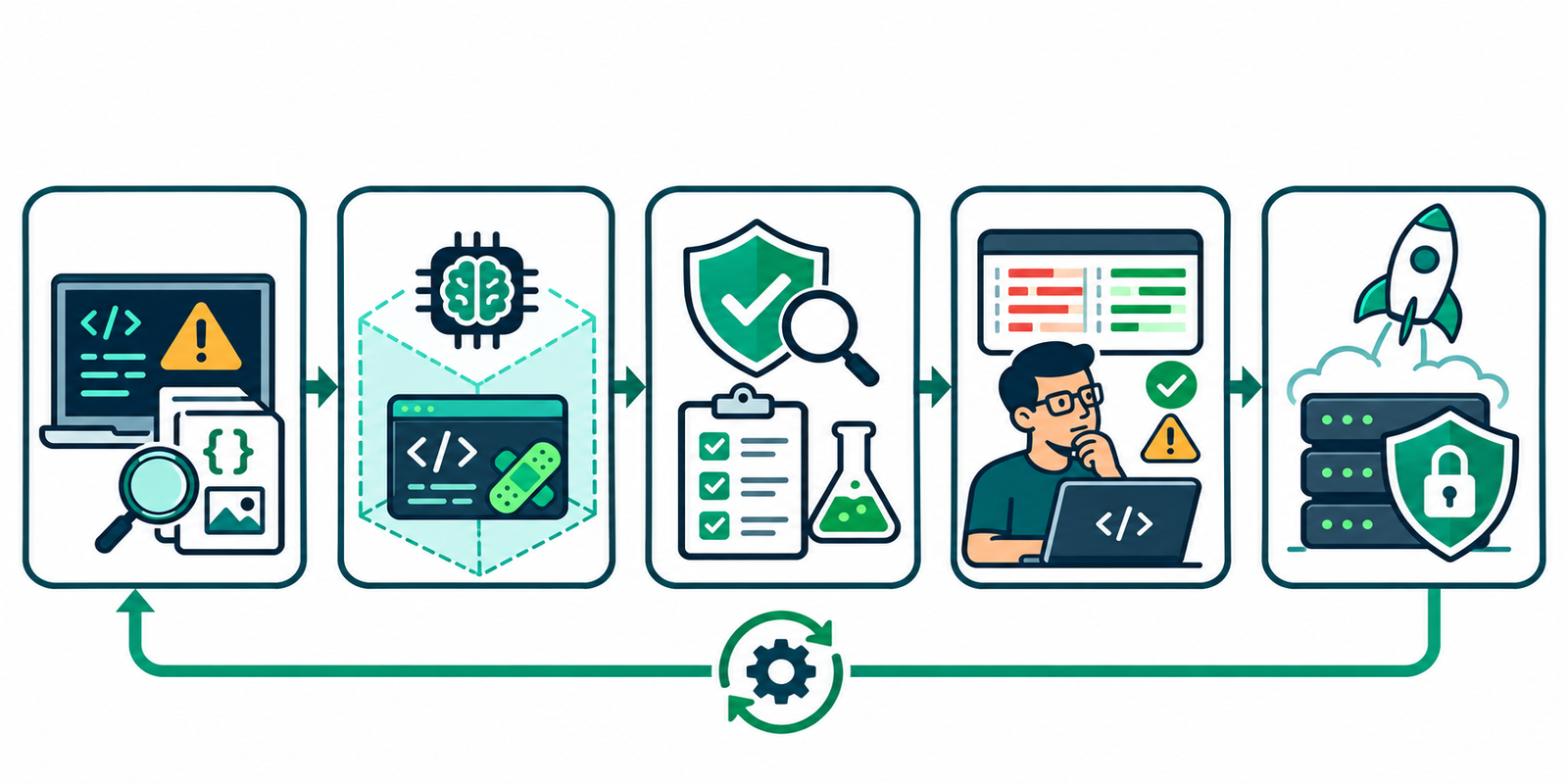
- Confirm the finding. Record the vulnerable path and affected deployment. Validate reachability, exploit assumptions and exposure without testing against an unauthorized live target.
- Constrain the task. Name the affected files, approved dependencies, acceptance tests and protected interfaces. Request a plan before edits for sensitive changes.
- Use an isolated environment. Give the agent a disposable branch, synthetic fixtures and short-lived credentials. Restrict network access and exclude production secrets.
- Generate one patch. Require an explanation tied to the original finding. Reject unrelated cleanup and new packages that obscure the security change.
- Verify independently. Re-run the relevant scanner, compile, run regression tests and add a test that demonstrates the original unsafe behavior is blocked.
- Review residual risk. A maintainer checks authorization, error handling, logging, backward compatibility and dependency licenses. Security owns any exception.
- Release and observe. Use the normal staged rollout, monitor the relevant signals and keep a rollback procedure that does not reopen the vulnerability without explicit risk acceptance.
The production-ready AI code checklist provides the broader release gates. For stronger test assertions, use the unit-testing guide rather than asking the remediation model to certify its own patch.
Run a practical evaluation
Use a small set of representative repositories with approved historical findings and safe synthetic cases. Include one supported language, one difficult framework, a dependency issue, an authorization problem and a false positive. Keep the same tasks and acceptance tests across candidates.
Measure confirmed findings, harmful suppressions, accepted fixes, reviewer effort, regressions, scan latency and total cost. Report denominators: five accepted fixes out of six proposals is different from five out of fifty. Keep detection quality and remediation quality separate because a strong patch generator may still depend on a weak signal.
Test operational failures too. Disable model access and confirm deterministic scanning still runs. Revoke the integration and confirm credentials stop working. Check what happens when the credit allowance is exhausted or the scanner cannot analyze a build. A timeout should produce a visible policy decision, not an unexplained green check.
Access, privacy and cost questions
Before purchase, verify current US availability, account requirements, supported IDEs, languages, frameworks and repository limits. Distinguish a perpetual free tier from a time-limited trial and from a feature included only in an enterprise quote. Request a written entitlement list for AI triage, fixes, APIs and audit logs.
Review source retention, model-training terms, subprocessors, region, deletion, SSO, role controls and support access. Check generated-code licensing and any indemnity conditions separately from detection features. Model cost should include scans, credits, CI minutes, reviewer time and the work of tuning rules.
Repository comments, issue descriptions and tool output can carry prompt injection. Use least privilege and approval gates described in our AI agent security guide. An agent’s network filter is one layer; GitHub’s firewall documentation explicitly describes coverage limitations that teams should account for.
A concrete acceptance record
For each accepted security patch, store the original alert identifier, the relevant threat assumption, the approved diff, the negative test and the post-fix scan result. Record the reviewer and release reference. If a later model or scanner update changes the assessment, the team can reconstruct the decision. This small record is more useful than preserving only an enthusiastic chat summary, because it connects the finding to observable behavior and the person who accepted the residual risk.
Frequently asked questions
Can AI replace SAST or dependency scanning?
AI can add context and proposed fixes, but maintain independent source, dependency, secret and configuration checks. These tools detect different failure classes and provide repeatable evidence.
Should security fixes merge automatically?
Begin with human approval. Even a small patch can change authentication, data access or compatibility. Automation should expand only for a narrowly defined risk class with reliable tests and an audited rollback path.
Which tool should a small team start with?
Start with the scanner that fits the existing repository host and languages. Pilot its AI remediation on known findings before adding another platform. Check free-tier ceilings and actual review effort.
Does closing an alert prove the vulnerability is fixed?
No. Confirm that the fix blocks the unsafe behavior, preserves requirements and passes independent review. Alerts may also close because analysis scope changed or a rule stopped running.


