
Direct answer: The best AI interview practice tools are Teal for job-specific mock interviews, Yoodli for delivery coaching, ChatGPT Voice for flexible practice, Huru for structured simulations, Big Interview for guided learning, Gemini Live for conversational rehearsal and Final Round AI for technical scenarios. The right choice depends on whether you need content feedback, speaking analytics or realistic follow-up questions.
AI interview practice tools can make rehearsal easier, but their scores are not hiring decisions and their suggested answers should never replace your real experience. This comparison focuses on tools that let U.S. job seekers practice before an interview. It does not endorse hidden answer generation during a live employer conversation.
Reviewed September 13, 2026. Plans, usage limits and AI features change frequently. Prices below are U.S. list prices visible during this review.
Best AI interview practice tools at a glance
| Tool | Best for | Free access | Main limitation |
|---|---|---|---|
| Teal | Job-specific practice tied to an application | 2 practice sessions | Unlimited practice requires Teal+ |
| Yoodli | Speaking pace, clarity and delivery | 5 lifetime roleplays | Free allowance is small |
| ChatGPT Voice | Flexible behavioral follow-ups | Limited free voice access | No dedicated interview scorecard |
| Huru | Structured role-specific mock interviews | Trial with first full feedback report | Not a permanent free plan |
| Big Interview | Curriculum plus recorded video practice | Often included by schools or workforce programs | Personal access starts at $39 monthly |
| Gemini Live | Free-flowing mobile rehearsal | Standard access without an AI plan | Limits vary and feedback is not interview-specific |
| Final Round AI | Technical and multi-round scenarios | Setup only; practice requires Pro | $25+ monthly and privacy tradeoffs |
How we compared the AI interviewers
We screened ten credible options and ranked seven. The comparison used current product pages, help centers, pricing pages and privacy disclosures. Criteria included spoken interaction, answer-aware follow-ups, job-description tailoring, delivery and content feedback, recording review, technical coverage, free allowance, price transparency, privacy controls and ease of repeating a session.
This is a documentation-based comparison, not a controlled output-quality benchmark. We did not purchase every paid plan or run the same resume through every system, so claims about realism and scoring are limited to documented capabilities and clearly identified independent observations. We also screened ScreenReady and Hiregram, but their shorter public operating histories make them harder to recommend above established alternatives. Google Interview Warmup was not ranked because its former U.S. tool page now redirects to general interview guidance.
A useful AI interviewer should help you retrieve truthful examples, speak them clearly and identify a specific improvement for the next attempt. It should not turn you into a memorized script reader. Research on interactive interview-practice systems also suggests that reflection and dialogue matter; one-way automated scores alone can produce a shallow feedback loop.
1. Teal: best overall for job-specific practice
Teal’s Interview Practice Agent sits inside its job tracker. It uses a saved job description to run a spoken conversation, asks follow-up questions based on your responses and provides a transcript, recording and post-session feedback. That connection to a real application is valuable: a product manager interview should not use the same prompts as a support or infrastructure role.
Free Teal accounts receive two interview-practice sessions and two scenarios. Teal+ makes practice unlimited and costs $13 weekly, $29 monthly or $79 quarterly according to its current help center. The platform requires an account and collects career content, including interview materials. Teal says third-party AI providers may process that content and that de-identified, aggregated patterns may be used to improve its AI features.
Best for: job seekers already tracking applications in Teal. Limitation: two free sessions are enough to evaluate the workflow, not enough for a long interview loop.
2. Yoodli: best for speaking and delivery coaching
Yoodli is strongest when the problem is how an answer sounds. Its AI interviewer can ask contextual follow-ups, while the coaching layer analyzes patterns such as pacing, filler words and concision. That makes it useful for people who know their examples but rush, ramble or bury the result.
The individual Free tier includes five lifetime practice sessions longer than 30 seconds. Pro is listed at $8 per month when billed annually for up to 10 roleplays per week; Advanced is $20 per month billed annually for unlimited roleplays and data excluded from AI training. Yoodli says private content is accessible only to the user unless shared, although anyone handling sensitive career material should still read the current policy before uploading it. Independent coverage from ITPro and Tech & Learning also highlights Yoodli’s delivery analytics and transcript-based review.
Best for: improving delivery through measurable repetitions. Limitation: delivery metrics cannot judge whether a technical or strategic answer is actually correct.
3. ChatGPT Voice: best flexible free-form interviewer
ChatGPT Voice is not a dedicated interview platform, but it can run a convincing practice loop when given a role, job description and explicit rubric. Ask it to pose one question at a time, use answer-aware follow-ups, wait until you finish, and then critique evidence, structure and relevance. A Tom’s Guide writer reported that this type of voice rehearsal reduced interview anxiety, but that is an individual observation rather than proof of better hiring outcomes.
OpenAI currently describes Free voice access as limited and variable over a rolling 24-hour period. The transcript may not exactly match what was said, especially with overlapping speech or background noise. Consumer users should check Data Controls before pasting a resume or confidential employer material, and remove names, phone numbers and other unnecessary identifiers.
Best for: custom behavioral practice without another subscription. Limitation: you must design the rubric yourself, and generic praise can pass for useful feedback unless you request evidence.
4. Huru: best dedicated mock-interview experience
Huru provides role-specific mock interviews, a question library, custom interviews and feedback on both answers and delivery. Its focus on behavioral practice and the STAR method makes the workflow more structured than a general chatbot. The product also advertises technical categories including software engineering, data science and product management, though users should not assume an automated coach can validate deep domain correctness.
Huru’s current trial includes platform access and the first complete AI feedback report. After that, Starter is $24.99 monthly and Growth is $99 yearly. This is a trial, not a permanent free tier. The public page does not make the trial duration and payment boundary as prominent as the first-report limit, so confirm the checkout screen before starting.
Best for: candidates who want a purpose-built interviewer with repeatable structure. Limitation: the useful ongoing experience is paid, and bold marketing claims should not be read as employment guarantees.
5. Big Interview: best for guided learning and institutional access
Big Interview combines lessons, an interview simulator, recorded answers and VideoAI feedback. It is a better fit than a pure chatbot for someone who needs to learn interview structure before drilling questions. Many universities, libraries, workforce programs and employers license it, so check your school or local career service before paying.
Personal plans are $39 for one month, $99 for three months and $299 for lifetime access. The 30-day money-back promise is not a free trial. On organizational accounts, the current help center says most configurations include five PracticeAI interviews, but the exact number depends on the institution. Big Interview says recordings are used to deliver personalized feedback, are not used for third-party general-purpose model training and can be deleted; institutional administrators may have access under their program’s rules.
Best for: students and career changers who benefit from instruction plus practice. Limitation: direct consumer pricing is high if a school or workforce program does not provide access.
6. Gemini Live: best conversational rehearsal on mobile
Gemini Live supports natural spoken back-and-forth and interruptions, which is useful for practicing concise answers under conversational pressure. Google’s own interview guidance recommends Live for real-time rehearsal and STAR-method practice. It is available through the Gemini mobile app, requires a Google account and offers standard access without a paid AI plan in the United States.
Google does not publish a fixed free voice quota; it says limits can vary with demand, model and feature availability. Gemini Live is also a general assistant rather than a dedicated evaluator, so ask it to quote the exact sentence that supports each critique. Review Gemini Apps activity settings before sharing career documents or personal stories.
Best for: quick spoken drills on a phone. Limitation: variable access and no dedicated interview dashboard or stable scoring rubric.
7. Final Round AI: best scenario breadth, with serious caveats
Final Round AI offers practice scenarios for behavioral, coding, system design, product cases, data and machine learning, salary negotiation and recruiter screens. That breadth may help technical candidates rehearse different stages without switching products.
However, the current free plan mainly lets users create goals and upload materials. Launching a practice interview requires Pro, advertised from $25 per month. The desktop app also promotes hidden live-interview assistance, which we do not recommend: employers may prohibit it, and undisclosed answer generation can misrepresent a candidate’s skills. Its privacy policy says it collects transcripts, questions, responses and uploaded career documents and may use information to test, train and improve AI models. The app’s FAQ also says session audio is automatically recorded and uploaded with no recording-off switch.
Best for: paid rehearsal across several technical formats. Limitation: cost, broad data collection and the ethical risk of features designed for covert live use.
How to choose an AI interview practice tool
- Choose Teal when relevance to a specific saved job matters most.
- Choose Yoodli when you need measurable delivery coaching.
- Choose ChatGPT Voice or Gemini Live for flexible, low-cost conversational drills.
- Choose Huru for a polished dedicated mock interview.
- Choose Big Interview when you have institutional access or need a curriculum.
- Consider Final Round AI only for practice and only after reviewing its recording and data terms.
Prepare a small evidence bank before you begin: six to eight truthful stories covering conflict, failure, leadership, ambiguity, collaboration and measurable results. Your AI-assisted resume and cover letter can help identify themes, but the interview examples must remain accurate. If you build custom prompts, use the constraint and verification techniques in our prompt engineering guide. New users may also want the broader generative AI beginner’s guide.
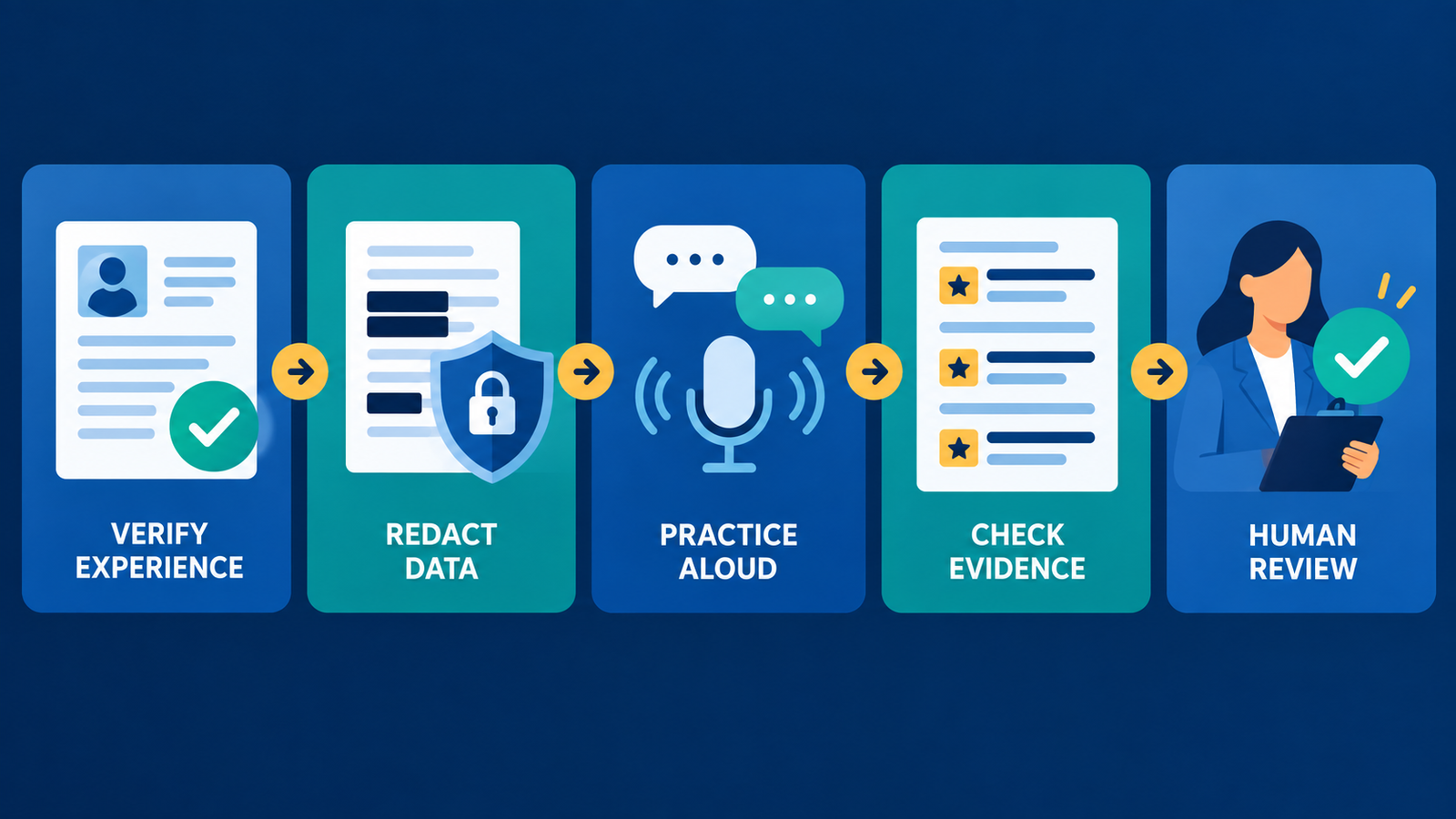
A safer five-step practice routine
- Remove phone numbers, addresses, references and confidential employer data from anything you upload.
- Give the tool the public job description and a short list of verified accomplishments.
- Answer aloud without reading a generated script.
- Review the transcript for relevance, evidence and missing context; treat pace and filler-word scores as signals, not verdicts.
- Repeat one weak answer, then ask a trusted person or career adviser to challenge the AI’s feedback.
The Associated Press has reported that career experts see value in using AI for mock questions while warning job seekers away from tools that secretly assist during real interviews and tests. That is the right line: use AI to strengthen recall and communication before the call, not to impersonate competence during it.
Frequently asked questions
Are AI interview practice tools free?
Several are free within limits. Teal includes two sessions, Yoodli includes five lifetime roleplays, and ChatGPT Voice and Gemini Live offer variable free access. Huru is a trial, Big Interview is usually paid unless an institution provides it, and Final Round AI requires Pro to launch practice.
Can an AI interviewer tell me whether my answer is correct?
Not reliably. It can flag structure, missing evidence, repetition and delivery patterns, but technical correctness and employer-specific expectations still need a knowledgeable human reviewer.
Should I upload my full resume?
Only if job-specific questions justify it and you accept the current privacy terms. A redacted resume plus the public job description is usually sufficient for practice.
Is it acceptable to use an AI assistant during a real interview?
Do not assume so. Undisclosed live assistance may violate an employer’s rules and can create a false impression of your skills. Ask for permission if an accessibility accommodation or approved tool is needed.


