
Alibaba’s new accelerator, Qwen roadmap and agent-focused cloud services show how tightly coupled AI infrastructure is becoming, but most performance claims still await independent testing.
NEW DELHI, September 22, 2026, 8:30 PM IST — Alibaba has unveiled a new AI processor, a roadmap for much larger Qwen models and a cloud stack built around autonomous agents, placing custom silicon, networking, storage and agent operations under one strategic plan.
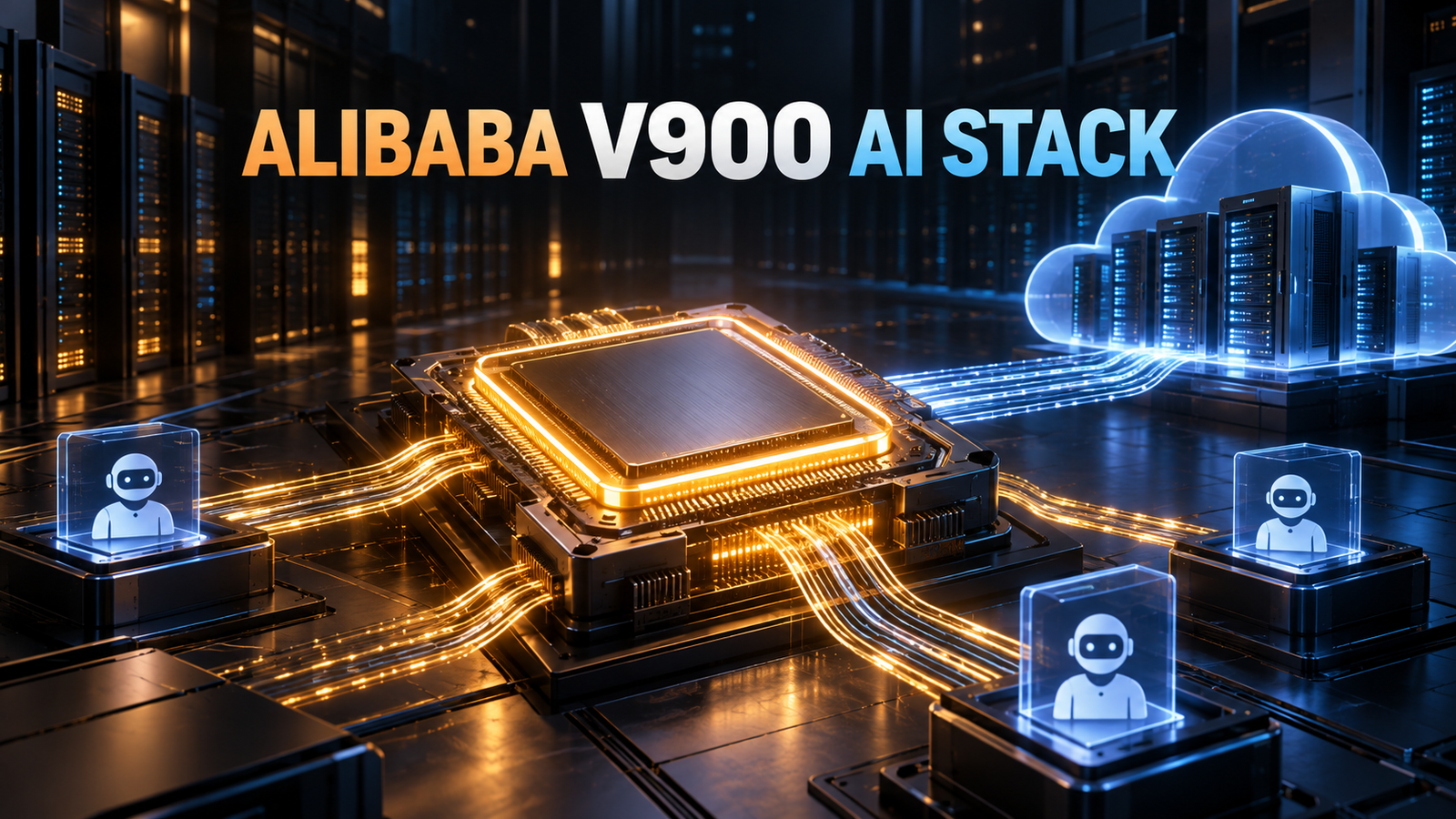
The centrepiece is the Zhenwu V900, a training-and-inference accelerator that Alibaba says delivers three times the performance of its previous Zhenwu M890. The company also said Qwen 4 is in training, while future Qwen 4.5 and Qwen 5 models are planned at a scale of five trillion to 10 trillion parameters.
For developers and platform teams, the more consequential story is not a single chip or model-size claim. Alibaba is trying to own the operational path from accelerator and interconnect through model training, agent runtime, security controls and enterprise context. That vertical integration could improve efficiency and simplify deployment for Alibaba Cloud customers, while also increasing dependence on one provider’s interfaces, hardware roadmap and regional availability.
What Alibaba announced
At the Apsara Conference in Hangzhou, Alibaba’s T-Head chip unit introduced the Zhenwu V900 with 216 GB of memory, 1,200 GB per second of inter-chip bandwidth and support for lower-precision formats including FP8 and FP4. Alibaba said the processor is intended for both high-precision training and lower-cost inference, and is scheduled for mass production and commercial release in the first quarter of 2027.
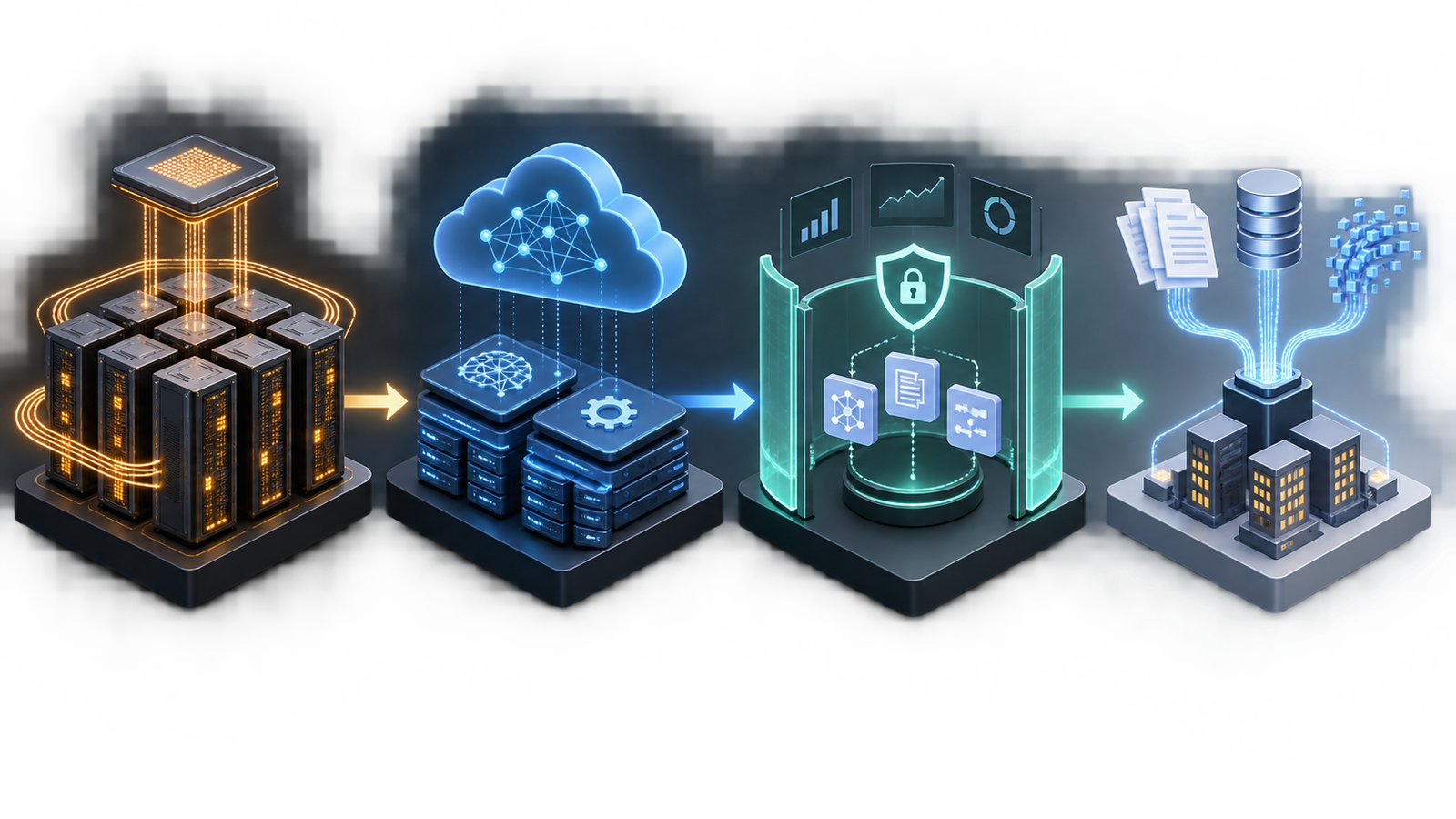
The company also described an upgraded supernode that combines the V900 with its own switch, SmartNIC and storage-controller technology. Alibaba said the design can support clusters containing as many as 500,000 accelerators. That is a maximum architecture claim, not confirmation that such a cluster has been deployed or independently benchmarked.
On the model side, Alibaba said Qwen 4 is currently in training. Its later Qwen 4.5 and Qwen 5 families are projected to reach between five trillion and 10 trillion parameters and target longer-horizon tasks. Parameter count is only a rough measure of model scale; it does not establish quality, reliability, serving cost or performance on production workloads.
Alibaba also reported two internal automation experiments. In one, Qwen3.8-Max completed 33 model-improvement cycles over a month and increased its Artificial Analysis score from 40 to 45. In another, the model made more than 10,000 electronic-design-automation tool calls over 60 hours and reduced the area of a chip bus module by 42 percent without a reported performance loss. These are company-reported results and should not be treated as proof of open-ended self-improvement.
An agentic cloud becomes part of the product
Alibaba grouped its cloud changes into model, harness and context layers. The model layer includes its Platform for AI, high-throughput parallel file storage and a new networking architecture. The harness layer adds AgentCore for building, running and monitoring agents, plus an Agent Security Center for policy and threat controls. The context layer includes an Agent Context service for real-time data and long-term memory, and an OpenLake upgrade designed to handle structured, unstructured, vector and streaming data.
The company claimed that Agent Context can reduce token use by as much as 67 percent in selected knowledge-heavy scenarios. It also said its upgraded storage and lakehouse systems can lower costs and improve query performance. Alibaba did not publish enough workload detail in its announcement to make those percentages directly comparable with other clouds, so engineering teams should treat them as starting points for evaluation rather than procurement-grade guarantees.
What developers and platform teams should watch
The V900 will not be commercially available until 2027, and Alibaba has not yet published independent accelerator benchmarks, instance types, regional availability or public pricing. Teams should therefore separate the announced roadmap from services they can test today.
When access becomes available, platform engineers will need to validate model compatibility, compiler maturity, observability exports, failure isolation and the portability of workloads between Zhenwu and other accelerators. FP4 support may lower inference cost, but teams should measure accuracy loss, output stability and tail latency on their own models rather than rely on theoretical throughput.
AgentCore and Agent Security Center also raise familiar production questions: how tools are permissioned, how secrets are scoped, whether every external action is auditable, and how a runaway task is stopped. GravityDevOps readers planning these controls can use the site’s LLMOps guide as an operational baseline and its RAG guide for the data and retrieval layer.
Alibaba said its global cloud data-centre capacity should surpass 20 gigawatts by 2032. That target signals the scale of the company’s ambition, but electrical capacity is not a standardised measure of delivered AI compute. The result will depend on chip supply, power availability, network utilisation and how efficiently models run on the stack.
A full-stack bet with execution risk
The announcement comes one week after Huawei detailed its Ascend 960 SuperPoD, adding to evidence that Chinese cloud and hardware companies are accelerating investment in domestic AI infrastructure. The approaches differ, but both emphasise system-level optimisation across accelerators, interconnects, cooling, storage and software rather than chip specifications alone.
Reuters reported that Alibaba’s Hong Kong-listed shares rose after the announcement and that customer demand for AI is running ahead of the company’s available supply. The Associated Press noted that Chinese-designed processors are gaining importance as US export restrictions limit access to some leading chips.
Alibaba’s plan is technically coherent: larger models require more compute, and agent workloads create new demands for memory, security and observability. The unanswered question is whether the company can ship the V900 at scale, expose mature developer tooling and deliver its claimed efficiency under real customer workloads. Until pricing, availability and independent results arrive, buyers should view the news as a roadmap with concrete milestones, not a completed platform transition.
Sources
Alibaba’s September 22 company announcement, distributed through Media OutReach; the official Apsara Conference page; independent reporting from The Associated Press and Reuters.


