

NEW DELHI, August 28, 2026, 5:05 p.m. IST — Amazon Web Services plans to add 2 million NVIDIA GPUs across its global infrastructure in 2027 and 2028, expanding a hardware programme announced only five months ago and tying the companies more closely across accelerators, CPUs, networking, managed models, data processing and robotics.
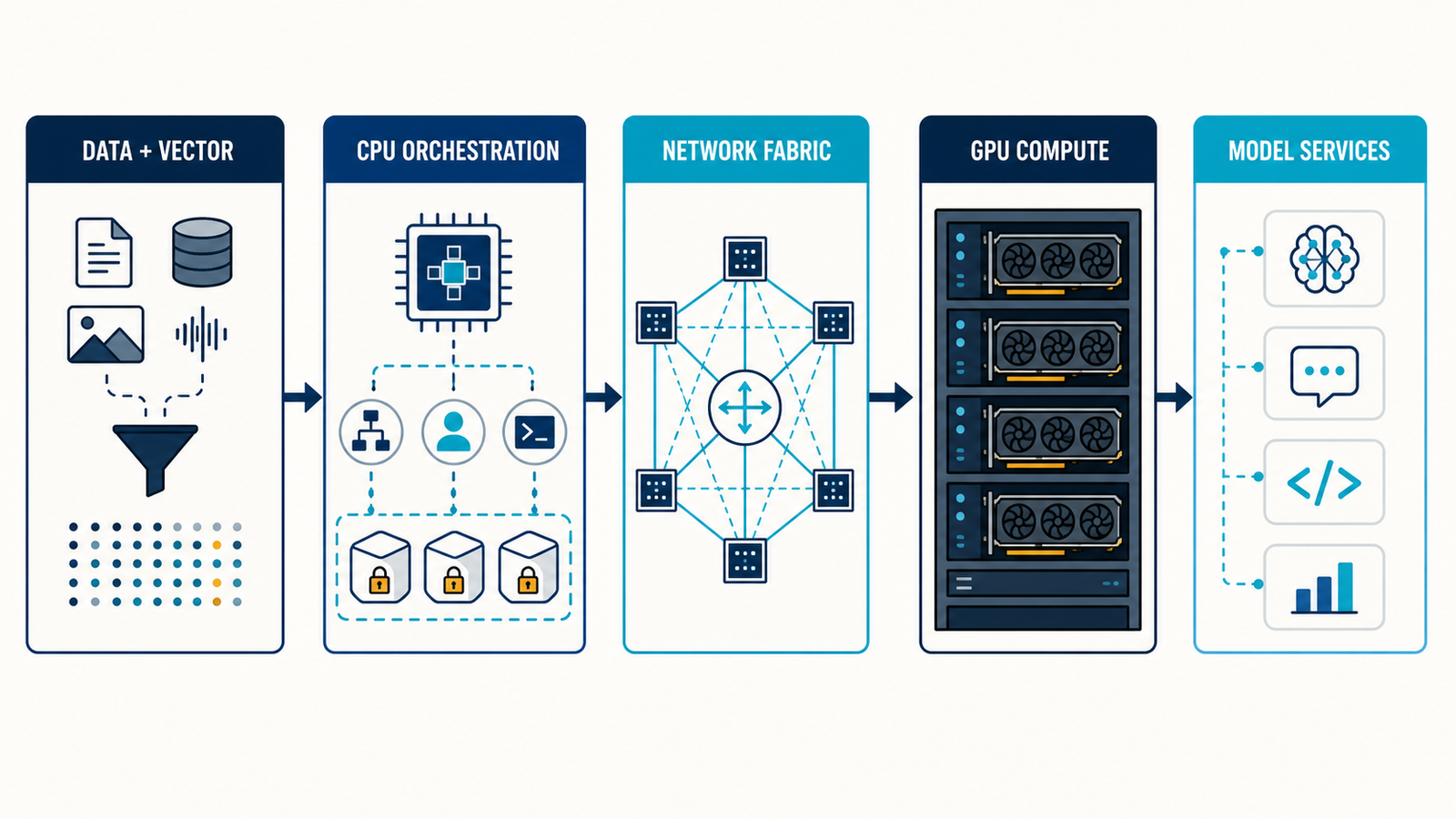
The size of the commitment is the headline, but the more immediate signal for cloud and platform teams is architectural. AWS is preparing for AI systems in which GPU capacity is only one part of the bottleneck: agent sandboxes, retrieval, orchestration, vector indexing and data preparation also place heavy demands on CPUs, memory, storage and network fabrics. The announcement does not promise lower customer prices or near-term instance availability, so teams should treat it as a capacity roadmap rather than a procurement shortcut.
What AWS and NVIDIA confirmed
In a joint announcement, AWS and NVIDIA said the additional fleet will include Blackwell Ultra, Rubin and Rubin Ultra GPUs. Deployment is planned for 2027–2028, on top of the more than 1 million NVIDIA GPUs AWS said in March it would begin adding in 2026.
The companies also said they are working to bring NVIDIA Vera CPU-based infrastructure to AWS, extend NVLink Fusion with NVIDIA custom high-bandwidth memory, and integrate NVIDIA systems with AWS Nitro and Elastic Fabric Adapter. A separate government component calls for AI factories with 100,000 GPUs on secure AWS infrastructure for U.S. federal and national-security workloads.
The partnership reaches beyond raw compute. NVIDIA Nemotron open models will remain available through Amazon Bedrock and SageMaker. AWS and NVIDIA also plan GPU-accelerated processing in Amazon EMR with cuDF, vector indexing in Amazon OpenSearch with cuVS, and expanded use of NVIDIA’s simulation, robotics and edge-computing stack inside Amazon Robotics.
AWS and NVIDIA attributed performance figures to their own testing: up to 3.7 times faster EMR data processing with 30% better price-performance than CPU configurations, and up to nine times faster OpenSearch vector indexing at one-quarter of the cost. Those figures were not independently reproduced in the announcement and should not be read as universal production results.
Why agent workloads change the infrastructure mix
Training clusters are often discussed as GPU systems, but production agents distribute work across more components. A single user request may trigger context retrieval, policy checks, code execution, external tools, repeated model calls and result validation. GPUs handle model inference, while CPUs and surrounding services coordinate sandboxes, queues, network connections and data movement.
NVIDIA said its Vera CPU contains 88 custom cores and 1.2 terabytes per second of memory bandwidth, and claimed up to 1.8 times faster per-core performance on agentic workloads. AWS has received an initial Vera CPU server and Vera Rubin GPU, according to an NVIDIA update. The company did not publish a date for customer-facing Vera instances on AWS.
This is also why the NVLink Fusion and NVHBM work matters. AWS is continuing to develop its own Trainium accelerators while adopting more of NVIDIA’s rack-scale architecture. A common high-speed interconnect and memory design could allow future systems to combine custom AWS silicon with NVIDIA components, but the announcement did not define instance types, region maps or portability guarantees.
For teams building retrieval-heavy services, the OpenSearch and EMR work may become more relevant than the headline GPU count. Feature engineering, ETL and index construction can delay deployments even when inference capacity is available. GravityDevOps readers planning these systems can review the practical boundaries between retrieval and generation in our guide to retrieval-augmented generation and the operating model described in LLMOps.
What developers and platform teams should do now
The announcement is a planning signal, not a reason to lock an application to unreleased hardware. Teams should benchmark complete request paths rather than tokens per second alone. Useful measurements include queue time, retrieval latency, tool-call duration, sandbox startup, cache hit rate, retry frequency and cost per successful task.
Platform designs should retain workload-level portability. Container images, model-serving interfaces, telemetry and evaluation suites should remain usable across current GPU instances, Trainium and future NVIDIA platforms where practical. That does not make accelerators interchangeable, but it reduces the migration cost when capacity, pricing or regional availability changes.
FinOps teams should also separate announced capacity from obtainable capacity. Reservations and committed-use decisions need confirmed instance names, regions, quotas, delivery dates and measured application economics. None of those customer-level details accompanied the 2 million-GPU plan.
For delivery pipelines, hardware changes should pass the same promotion gates as model changes: reproducible benchmarks, quality checks, load tests, failure-mode testing and rollback. The principles in GravityDevOps’ comparison of CI/CD tools apply directly to infrastructure variants that can change performance and cost without changing application code.
Scale is confirmed; economics remain unsettled
Independent coverage supports the scale of the deal. The Associated Press reported the 2 million-GPU plan alongside NVIDIA’s quarterly results and noted continuing supply constraints across the chipmaker’s chain. TechCrunch reported that financial terms were not disclosed and placed the expansion against AWS’s continued investment in its own Trainium and Graviton chips.
That tension is important. The agreement expands customer choice on paper, but it also concentrates more cloud infrastructure around NVIDIA’s full stack. AWS’s custom silicon remains a counterweight, and a mixed architecture could improve supply options. Actual customer outcomes will depend on software compatibility, quota access, energy and network constraints, and the price AWS sets for future services.
The confirmed development is therefore narrower than the biggest claims around it: AWS intends to deploy 2 million additional NVIDIA GPUs and deepen multiple technical integrations over the next two years. Whether that capacity lowers costs, shortens queues or improves reliability for a particular AI workload remains an open operational question.
Sources
AWS and NVIDIA joint announcement; NVIDIA Vera delivery update; Associated Press earnings and capacity report; TechCrunch infrastructure analysis.


