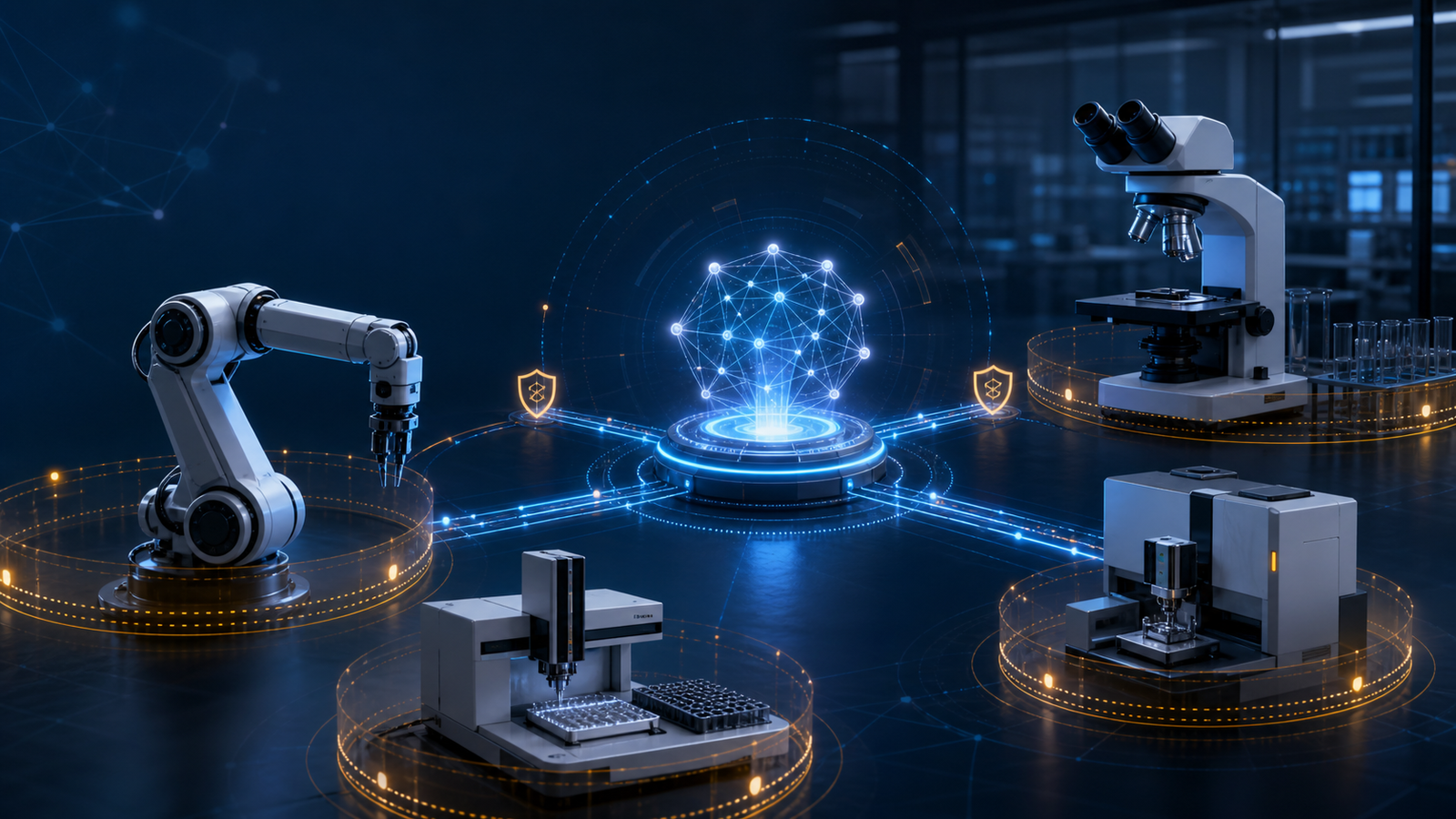

BENGALURU, India, August 29, 2026, 7:46 PM IST — Anthropic has opened a limited research preview of the Model Hardware Standard, a proposed common interface that lets AI agents discover and operate programmable equipment including microscopes, liquid handlers, robotic arms and quantum-laser systems.
The project, developed initially with HHMI Janelia Research Campus, aims to replace one-off integrations with standardized device drivers and a small set of read and write operations. Anthropic says the model-agnostic layer can be reached through the Model Context Protocol, command-line tools or conventional APIs, allowing an agent to coordinate multiple instruments without a custom translator for every connection.
The development matters because the operational risk changes when an agent moves from reading software data to changing a physical process. A shared interface could shorten integration work and make experiments easier to reproduce, but it also creates a common control path that platform and operations teams will need to secure as carefully as a production deployment system.
A preview, not yet an open standard
Anthropic announced MHS on August 27 and is accepting participants by application. The separate MHS preview site says partners will test the standard, build safety evaluations and develop deployment practices before an open-source release. No public release date is given.
That distinction is important. The announcement describes the architecture and several partner trials, but developers cannot yet independently inspect a complete public specification, conformance suite or general-release implementation. Claims about shorter integration times and experimental results come from Anthropic and participating organizations, not a broad, independent benchmark.
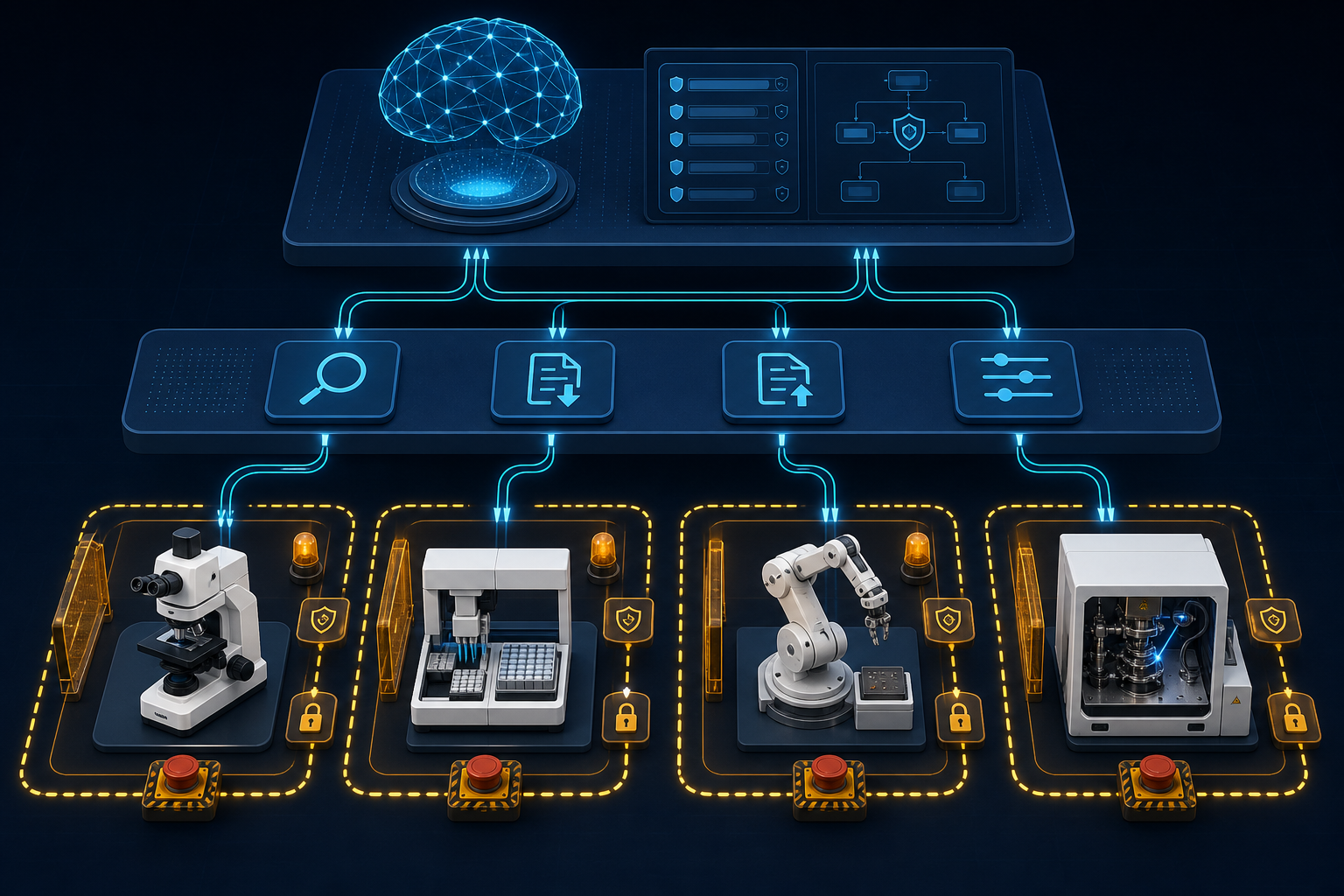
According to Anthropic’s announcement, an MHS driver exposes simple operations such as reading a temperature or changing a set point. It also carries a machine-readable reference assembled from device metadata and natural-language tags, including what a device can measure, what operators may adjust and which limits the driver will enforce.
An agent can then sequence work across instruments, inspect their state and adapt parameters. For longer or faster tasks, Anthropic says the agent can package commands into deterministic code so the equipment does not depend on a fresh model decision at every control-loop step.
Early trials span labs, factories and robotics
Anthropic reported that Genentech used MHS in a proof of concept coordinating a liquid handler, robotic arm and plate reader for a protein assay. Carnegie Mellon researchers used it in drug-discovery experiments, while QuEra Computing tested an agent that restored a laser operating condition inside a neutral-atom quantum system.
The company also named manufacturers and software projects exploring support, including Doosan Robotics, Tecan, Universal Robots, Raspberry Pi and Hugging Face’s LeRobot. These are early integrations rather than evidence of broad production compatibility.
A separate Strands Agents engineering post confirms that AWS participants are building MHS support into a pre-release version of Strands Robots. The implementation treats MHS as another network backend alongside local Zenoh networking and AWS IoT Core. In simulation, the same agent-facing abstraction can later point to real equipment, although switching from simulation to hardware still requires the controls appropriate to the physical system.
Quartz independently reported that the preview is limited and that Anthropic has not committed to a public-release date. It also highlighted a limitation acknowledged by Anthropic: models trained mainly from text and images can misunderstand physical causes. In one Genentech test, human experts had to identify sample foaming as a physical problem rather than a software fault.
What platform teams should evaluate
For developers and DevOps teams, MHS resembles an infrastructure adapter more than a complete autonomy platform. Standard discovery and commands can reduce integration work, but they do not eliminate the need for device identity, authenticated transport, least-privilege authorization, change approval and immutable audit records.
Operators should separate observation from actuation. Read-only telemetry can be exposed broadly, while write operations should be scoped by device, command, value range and time window. High-consequence changes may require a human approval or a second independent controller. Hardware interlocks and emergency stops must remain enforceable outside the model and its agent harness.
Network design is equally important. Discoverable devices should not automatically become reachable from every agent runtime. Teams will need segmented control networks, explicit allowlists and carefully reviewed gateways between cloud agents and factory or laboratory equipment. Credentials should be short-lived, and every action should carry the requesting identity, model and agent version, driver version, policy decision and resulting device state.
The same discipline applies to rollout. Start in simulation or with a digital twin, record traces, inject sensor and network failures, then progress through read-only shadow mode and constrained physical trials. Replays should verify that a deterministic script produces the expected outcome before it is allowed to control live equipment. GravityDevOps readers building those controls can draw on the site’s background guides to LLMOps, retrieval-augmented generation and prompt engineering for developers, while treating physical actuation as a separate safety domain.
What remains uncertain
MHS could reduce the repeated integration work that slows laboratory and industrial automation, particularly if manufacturers publish maintained drivers and independent conformance tests emerge. Its model-agnostic design also leaves room for multiple agent platforms rather than binding equipment to Claude.
But the preview does not yet establish interoperability across vendors at production scale. The public materials do not specify a final governance model, versioning guarantees, certification process, vulnerability-response policy or timeline for open sourcing. They also do not show whether natural-language device descriptions remain consistent enough for safety-critical use as hardware configurations change.
The immediate news is therefore narrower than a universal operating system for machines: Anthropic and its partners have exposed a promising common layer to controlled testing. For engineering teams, the useful next step is to evaluate how that layer fits beneath existing safety systems and above device-specific controls—not to treat the agent as the final authority.


