

NEW DELHI, July 2, 2026, 6:11 PM IST — Anthropic has restored broad access to Claude Fable 5 after U.S. export controls forced the company to suspend its newest frontier models for all customers last month, turning a policy dispute into a live reliability lesson for teams building on hosted AI APIs.
The company said in a June 30 update that export controls on Claude Fable 5 and Claude Mythos 5 had been lifted, with Fable 5 returning globally on Claude Platform, Claude.ai, Claude Code and Claude Cowork from July 1. Anthropic also said access through AWS, Google Cloud and Microsoft Foundry would be re-enabled as quickly as possible, while Mythos 5 remains limited to approved U.S. organizations under its Glasswing cybersecurity program.
For developers, DevOps engineers and platform teams, the immediate news is not only that a high-end model is back online. The bigger point is that model access can now change because of regulator action, provider-side guardrails, cloud marketplace timing and safety-classifier behavior. That makes frontier AI less like a static dependency and more like an operational service with policy, compliance and failover risks.
What is confirmed
Anthropic released Fable 5 and Mythos 5 on June 9. In its own account, the two products share the same underlying model, but Fable 5 was released with stronger safeguards for general availability, while Mythos 5 was restricted to a smaller set of trusted defensive-cybersecurity partners. On June 12, the U.S. government directed Anthropic to restrict access by foreign nationals, including foreign-national employees. Anthropic said it could not reliably verify nationality in real time, so it disabled access to both models for all users.
The Associated Press and Reuters reported that the Commerce Department lifted the restrictions after the company worked with the government on safeguards. Anthropic says Fable 5 is again available globally, while Mythos 5 is restored only for a set of U.S. organizations approved by the government.
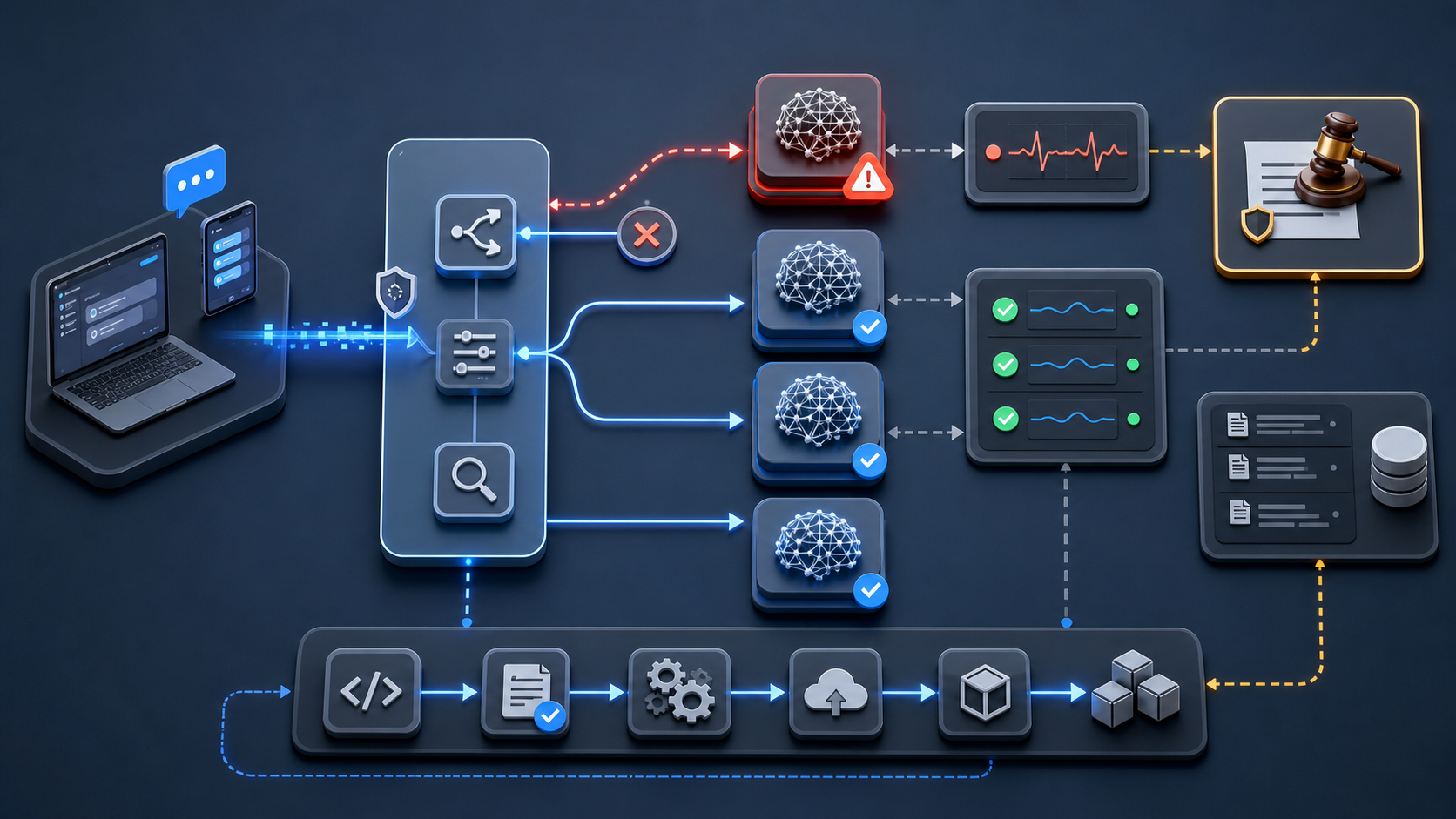
The technical mitigation is also important. Anthropic said it trained an improved safety classifier targeting the reported bypass, with blocked Fable 5 requests sent instead to Opus 4.8. The company said the specific technique described in the Amazon report is blocked in more than 99 percent of cases, but it also acknowledged a practical cost: benign coding and debugging requests may be flagged more often.
Why it matters now
The Fable 5 incident compresses several emerging AI-platform risks into one weekslong event. A model was launched, restricted, removed from general use, partially cleared, and restored with new runtime behavior. That timeline is familiar to incident-response teams even if the trigger was not a conventional outage.
AI application owners should treat this as a dependency-management signal. If a production workflow assumes one specific frontier model will always be available in one specific region, through one specific provider, it now has a single point of failure. That risk is not limited to Anthropic. AP also reported that OpenAI had restricted access to a new model at the administration’s request, indicating that government review of frontier systems could affect more than one lab.
There is also a user-experience issue. A request rerouted from Fable 5 to Opus 4.8 may be safer, but it can change latency, quality, cost and expected behavior. Teams using AI in coding assistants, support tools, security triage or automated remediation should monitor model substitution just as they monitor degraded API regions or changed cloud-service quotas.

Operational takeaways for DevOps and cloud teams
Platform teams should update AI runbooks to cover policy-driven access changes, not just provider outages. At minimum, production AI gateways should record model version, provider, route, refusal reason, fallback model and latency. That telemetry matters when a safety classifier introduces more false positives or when a cloud marketplace lags behind the primary vendor platform.
Teams already practicing LLMOps should add model-access resilience to their evaluation stack. That means testing prompts against primary and fallback models, validating acceptable behavior under stricter guardrails, and documenting which workloads can degrade gracefully. Retrieval-heavy systems should also verify that RAG pipelines still return useful results when the generation model changes.
Security and compliance groups should avoid treating frontier-model approval as a one-time procurement checkbox. The Fable 5 restoration shows that model availability may depend on external safety review, export-control interpretation and provider implementation details. That argues for regular vendor-risk reviews, clear customer-facing incident notices, and approval paths for emergency model substitution.
For developer-experience teams, the practical question is how much friction a safety margin introduces. Anthropic says the stronger classifier may block some legitimate coding and debugging tasks. Internal AI coding platforms should therefore track blocked-request rates and create escalation paths for legitimate defensive-security work. Good prompt engineering discipline helps, but it cannot replace observability around model refusals and reroutes.
What remains uncertain
Several details are still unresolved. Anthropic has not said exactly when every cloud-provider channel will be fully restored. The company says it will continue refining the new classifier, but customers will need real-world evidence on false positives, cost impact and fallback quality. It is also unclear how predictable future government reviews of frontier models will be for enterprise buyers planning multi-quarter AI deployments.
The balanced reading is straightforward: Fable 5’s return is good news for teams that were blocked from using the model, but it is not a return to the pre-incident baseline. Frontier AI systems are now operational dependencies shaped by model capability, safety controls, government review and cloud distribution. Teams building serious AI workloads should design for that reality before the next access change arrives.
Sources
This article is based on Anthropic’s Fable 5 redeployment update and its earlier statement on the June 12 suspension, plus reporting from AP, Reuters via WMBD and WIRED.


