
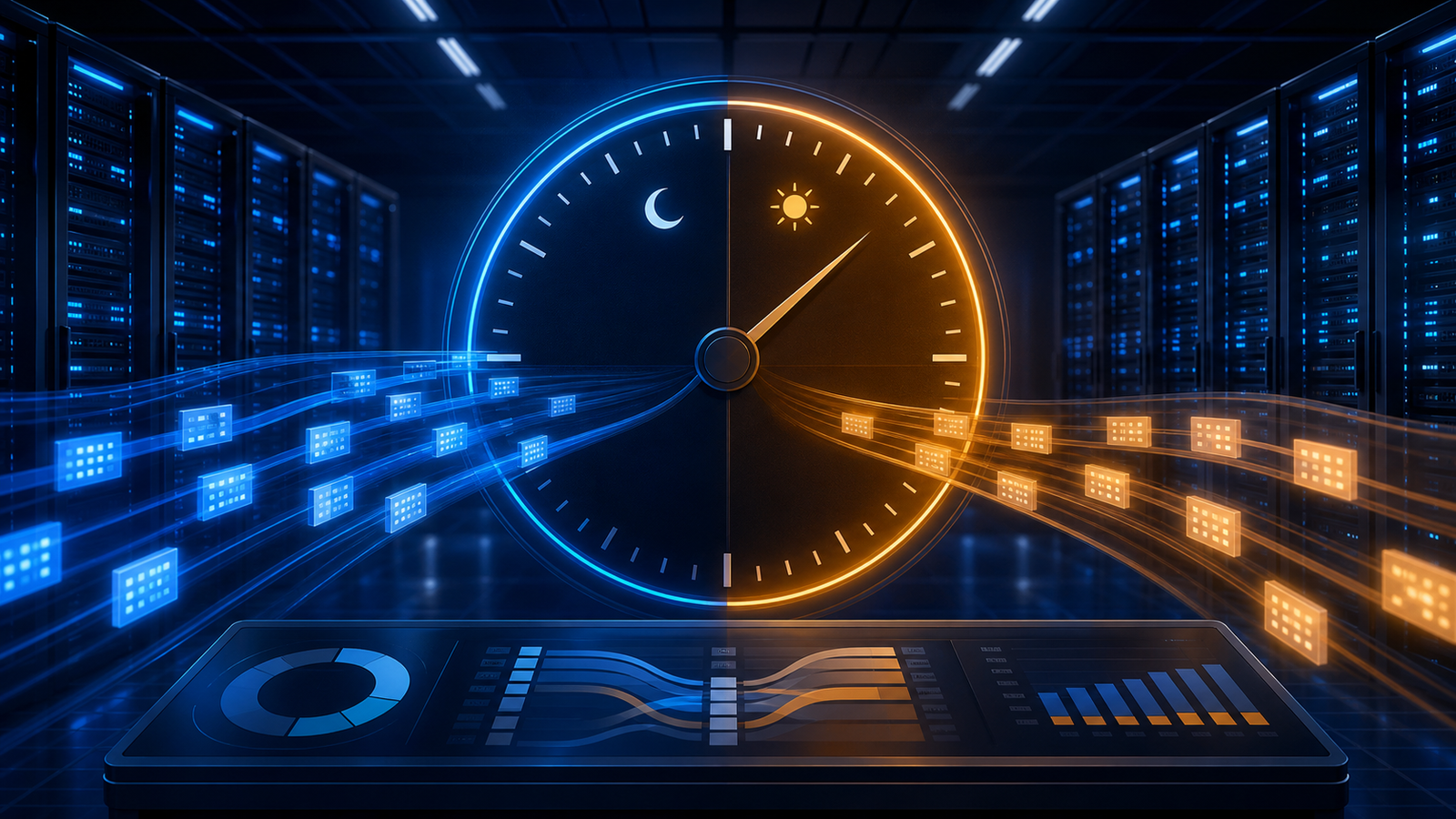

SEO excerpt: DeepSeek has put V4 Pro into general availability and activated time-of-day API pricing, giving AI platform teams a new reason to schedule batch inference and monitor token costs by UTC window.
NEW DELHI, August 17, 2026, 6:12 PM IST — DeepSeek has moved its V4 Pro model into general availability and activated a peak-and-off-peak pricing structure for its API, turning the time a workload runs into a material infrastructure cost variable.
The change took effect at 16:00 UTC on Sunday, or 9:30 PM IST on August 16, according to DeepSeek’s official API changelog. The company says the new schedule is intended to distribute demand more evenly. For engineering teams, the immediate consequence is more concrete: identical requests can now cost twice as much during two daily peak windows.
The shift matters because DeepSeek’s low token prices have made its models attractive for coding agents, document processing and other high-volume inference. Teams that treated the API as a flat-rate commodity now need the same scheduling, tagging and budget controls they already apply to cloud compute.
What DeepSeek confirmed
DeepSeek said the general-availability build of V4 Pro has rolled out across its app, website and API. Existing API integrations can continue using the deepseek-v4-pro model name, while the provider serves the latest version behind that identifier.
Both V4 Pro and V4 Flash now support low, high and max thinking-effort settings. DeepSeek recommends low effort for simple tasks, high for routine agent work and max for more complex jobs. Those labels describe a provider control, not a guarantee of accuracy or completion quality, so production users still need workload-specific evaluations.
The live DeepSeek pricing page lists peak hours as 01:00–04:00 UTC and 06:00–10:00 UTC every day. In India, those windows are 6:30–9:30 AM and 11:30 AM–3:30 PM IST. All other hours receive the off-peak rate.
For V4 Flash, cache-miss input costs $0.22 per million tokens off peak and $0.44 at peak; output costs $0.66 off peak and $1.32 at peak. For V4 Pro, cache-miss input costs $0.66 off peak and $1.32 at peak; output costs $1.98 off peak and $3.96 at peak. Cache-hit input is also billed at separate rates: $0.007 and $0.014 for Flash, and $0.022 and $0.044 for Pro.
Those are provider list prices and can change. They also do not represent the complete operating cost of an AI service, which may include orchestration, retrieval, observability, storage, evaluation, retries and human review.
Why the timing change matters
Time-of-day pricing is familiar in electricity markets and some cloud services, but it is still unusual as a first-class public pricing dimension for a foundation-model API. The policy creates a direct incentive to separate interactive traffic from work that can wait.
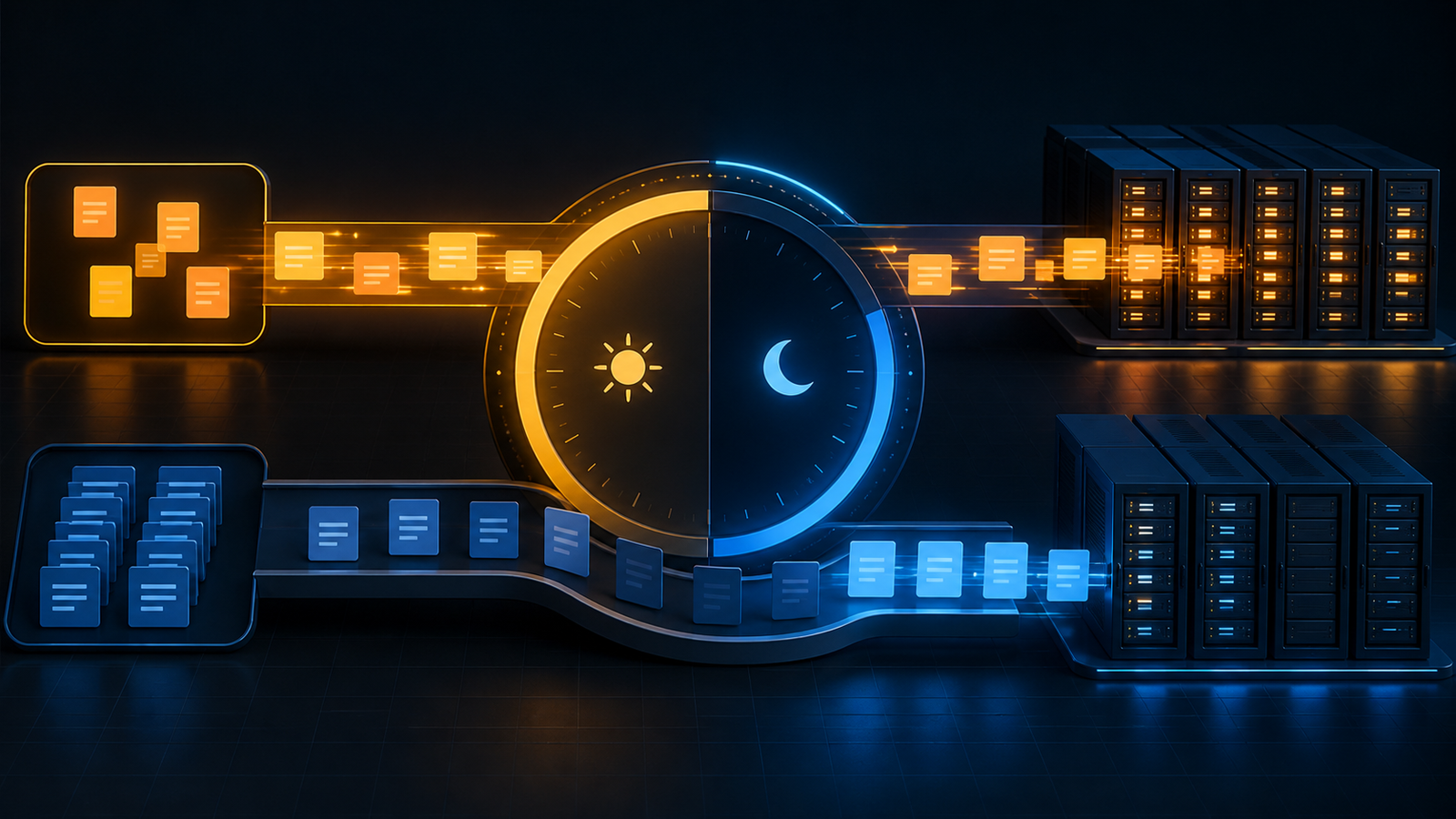
A customer-facing coding assistant may have little freedom to delay a response. Repository indexing, test-generation backfills, nightly document classification and evaluation suites often do. Moving those jobs outside the seven peak UTC hours could halve DeepSeek’s model charge compared with running the same token volume during peak periods.
The practical saving will vary with cache-hit ratio, input-to-output mix, retry behavior and the model selected. A nominal two-times peak multiplier does not mean every team’s total AI bill will double, and an off-peak queue is not automatically cheaper if delays create larger batches, stale results or operational failures.
A FinOps issue for AI platforms
Platform teams should now record the model version, thinking effort, input tokens, output tokens, cache status and UTC execution window for each request. Without those dimensions, a cost increase can look like unexplained model drift when it is actually traffic moving into a more expensive period.
Schedulers should use UTC as the source of truth because the provider defines its windows that way. Jobs that cross a boundary also need observation rather than assumption: DeepSeek’s public documentation states the price windows, but teams should verify how billing is applied to long-running or retried requests in their own account data.
Multi-model routers need updated price tables as well. A router that considers only a static per-token rate may keep selecting DeepSeek during peak hours even when another model offers a better cost, latency or reliability trade-off. Model choice should remain gated by quality evaluations; price alone is not evidence that two models are interchangeable.
This is also a change-management problem. If a model identifier silently advances to a new served version, teams should rerun regression suites for tool use, structured responses, refusal behavior and domain accuracy before expanding traffic. GravityDevOps’ guides to LLMOps and CI/CD tooling provide useful context for adding evaluation and approval gates around model changes.
Context: from price war to capacity signal
The South China Morning Post reported in June that DeepSeek was preparing peak-hour surcharges after helping trigger a broader model price war. The final schedule and dollar rates now published by DeepSeek differ from some of those earlier subscriber notices, so teams should treat the current official pricing page as authoritative.
DeepSeek’s V4 family was first released in preview in April with a one-million-token context window and open weights. The Associated Press covered the initial V4 rollout and the competitive claims around it. The latest general-availability announcement confirms deployment status, but it does not independently validate DeepSeek’s benchmark comparisons or establish production reliability for any particular workload.
The broader signal is that token pricing is becoming dynamic as providers balance demand, capacity and market share. AI operations teams should expect pricing configuration to change more often than traditional software license schedules and design budgets accordingly.
What teams should watch next
DeepSeek has not promised that the current hours or prices are permanent. Teams should watch for billing-export changes, version identifiers, latency during the cheaper windows and any clarification on requests that begin near a boundary. They should also keep a tested fallback model for service continuity rather than shifting all traffic solely to chase the lowest listed rate.
For now, the confirmed change is straightforward: V4 Pro is generally available, thinking effort is configurable across Pro and Flash, and API usage has a daily price clock. The operational response is equally clear—measure by request, schedule what can wait, and keep quality and reliability ahead of headline token prices.
Sources
DeepSeek, API changelog; DeepSeek, models and pricing; DeepSeek, thinking-mode documentation; South China Morning Post; Associated Press.


