

SEO excerpt: Varonis says Google has patched a Dialogflow CX weakness that could let an authorized editor abuse Code Blocks across agents in the same project. The practical lesson is least-privilege access, change review, logging and isolation for AI agents.
BENGALURU, India, July 8, 2026, 11:03 p.m. IST – Google has fixed a security issue in Dialogflow CX that researchers say could have let a user with agent-edit permissions turn one chatbot into a route for tampering with other agents in the same Google Cloud project.
The flaw, disclosed by Varonis under the name Rogue Agent and reported by SecurityWeek, is not a case of an unauthenticated attacker tricking a public chatbot with a clever prompt. It is more operationally relevant for platform teams: an already authorized user could abuse a feature intended for agent customization and make the effect persist inside a managed agent runtime.
Axios reported that Google said the issue has been fully mitigated, that it found no evidence of customer compromise, and that no customer action is required. That matters. This is a patched vulnerability, not an active emergency advisory.
Still, the disclosure is useful for developers, DevOps engineers, cloud security teams and AI platform owners because it shows how AI agent permissions are becoming production change controls. When a chatbot can run scripted logic, call tools or sit near customer conversations, the right to edit an agent is closer to the right to deploy software than the right to tweak copy.
What Is Confirmed
- Varonis says it reported the issue to Google in November 2025, saw an initial fix in April 2026, and confirmed full remediation in June 2026.
- The research focused on Dialogflow CX Playbooks and Code Blocks, a feature Google documents as a way to define custom logic for conversational agents.
- According to Varonis, the attack path required the Dialogflow playbook update permission on an existing agent. It was not described as a public internet takeover.
- The risk centered on persistence and cross-agent impact inside the same project, including the possibility of manipulating conversations, influencing agent behavior or exposing sensitive conversation data.
- Google’s position, as reported by Axios, is that the problem has been mitigated and that customers do not need to take remedial action for the patched service issue.
How the Weakness Worked
Dialogflow CX is Google Cloud’s platform for building conversational AI agents. Its Playbooks feature lets builders define goal-oriented behavior, and Code Blocks can add custom logic. That flexibility is valuable for enterprise agents because real workflows often need validation, routing, data lookup and conditional behavior.
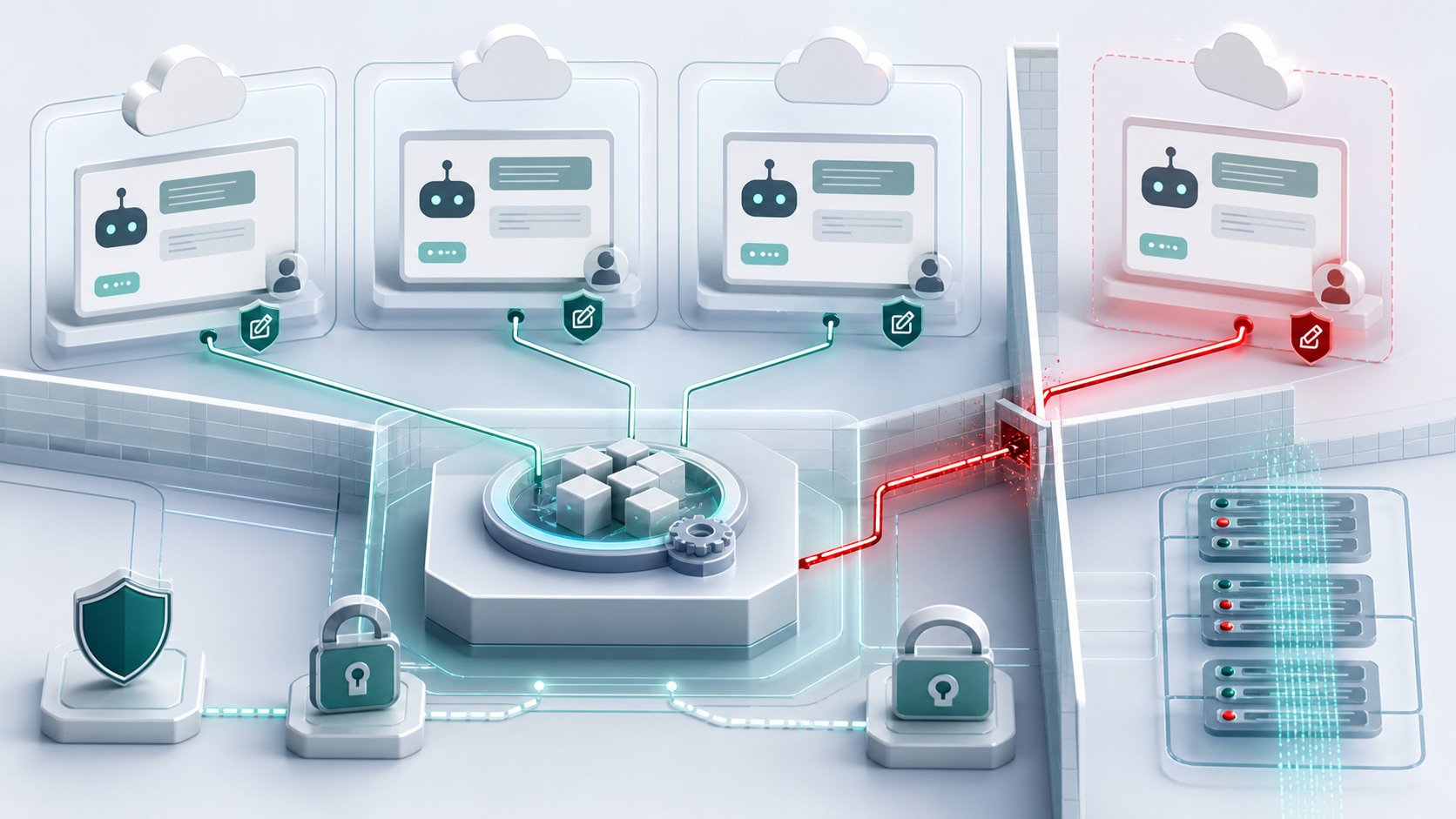
Varonis says Rogue Agent exploited how Code Blocks were handled inside Dialogflow CX’s managed runtime. With the right edit permission, a malicious or compromised user could alter one agent and create effects that reached beyond that agent’s expected boundary. The research described potential impact across nearby agents in the same project, including conversation hijacking, response manipulation and data exposure scenarios.
The important distinction is that this was not only a prompt safety problem. Prompt injection matters, but this disclosure sits closer to cloud application security: identity, permissions, runtime isolation, logging and blast-radius control. In other words, it belongs on the same risk board as IAM changes, CI/CD approvals, secret access and production configuration drift.
Why It Matters for DevOps and Cloud Teams
The industry is quickly moving from simple chatbots to agents that can call tools, execute workflow steps and interact with internal systems. That shift makes agent configuration part of the delivery pipeline. A change to a playbook, tool route, connector, code block or retrieval policy can alter production behavior just as surely as a code deployment.
For teams building AI support bots, internal copilots, IT automation agents or customer-facing workflow agents, the lesson is practical. Treat agent-edit permissions as privileged production access. Restrict them with least privilege, require peer review for changes, and monitor update events in the same way teams monitor infrastructure or application releases.
This also connects to broader LLMOps work. Teams maintaining model-backed systems need versioned prompts, controlled rollouts, evaluation gates, incident rollback paths and observability. GravityDevOps readers tracking this discipline can connect the disclosure to our guide on what LLMOps means in production, as well as our developer-focused coverage of prompt engineering and RAG architectures.

Operational Readout
The immediate customer-facing message from Google, via Axios, is calm: the service issue has been fixed and no customer action is required. Platform teams should not treat the disclosure as a reason to pull Dialogflow CX out of production without evidence of exposure.
The better response is to use the event as a control-plane check. Inventory which agents can run custom logic. Review who can update playbooks and agent behavior. Make sure audit logs for agent configuration changes are retained and reviewed. Separate sensitive customer-facing agents from experimental agents when the blast radius would be unacceptable. Avoid placing secrets in agent code or conversation context. Confirm that chatbot systems do not ask users for credentials or other data that should never enter a conversational channel.
Those checks are not specific to Dialogflow CX. The same pattern applies to any managed agent system, tool-calling framework, MCP-style integration layer or chatbot that can reach enterprise data. AI agents are now part of the software supply chain, and the same rigor that teams apply to CI/CD pipelines needs to extend to agent configuration and runtime access.
Timeline and Context
Varonis says it disclosed the issue to Google in November 2025. Google shipped an initial fix in April 2026 and a full fix in June 2026, according to the research firm. Varonis published its technical write-up on July 7, and SecurityWeek covered the vulnerability for the broader security audience on July 8.
The timing fits a wider pattern in AI security. The first wave of enterprise AI risk centered on model choice, data retention and prompt safety. The next wave is about agent infrastructure: tool permissions, runtime isolation, cloud IAM, logs, connectors and deployment governance. For DevOps teams, that is familiar terrain, but the assets and ownership lines are newer.
Balanced Analysis
The disclosure should not be overstated. There is no public evidence in the cited reports that customers were compromised, and the affected managed service path has been patched. The attack also required existing permissions, which means it was not equivalent to a random external user taking over a bot from the public internet.
But it should not be dismissed either. Many AI agent projects are still owned by product, support, marketing or innovation teams before platform engineering is fully involved. That can leave agent builders with broad edit rights, weak review processes and limited log review. Rogue Agent is a reminder that AI agents are not just content surfaces. They are configurable software systems with identities, runtimes and blast radiuses.
The practical takeaway for GravityDevOps readers is simple: the more useful an agent becomes, the more it deserves normal production controls. That includes least privilege, environment separation, audited changes, pre-release evaluation and a rollback plan that does not depend on a single vendor console.
Reader Questions
Do Dialogflow CX customers need to patch anything? Google told Axios that the issue has been fully mitigated and that no customer action is required. Teams should still review permissions and logs as part of normal cloud hygiene.
Was this just prompt injection? No. Prompt injection is part of the broader agent-security landscape, but this disclosure was about edit permissions, Code Blocks and managed runtime behavior.
What should platform teams prioritize? Start with who can update agents and playbooks, then review logging, change approvals, project separation, secret handling and rollback paths for AI agent workflows.
Sources
This report is based on Varonis research on Rogue Agent, SecurityWeek’s July 8 coverage, Axios reporting on Google’s response, and Google Cloud documentation for Dialogflow CX Playbooks and Code Blocks.


