

NEW DELHI, July 16, 2026, 10:59 PM IST — Google Cloud has added Parallel Web Search as a native grounding option for Gemini Enterprise Agent Platform, expanding how enterprise AI agents can retrieve current public-web information and attach source citations to their answers.
The integration is available in preview through the Gemini API, Agent Studio and Google Cloud Marketplace. It matters for engineering teams because web grounding is becoming an operational dependency for agents used in research, compliance checks, catalog enrichment and other workflows where stale model knowledge can cause costly errors. Google is also making the search provider a selectable component rather than tying every workload to a single retrieval path.
What Google Cloud confirmed
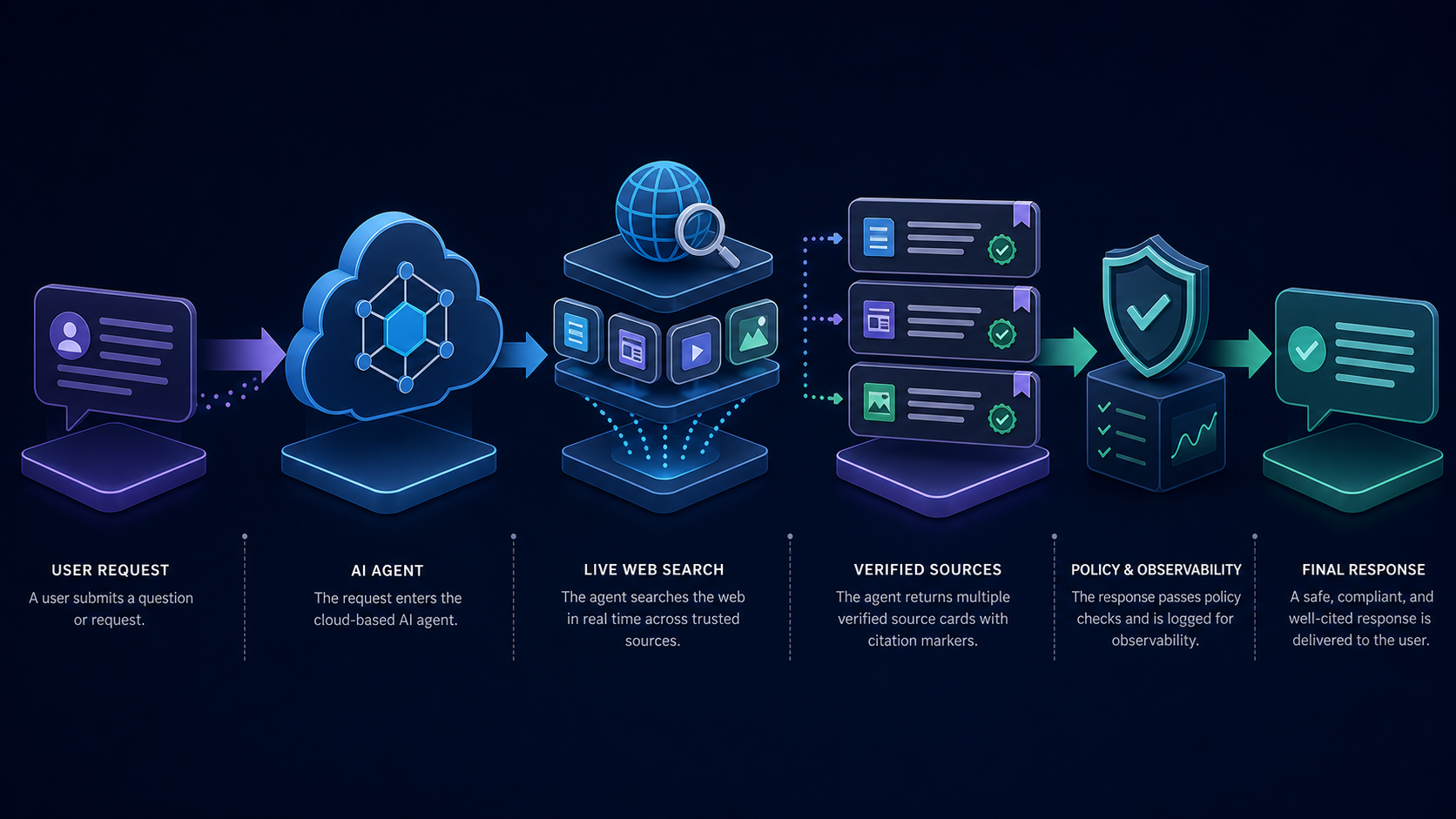
Google announced the partnership with Parallel Web Systems on Thursday. According to the Google Developers Blog announcement, the service connects Gemini models to Parallel’s web index and returns citation annotations tied to original sources. Developers can subscribe through Google Cloud Marketplace, select the provider in Agent Studio or call it through the Gemini API.
The accompanying Google Cloud documentation describes the capability as a separate offering governed by its own terms. It is currently marked pre-general availability, which means support and behavior can change before a full production release.
Supported models listed by Google include Gemini 2.5 Flash, Gemini 2.5 Flash-Lite, Gemini 2.5 Pro, Gemini 3.1 Pro preview, Gemini 3.1 Flash Lite and Gemini 3.5 Flash. The default quota is 200 prompts per minute, with higher limits handled through Google or Parallel support, depending on how the service is purchased.
Customers have two access paths. They can buy the service through Google Cloud Marketplace and consolidate charges on their existing cloud invoice, or bring an existing Parallel API key and retain separate billing. Google also documents an optional zero-data-retention offering for sensitive workloads, but teams must subscribe to that specific option and enable it in requests.
The operational tradeoffs behind live-web grounding
Grounding does not make an agent automatically correct. It changes the failure mode: instead of relying only on a model’s training data, the system can retrieve recent pages and expose citations that users or downstream services can inspect. Retrieval quality, source selection, publisher changes and prompt decomposition still affect the result.
Google says the integration is intended for multi-hop research, information enrichment, employee assistants, consumer applications and autonomous tasks such as news analysis or know-your-customer checks. The company also highlights the ability to extract and cache results, enrich internal datasets and pass retrieved context to other models in a multi-agent system.
That flexibility creates governance work. The documentation says Google sends data including queries derived or rewritten from the original prompt to Parallel for processing. Platform owners should therefore review data classification, retention configuration and regional requirements before allowing confidential user requests into the retrieval layer. A zero-retention option is useful, but it is not a substitute for preventing secrets or regulated data from entering a public-web search request.
Costs also span more than one meter. Google lists Gemini prompt, thinking and output tokens, grounding charges and Parallel search usage as potentially billable components. Teams should measure cost per successful grounded task rather than only model token cost, particularly when agents retry searches or decompose a question into several queries.
What developers and platform teams should do now
For developers, the immediate benefit is architectural choice. A web-grounded workflow can use Parallel inside the same Gemini request path, while the bring-your-own-key option keeps an existing Parallel commercial relationship. Google also says results can be post-processed with other language models, which can help teams avoid coupling an entire orchestration graph to one model.
For DevOps and platform teams, preview status should shape rollout. Start with a bounded workload, pin supported model identifiers, set request and spend limits, and capture the query, retrieved sources, citations, latency and final output in traces. Evaluate whether cited pages actually support the claims made, not merely whether citations are present.
Teams should also add regression tests for time-sensitive questions, source-domain allow or deny policies where appropriate, and fallbacks for search failures. If retrieved web material is cached into an internal corpus, ownership and deletion rules need to be explicit. GravityDevOps readers building that layer may also find the site’s guides to retrieval-augmented generation and LLMOps useful for separating retrieval quality from model quality and operating the combined system.
Why the announcement matters now
Enterprise agent platforms are moving from model-only APIs toward managed combinations of models, search, private data connectors, policy controls and observability. Google Cloud already offers other grounding paths, including Google Search, Maps, Agent Search, RAG Engine, Elasticsearch and custom search APIs. Adding Parallel positions retrieval-provider choice as part of the platform architecture rather than a hidden implementation detail.
The announcement does not establish that Parallel grounding is more accurate, cheaper or faster than Google’s other options; Google published no comparative benchmark in the launch post. Those claims remain to be tested against each organization’s data, latency targets and risk profile. The practical news is narrower but significant: Gemini Agent Platform customers now have another managed live-web retrieval path, with citation support and explicit choices around billing, API access and data retention.
Sources: Google Developers Blog; Google Cloud documentation; Google Cloud grounding overview; Parallel Web Systems.


