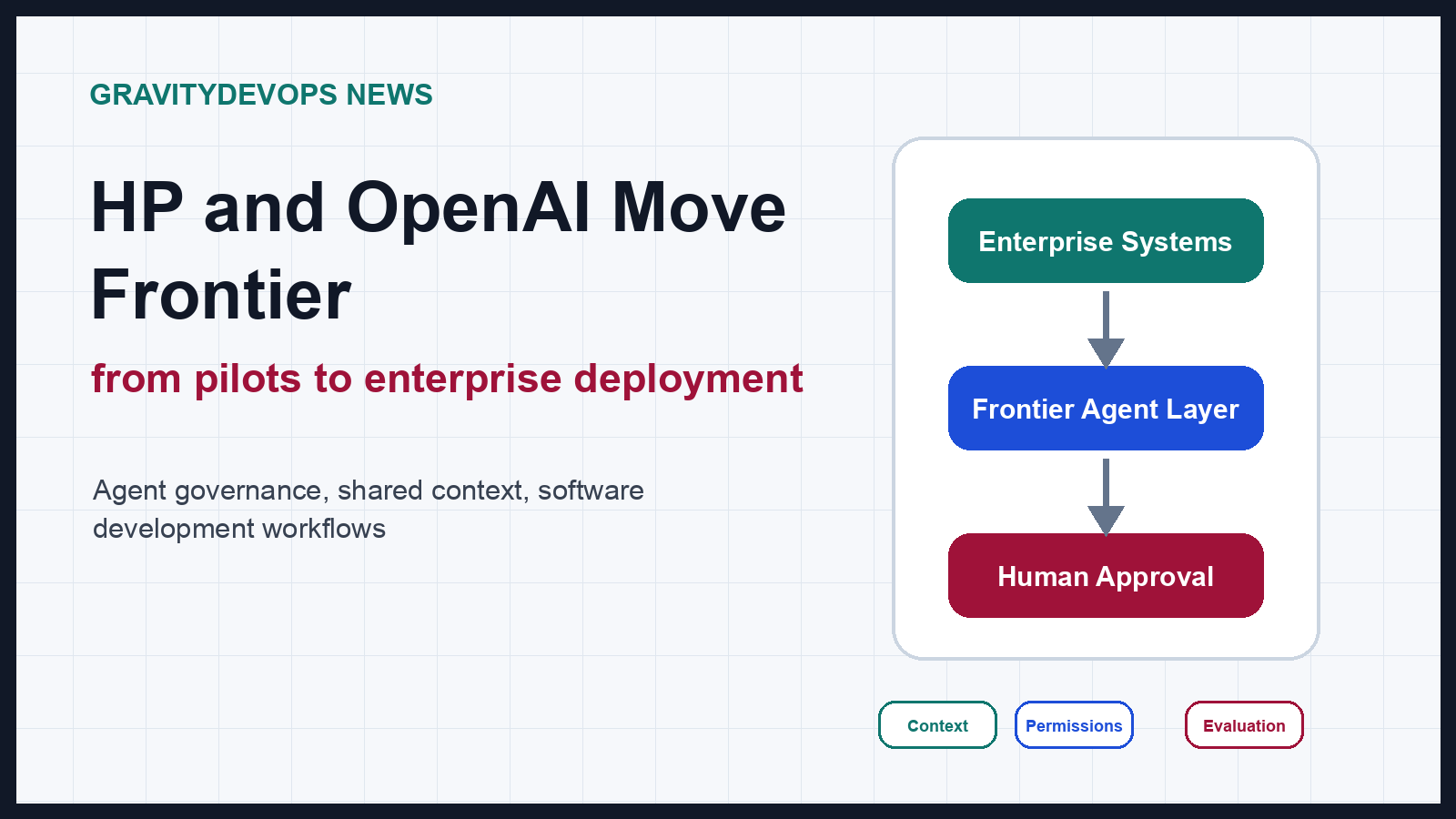

NEW DELHI, June 28, 2026, 8:55 p.m. IST – HP Inc. and OpenAI have launched a strategic partnership that will move OpenAI Frontier from selected pilots into a broader enterprise deployment across HP customer experiences, telemetry insights, employee productivity and software development.
The announcement matters because it gives enterprise AI teams a fresh, named example of agentic AI moving beyond isolated experiments. HP says it started evaluating Frontier in February 2026, testing agent capabilities, platform components, security and enterprise integration before committing to a wider rollout. OpenAI, in a separate company post, framed the move as a shift from pilot wins to an operating model for production AI work.
For developers, DevOps engineers and platform teams, the practical signal is not simply that another large company is adopting AI agents. It is that the adoption is being described in the language of shared context, governed access, evaluations and workflow integration – the same control-plane concerns that already shape cloud platforms, CI/CD systems and LLMOps programs.
What HP and OpenAI Confirmed
HP said on June 28 that it will integrate OpenAI Frontier into global efforts to improve customer-facing experiences and accelerate internal operations. The company listed four initial areas for deployment: customer and partner-facing solutions, customer telemetry insights and reporting through HP’s WXP platform, employee productivity and software development.
OpenAI published its own account of the partnership the same day, saying HP will scale activation of Frontier after earlier pilots. OpenAI said the pilots included use of its tools by HP engineering and security teams, including one engineer moving through 122 pull requests across 43 projects over several weeks and a security team remediating several software bugs in a day. Those figures come from OpenAI’s post and should be read as company-reported examples, not independent benchmarks.
The companies did not disclose the number of HP employees covered by the rollout, a production timeline, commercial terms, model mix, or audited performance results. That leaves several important questions open for technology buyers, especially around cost, governance overhead and how many agent workflows can safely move from recommendation to action.
Why Frontier Is The Technical Centerpiece
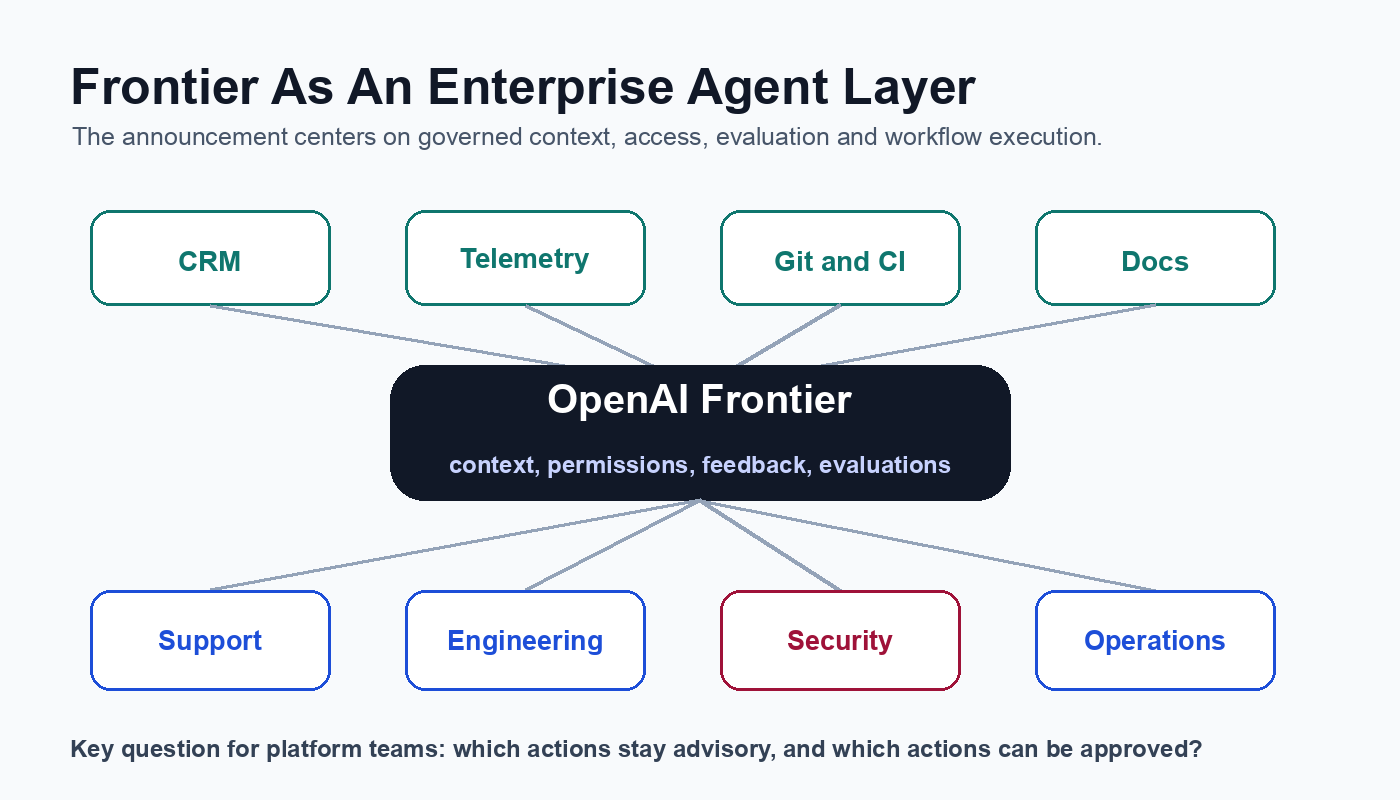
OpenAI introduced Frontier earlier in 2026 as an enterprise platform for building, deploying and managing AI agents. The company described the platform as giving agents shared business context, onboarding, feedback loops, permissions and boundaries so they can work across systems rather than live inside one chat window or one application.
That positioning is important for platform engineering teams. A useful enterprise agent typically needs access to ticketing systems, code repositories, runbooks, observability data, documents, identity systems and business applications. Without a governed layer for context and permissions, every agent integration can become another one-off automation with unclear ownership and uneven auditability.
In HP’s case, the official announcement points to customer support, telemetry reporting and software development as near-term deployment areas. Those are high-friction workflows where AI can help with triage, summarization, code review preparation and root-cause investigation, but they are also areas where incorrect actions can affect customers, production systems or security posture.
DevOps Impact: Treat Agents Like Production Systems
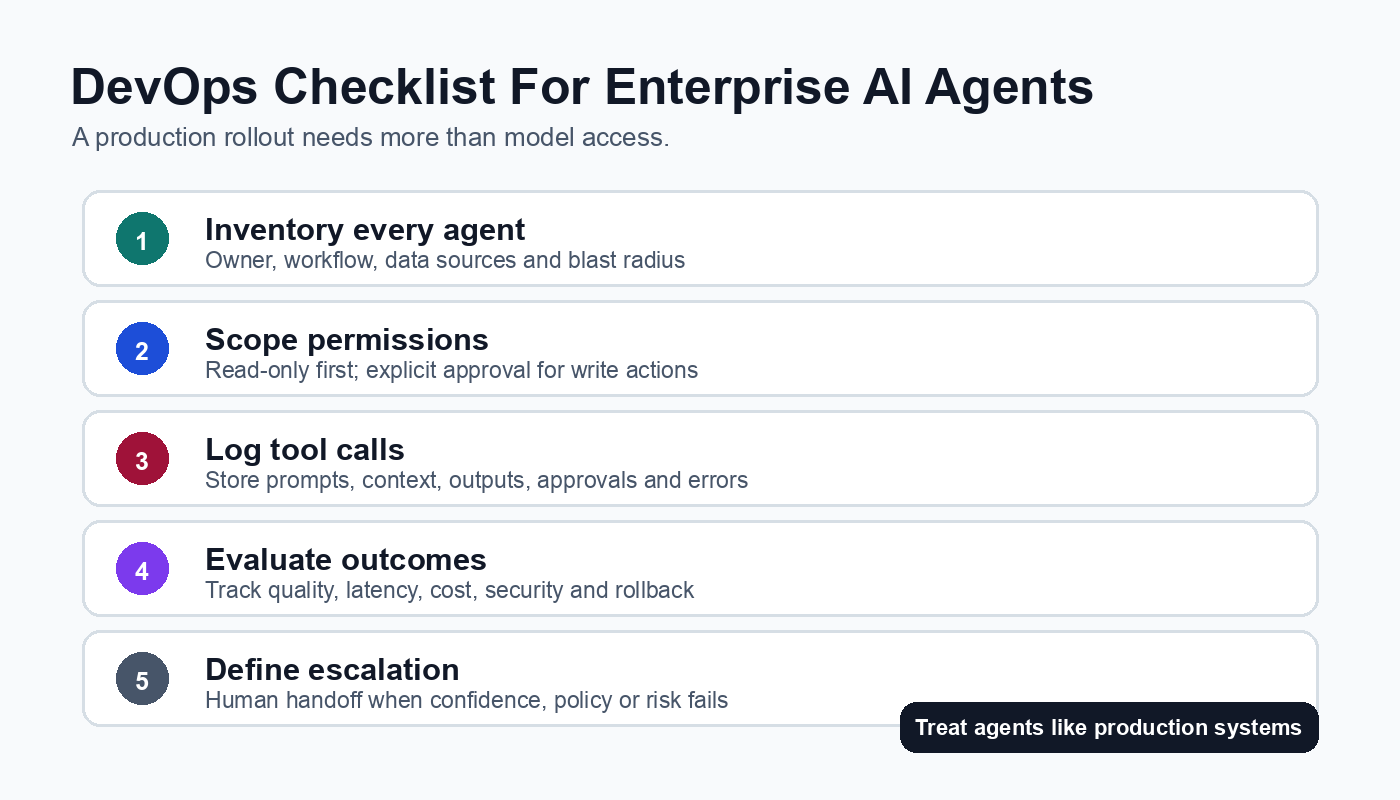
The HP/OpenAI announcement should push DevOps and cloud teams to treat enterprise agents as production systems rather than productivity experiments. That means inventorying agent workflows, mapping what data each workflow can read, defining who can approve write actions, logging tool calls and measuring outcomes with operational metrics.
A sensible rollout pattern is read-only first. Agents can summarize incidents, inspect CI failures, draft pull-request notes, compare logs, or assemble remediation plans before they receive permission to modify code, rotate credentials, change cloud resources or update customer-facing records. That approach keeps the learning loop active while limiting blast radius.
Teams already investing in LLMOps, retrieval-augmented generation and CI/CD governance have a head start. The same practices that help with model evaluation, prompt quality, source grounding, rollback planning and release approvals can be adapted for agent workflows. The difference is that agents introduce action, identity and permissions as first-class operational concerns.
What Remains Unclear
The announcement is meaningful, but it is still a vendor and customer rollout story rather than proof that agentic AI is broadly solved in the enterprise. HP and OpenAI did not publish a full architecture, security model, evaluation methodology, incident-handling process or cost profile. Buyers should avoid treating the partnership as evidence that similar results will transfer directly to their environment.
There is also a difference between a successful pilot and a durable production service. Once agents sit across customer interactions, telemetry systems or software development workflows, organizations need ownership rules, failure modes, escalation paths and business-continuity plans. They also need to decide which outputs can be automated, which require human approval and which should remain advisory.
The most useful near-term takeaway for GravityDevOps readers is that the enterprise AI conversation is moving from model access toward operating models. The relevant questions are shifting from which chatbot to buy toward how to govern AI agents that can see business context, invoke tools, learn from feedback and potentially affect production work.
What Platform Teams Should Watch Next
Over the next few months, platform leaders should watch whether HP and OpenAI publish more detail on deployment scope, measured productivity, security controls and integration patterns. Clearer evidence on code-review throughput, defect rates, customer-resolution time and human approval rates would be more useful than broad claims about transformation.
Technical decision-makers should also track whether Frontier becomes a closed enterprise layer or an interoperable control plane for agents from multiple vendors. OpenAI has described Frontier as built on open standards and positioned it as a way for in-house, OpenAI and third-party agents to share business context. If that interoperability holds in practice, it could reduce agent sprawl. If it does not, enterprises may face another round of platform lock-in.
For now, the HP/OpenAI partnership is best read as a credible marker that large enterprises are preparing to operationalize AI agents in real workflows. The work for DevOps teams is to make sure those workflows arrive with the same discipline expected of any production platform: scoped access, observability, evaluation, approvals and rollback paths.


