
SEO excerpt: Britain gains first international access to Ukraine’s Avengers Labs dataset, putting secure data pipelines, joint assurance and pilot deployment at the center of defense AI.
NEW DELHI, August 25, 2026, 6:09 PM IST — The United Kingdom and Ukraine have signed an artificial-intelligence partnership that will give British researchers and companies access to Ukraine’s Avengers Labs battlefield-data platform, creating a government-backed route from operational sensor data to jointly developed AI systems.
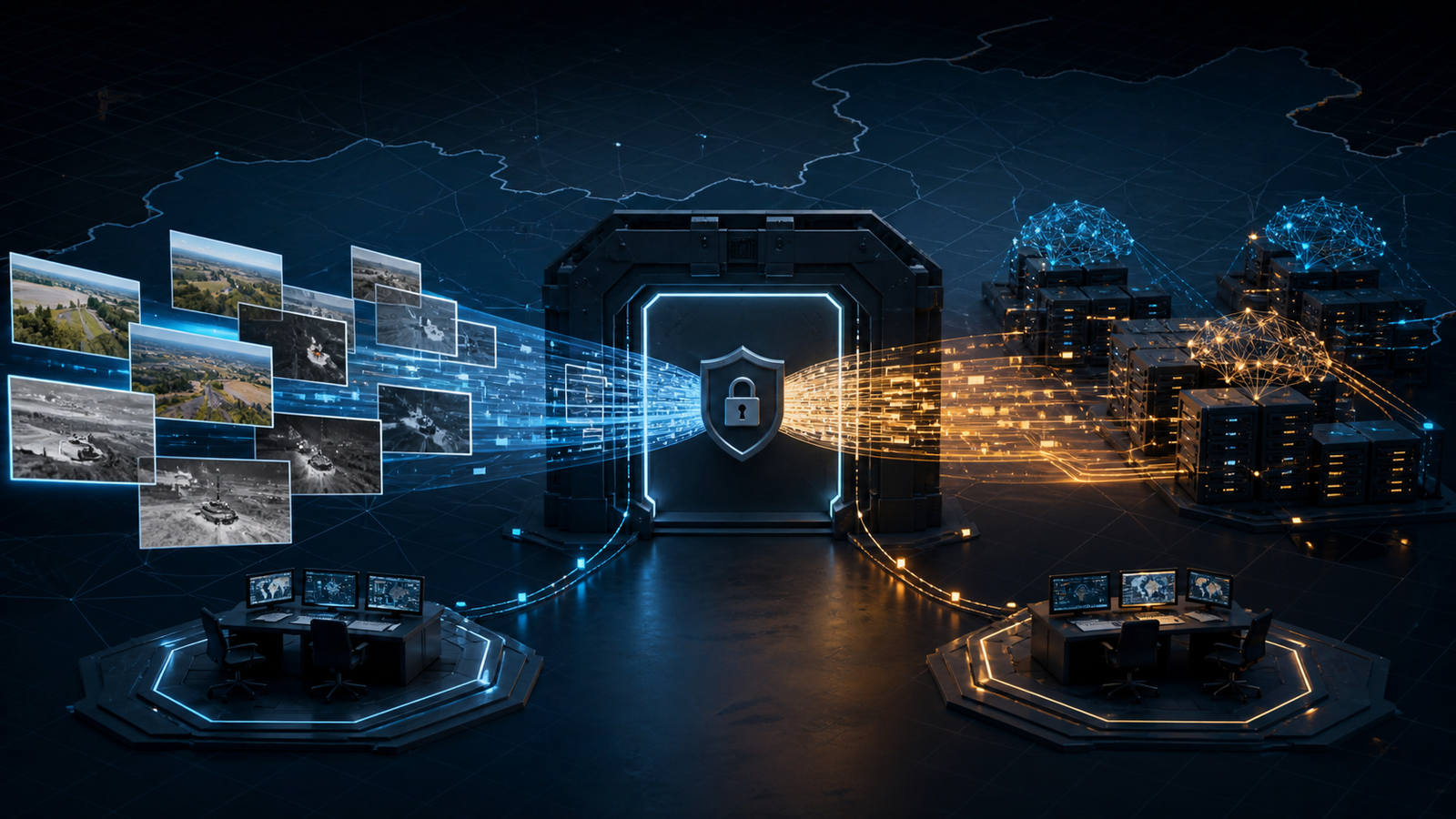
The agreement matters beyond defense because it moves a hard production question into the foreground: how do teams share rare, sensitive, continuously changing data across organizational and national boundaries without losing control of provenance, access or deployment? The joint declaration calls for secure data and compute pathways, joint assurance, and protections for sovereignty, intellectual property and export-controlled material. Those are the foundations of an MLOps control plane, not details to add after a model works.
What the UK and Ukraine confirmed
The UK government said on August 24 that Britain will become the first international partner to access Avengers Labs. The platform uses imagery and sensor observations collected in Ukraine to train models for detecting objects including tanks, artillery, air-defense systems, infantry and aerial targets.
Ukraine’s Ministry of Defence said earlier this month that Avengers Labs is built around five million annotated battlefield frames, most drawn from the DELTA combat-management system and continually supplemented with new operational data. It said the platform already supports an automated target-detection system that processes more than 100,000 drone video streams a month.
The ministry also reported a 70 percent real-time detection rate for enemy targets. That number should be read as a government-reported operational metric, not an independently reproduced benchmark. Neither government disclosed the evaluation set, class balance, precision and recall, false-positive cost, environmental breakdown or the frequency with which models are retrained.
Reuters independently confirmed the signing, Britain’s first-partner status and the five-million-frame scale, citing the two governments. The partnership itself is broader than dataset access. A separate joint declaration says the countries intend to work through government, industry and academic channels on co-developed models, secure data and compute pathways, autonomy, cybersecurity, synthetic data and joint assurance.
The declaration is political intent rather than a legally binding agreement. It says implementation will be pilot-first and that more detailed arrangements are expected within the next few months.
From shared data to deployable systems
The announced pilots show that the program is not limited to training vision models. One trial involving British companies Sintela, Mind Foundry and Skyral will use Ukrainian data with fiber-optic sensing technology at a UK defense site. The government said similar technology could later be considered for airports, prisons, railways and energy infrastructure. A second project will explore low-power AI chips for drones, robotics and autonomous systems.
Those pilots span distinct operational domains, which makes data governance and model qualification more important. A detector trained on aerial battlefield imagery cannot simply be assumed to perform reliably on signals from buried fiber, and a model validated on one sensor generation may drift when optics, infrared characteristics, geography or adversarial behavior change.
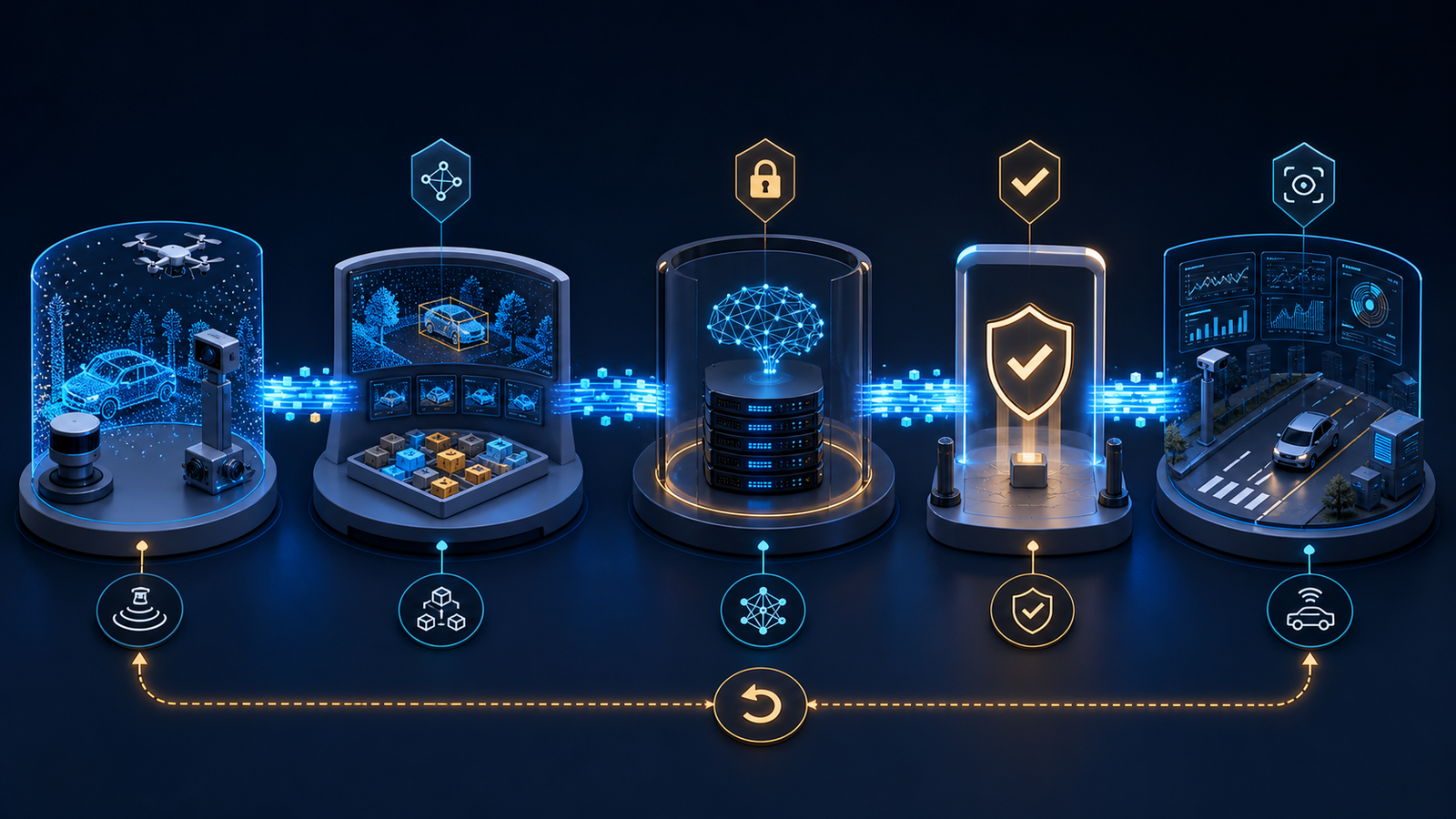
For developers and platform teams, the practical work begins with versioning the entire evidence chain: source sensor, capture time, annotation policy, label revision, transformation history, training snapshot, model artifact and approval record. A model registry alone is insufficient if the dataset lineage behind a release cannot be reconstructed.
This is the same discipline that underpins reliable LLMOps, but the consequences are more severe. Offline test scores need to be paired with scenario tests, sensor-specific thresholds, human review rules, canary deployment, rollback criteria and monitoring that distinguishes data drift from system failure. For teams designing delivery controls, the principles overlap with mature CI/CD pipelines: signed artifacts, separated environments, explicit promotion gates and auditable changes.
Security starts before model training
The public documents promise trusted safeguards but do not describe the implementation. They do not specify whether British participants will receive raw data, work through a controlled query or training environment, or obtain access to curated subsets. They also leave classification tiers, retention periods, personnel screening, tenant isolation, export-control enforcement and incident response undisclosed.
That uncertainty is consequential. Centralizing real-world sensor data creates a valuable training asset and a high-value target. The platform must defend against unauthorized extraction, poisoned annotations, malicious uploads, model inversion and leakage through logs or derived artifacts. Access should be scoped by project and purpose, with short-lived credentials and immutable audit records. Training jobs and evaluation jobs should run in isolated environments, and exports should be policy-checked rather than treated as ordinary file downloads.
The data also changes continuously. A safe pipeline needs quarantine and validation stages before new observations enter a trusted training corpus. Annotation disagreement should be recorded rather than flattened away, particularly for ambiguous or degraded imagery. Teams should track performance by sensor, weather, geography and target class instead of relying on a single aggregate percentage.
The declaration’s reference to synthetic data introduces another verification problem. Synthetic examples can expand coverage of rare conditions, but they can also amplify simulator assumptions or create shortcuts that look useful in validation and fail in deployment. Production teams need separate reporting for real and synthetic samples, provenance at the record level and held-out tests drawn from operational data.
What remains uncertain
The agreement does not identify which British organizations will receive Avengers Labs access, what model families they may train, how intellectual property will be divided or who will authorize deployment. It also does not say whether the three named pilot companies will directly access the five-million-frame dataset.
There is no public model card, independent audit, safety case or detailed account of human authorization for the operational systems described by Ukraine. The 70 percent detection claim therefore cannot establish reliability, safety or suitability for a new environment. False positives and false negatives carry very different costs, and aggregate detection rates conceal both.
The partnership is nevertheless a notable shift from general defense-AI commitments to a shared operational data program. Its success will be measured less by the size of the dataset than by whether the partners can preserve traceability, constrain access and prove that each deployed model behaves within an approved envelope.
Why this matters for cloud and platform teams
Most enterprises will never handle battlefield data, but many face the same architecture in less extreme form: proprietary records are shared with an external model team, transformed across multiple pipelines and used to drive actions in a regulated environment. The UK–Ukraine program makes the control requirements unusually visible.
The portable lesson is to keep retrieval, training and action permissions separate. A team that can search sensitive source material should not automatically be able to export it, retrain a production model or deploy a new version. Where systems use retrieval rather than training, source-level citations and access-aware indexing remain essential; GravityDevOps’ overview of retrieval-augmented generation explains that basic pattern.
For technical decision-makers, the immediate questions are concrete: Can every model output be traced to an approved data snapshot? Can a compromised partner account be contained? Can a release be rolled back without losing the audit trail? Can teams measure performance separately across sensors and environments? The public partnership sets the right headings. The next test is whether its implementation makes those controls observable.
Sources
This report is based on the UK government partnership announcement, the joint declaration of intent, the Ukraine Ministry of Defence description of Avengers Labs and Reuters’ independent report.


