
Direct answer: Canva is the best free AI image generator for social media when you need generation, editable layouts, platform templates and export in one place. Adobe Express is the strongest alternative for template-led posts, while Ideogram is better for artwork containing short display text. Every free option has an allowance, privacy or usage-rights tradeoff.
Social media images are finished designs, not just attractive model outputs. A useful tool must help you create the scene, crop it for different feeds, add exact text, preserve a product or person, and export without introducing a licensing surprise. Free plans make those jobs possible, but rarely without account requirements, public generations, pooled credits or premium-only brand controls.
This comparison was checked on August 30, 2026, using current US-facing product, pricing, help and terms pages. It is a documentation-based review, not a GravityDevOps matched-prompt image-quality test. Allowances and model access change frequently, so confirm the live meter and download terms before building a recurring content workflow.
Best free AI image generators for social media at a glance
| Tool | Best for | Free access checked | Main limitation |
|---|---|---|---|
| Canva | Complete social-post workflow | Free editor and pooled AI allowance | Premium assets and larger allowances require payment |
| Adobe Express | Template-first branded posts | Free editor and limited daily AI generations | No durable numerical Free generation quota |
| Ideogram | Artwork with short display text | 10 weekly slow credits, up to 40 images | Free generations are public |
| ChatGPT Images | Prompt-led concepts and revisions | Image creation on Free with a separate variable limit | Needs a layout editor for precise multi-format production |
| Gemini | Editing a supplied product or portrait | Free image generation for eligible US users | Compute-based limits can change |
| Leonardo.Ai | Style exploration and reference images | 150 tokens daily | Free creations are public |
| Microsoft Designer | Personal social graphics | Free with a Microsoft account | Consumer license is personal and non-commercial |
Bottom line: start with Canva or Adobe Express if the deliverable is a finished post rather than standalone artwork. Choose Ideogram when short text inside the generated scene matters, or ChatGPT and Gemini when conversational editing is the main job. Use Microsoft Designer only for personal posts unless your separate Microsoft license expressly covers commercial work.
How we selected and ranked these social media image generators
We screened ten credible services: Canva, Adobe Express, Ideogram, ChatGPT Images, Gemini, Leonardo.Ai, Microsoft Designer, Recraft, Krea and Midjourney. To rank, a tool needed current zero-dollar access in the United States and a practical path from prompt or reference image to a social-ready visual. A short credit-card trial did not count as a free plan.
The ranking weighs social-format support, editable text and layout, reference-image control, free allowance, reset behavior, watermark, export practicality, public or private defaults, commercial-use language and ease of revision. Ongoing free access ranked above a one-time allowance. We penalized unpublished quotas, public generations and terms that limit a free output to personal use.
We verified product behavior and limits from official documentation and used the Artificial Analysis Image Arena only as independent context on general model preference. That leaderboard does not measure social-post readability, brand consistency, factual accuracy or conversion performance. We did not claim hands-on quality testing.
1. Canva: best free all-in-one social media image generator
Canva Magic Media can generate photos and graphics in square, landscape or portrait layouts, then place the result directly into an editable design. Canva also provides social templates, uploads, stock elements, typography and a large format library. That combination is more useful for daily publishing than a model that stops after producing one flat image.
Canva Free currently estimates up to 200 monthly uses of Standard AI or 20 uses of Premium AI. Those are pooled allowances rather than separate quotas for image generation, and the practical total varies by feature. The Free plan also includes one limited Brand Kit with three colors. A design using Pro content must be upgraded, purchased or have the premium element removed before download.
Limitation: Canva requires sign-in, and its free AI allowance may be consumed by other tools. Canva says users own Magic Media creations subject to its terms, but copyright protection can be uncertain and the service cannot clear rights in recognizable people, brands or copyrighted characters. Check every stock element and uploaded asset separately.
2. Adobe Express: best for template-first branded posts
Adobe Express Generate Image supports style and composition references, then opens a result in the Express editor for text, templates, brand elements and social formats. It is a strong fit when you have a real product photo or campaign image and need a new background, alternate crop or related scene rather than an entirely synthetic post.
Adobe gives Express Free users a limited number of daily generative uses across a curated set of models. The company does not publish one durable numerical Free quota, so the in-product meter is the source of truth. Basic editing remains available after the allowance is exhausted, but premium templates, assets, brand functions and generative resizing can require a paid plan.
Limitation: Adobe’s generative-credit guidance confirms a limited daily allowance without promising a fixed count. Firefly features are designed for commercial creative work, but that does not grant permission to use a logo, likeness, copyrighted character or source image you do not control.
3. Ideogram: best for artwork with short display text
Ideogram Free provides 10 slow credits each week, enough for up to 40 images under its published maximum. It supports multiple aspect ratios and is particularly useful for poster-like social concepts where a few visible words are part of the artwork. Ideogram says it does not restrict the user’s rights in outputs.
Limitation: Free generations are public by default, and private generation is paid. Image upload and some editing workflows require priority credits, which the Free plan does not include. Do not use the free tier for an unreleased campaign, confidential client material or a private reference photo. Even when generated lettering looks good, replace mission-critical dates, prices and calls to action with editable text.
4. ChatGPT Images: best for prompt-led concepts and revisions
ChatGPT Images can create and edit images conversationally, follow aspect-ratio requests, use uploaded references and make targeted revisions. It is useful for moving a subject, simplifying a background, creating negative space for copy or turning one approved concept into several visual directions.
Image creation is available on ChatGPT Free, but OpenAI publishes no fixed Free image count. The image allowance is separate from the main chat limit, and ChatGPT shows reset timing after the user reaches the current cap.
Limitation: ChatGPT is not a precision multi-canvas layout tool. Export the artwork and add exact typography, safe margins and final crops in a design editor. Before uploading a client photo, product roadmap or unreleased campaign, review the account’s Data Controls and applicable workspace policy.
5. Gemini: best for editing a supplied product or portrait
Gemini Apps can generate and edit images from text, an uploaded photo or multiple reference images. The workflow is well suited to preserving a real product or authorized portrait while changing the setting, lighting or surrounding composition for different posts.
Google provides free image generation to eligible users in the United States, including expanded personalized generation for eligible accounts. Limits are compute-based and can vary with demand, model choice and prompt complexity rather than following one reliable production quota. Generated images include SynthID provenance.
Limitation: the free allowance is not predictable enough for a high-volume calendar. Review faces, hands, labels, prices and factual details at full resolution. Google tells users to avoid violating copyright and privacy rights, and a generated likeness does not replace the subject’s consent.
6. Leonardo.Ai: best for visual styles and reference control
Leonardo.Ai gives Free users 150 tokens each day, with presets, multiple models and limited image-guidance controls. It is useful for exploring illustrated campaigns, stylized product scenes and visual themes before moving the chosen asset into a social layout editor.
Limitation: token cost varies by model, size and operation, so 150 tokens does not equal a fixed number of finished posts. Free creations are public. Leonardo permits commercial use under a non-exclusive license, while retaining broad rights to public prompts and outputs. Paid plans add private generation and stronger quality controls.
7. Microsoft Designer: best for personal social graphics
Microsoft Designer can generate images, banners and social designs from a description, add text and shapes, remove or blur backgrounds, and export the result. The consumer app is free with a Microsoft account, although Microsoft says a subscription may be required for more frequent creation.
Limitation: Microsoft’s current consumer FAQ licenses Designer for personal, non-commercial use. That makes it unsuitable for a company, paid client or monetized campaign unless another applicable subscription and agreement grants the necessary rights. Microsoft also does not publish a stable Free generation count, and generated text may contain spelling errors. AI outputs carry Content Credentials metadata.
Tools we screened but did not rank
- Recraft: it offers 30 daily Free credits and capable image, vector and editing tools, but Free Tier assets are public, owned by Recraft and restricted to personal use. Upgrading later does not retroactively change those rights.
- Krea: limited free generation is available, but current model and export entitlements are less transparent for a repeatable social-post workflow than the ranked options.
- Midjourney: it remains a major image generator but does not provide a continuing general free plan that fits this zero-cost comparison.
How to create better social media images with free AI
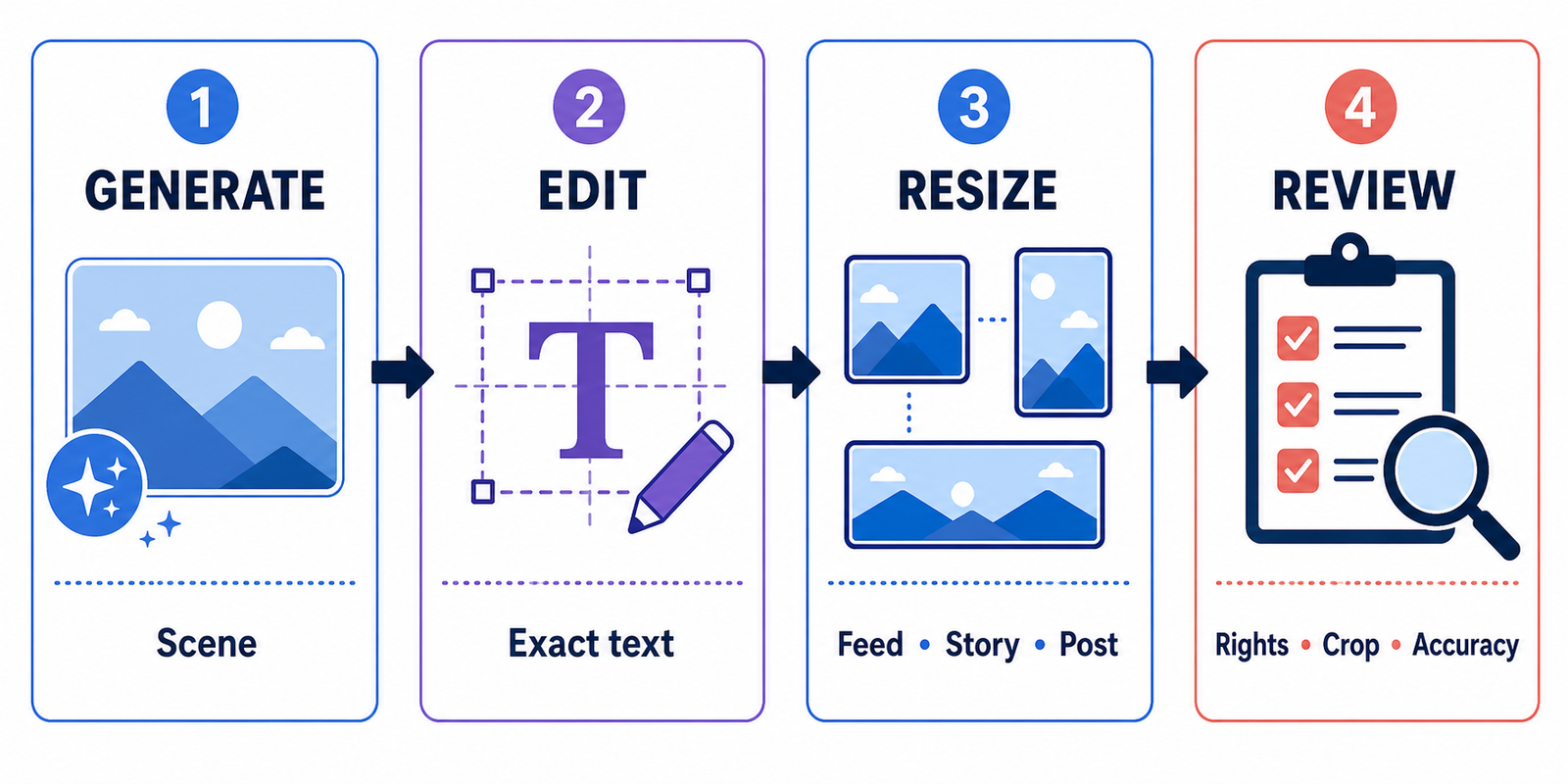
- Start with one platform and placement. Choose the feed, story, ad or link-preview format before prompting. A square master is convenient, but automatic crops can remove a face, product or call to action.
- Generate the scene without critical copy. Ask for one clear focal subject, clean foreground-background separation and negative space. Add exact headlines, dates and prices as editable text afterward.
- Use approved references. Upload a product, logo or portrait only when you have permission. Tell the model what must remain unchanged, then compare the result against the source at full size.
- Build a small reusable system. Save two fonts, a restrained color set, logo placement and safe margins. Consistency usually matters more than generating a radically different style for every post.
- Export and inspect each crop. Preview the final image on a phone and check edges, text, faces, hands, labels and contrast. LinkedIn, for example, recommends 1080-pixel-wide photos and accepts ratios from 3:1 to 4:5 for standard image posts.
- Keep proof and source files. Save the prompt, original upload, generated output and final editable design. Those records make corrections and rights reviews easier.
For broader model differences, see our guide to free AI image generators. If the job is specifically a video cover, compare the best free AI image generators for YouTube thumbnails. Our prompt engineering guide explains how constraints and references improve repeatability, while the generative AI beginner’s guide covers the underlying technology and its limits.
Practical recommendation
Choose Canva when you want one free workspace for AI generation, editable layouts and delivery formats. Choose Adobe Express when you prefer template-led design or already work with a product photo. Use Ideogram for poster-like concepts with short visible text, and ChatGPT or Gemini for iterative edits around a supplied image.
For business or client work, prioritize clear commercial-use terms and private inputs over the largest free allowance. Free access never transfers rights to another person’s face, a trademark, a copyrighted character or an image you did not have permission to upload. Human review remains essential before publication.
Frequently asked questions
Can I create social media images with AI for free?
Yes. Canva, Adobe Express, Ideogram, ChatGPT, Gemini, Leonardo and Microsoft Designer all provide some zero-cost access. The boundary may be a pooled monthly allowance, limited daily generations, variable rate limits, public outputs or personal-use-only licensing.
Which free AI image generator is best for Instagram posts?
Canva is the most practical all-in-one choice because it combines AI images with editable Instagram layouts, typography and exports. Adobe Express is a close alternative. If you generate the artwork elsewhere, finish it in a layout editor and inspect both square and portrait crops.
Can I use free AI images for business social media?
It depends on the exact plan and source assets. Ideogram and Leonardo permit commercial use under their stated terms, while Microsoft Designer’s consumer app and Recraft Free restrict outputs to personal use. No tool can clear third-party likeness, trademark or copyright rights for you.
Do free AI image generators add watermarks?
The ranked workflows can produce downloadable images without a visible vendor watermark, but free templates may contain premium assets that block export or require replacement. Invisible provenance such as SynthID or Content Credentials is different from a visible watermark and may remain attached to the file.


