
Best free AI music generators in 2026: Suno is the best starting point for complete songs with vocals, while ElevenLabs Music offers stronger section-by-section control and Loudly is a practical choice for short background-music experiments. Soundful, AIVA and Mubert are useful for instrumental workflows. Udio remains capable for on-platform creation, but it currently disables downloads.
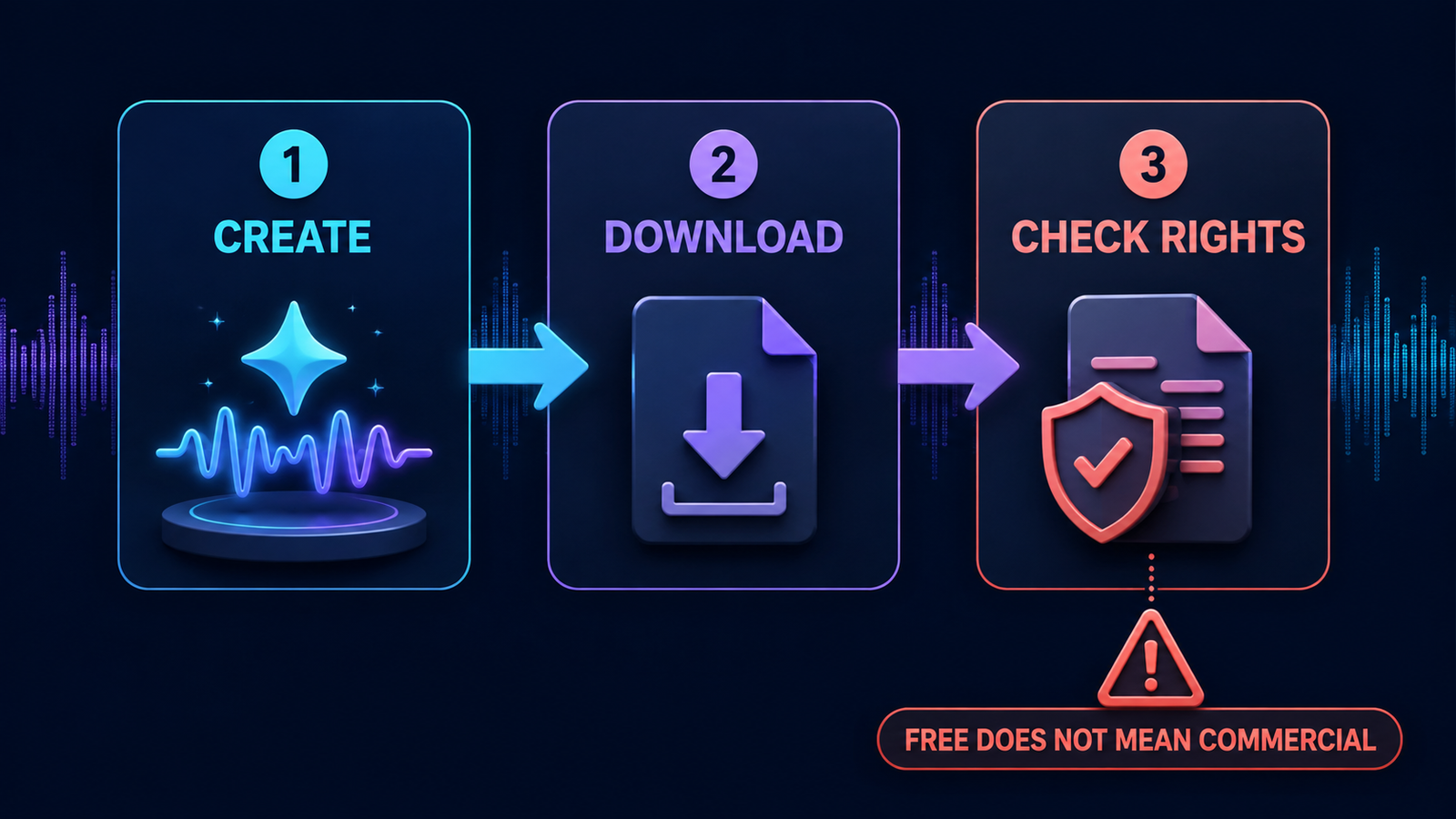
“Free” rarely means release-ready. Every tool below lets a US user generate music without paying, but allowances, downloads and usage rights differ sharply. Several free plans restrict output to personal or noncommercial use, require attribution, or keep the audio inside the service. A free generation is not automatically royalty-free, commercially licensed or eligible for distribution.
This comparison was checked on September 4, 2026, using current US-facing product, pricing, help and legal pages. Free plans can change without much notice. Confirm the live terms shown in your account before publishing, monetizing or delivering any generated track to a client.
Best free AI music generators in 2026 at a glance
| Tool | Best for | Free allowance checked | Main free-plan limitation |
|---|---|---|---|
| Suno | Complete songs with vocals | 50 daily credits, about 10 songs | Personal use; seven lifetime downloads |
| ElevenLabs Music | Structured, multilingual songs | 10,000 monthly credits, about 3–5 tracks | Personal use with attribution |
| Loudly | Short background-music ideas | Daily generations; 30-second free tracks | Numeric daily allowance is not public |
| Soundful | Instrumental styles and rapid variations | Unlimited generations; one MP3 monthly | Personal use and attribution |
| AIVA | MIDI-based composition | Three downloads monthly, up to three minutes | Noncommercial; AIVA owns copyright |
| Mubert Render | Background beds for personal videos | 25 generations and five MP3 downloads monthly | Noncommercial and attribution required |
| Udio | On-platform song experimentation | 10 daily plus 100 monthly credits | All audio, video and stem downloads disabled |
How we selected the best free AI music generators
We screened 12 credible services and ranked seven. The criteria were musical scope, prompt and arrangement control, vocal support, editing, free allowance, account and card requirements, track length, download formats, stems, attribution, commercial-use terms, privacy and rights clarity. We gave extra weight to whether a user can actually export a file and understand what may be done with it.
Suno, ElevenLabs Music, Loudly, Soundful, AIVA, Mubert Render and Udio made the list. Stable Audio, Beatoven.ai, Boomy, SOUNDRAW and Musicfy were screened as alternatives. Their current free access was too limited, unclear or peripheral to this general music-generation intent for a top-seven recommendation.
This is a documentation-based comparison, not a GravityDevOps matched-prompt listening test. We did not test paid accounts or every export path. A TechRadar hands-on survey supplied independent Suno workflow context. A 2026 multi-genre listening study found that recognition and style bias varied by genre, while a small emotion-focused evaluation scored models across quality, emotional control, structure and stability. Neither validates every current version.
1. Suno: best overall free AI music generator
Suno is the easiest recommendation for someone who wants a recognizable song rather than a short instrumental bed. A plain-language prompt can produce lyrics, vocals, arrangement and production in one pass. It also supports custom lyrics, style controls and audio uploads, making it useful for sketches that begin with either words or a rough recording.
The Free plan provides 50 credits each day, described as enough for about 10 songs, and access to the v4.5-all model. It requires an account but no credit card. A major restriction took effect on September 3, 2026: Suno now limits Free users to seven total lifetime downloads. Tracks remain playable and shareable by Suno link after that cap.
Free songs are for personal, noncommercial use. Suno’s free-plan rights page says they cannot be monetized, and paying later does not normally grant retroactive commercial rights. Suno also says it retains ownership of free-plan generations. Paid access can grant commercial-use rights to eligible songs downloaded while subscribed, but the company does not promise that copyright protection will attach to AI output.
Pros: full songs with vocals, generous daily creation allowance, simple prompting and strong idea-to-song workflow.
Cons: only seven lifetime Free downloads, no commercial use, shared queue and no free stem separation.
2. ElevenLabs Music: best for structured and multilingual songs
ElevenLabs Music v2 is a strong option when the prompt needs explicit song sections, genre transitions, multilingual lyrics or iterative inpainting. The interface supports audio references, section-by-section extension and tracks from a few seconds to 10 minutes. That makes it more controllable than a generator designed mainly to return a finished song after one prompt.
The current Music pricing table gives Free accounts 10,000 shared monthly credits, estimated at roughly three to five tracks. Free exports use standard MP3 quality. The allowance is shared with other ElevenLabs products, so text-to-speech or other generation can reduce what remains for music.
Free output is personal-use only. If it is shared noncommercially, ElevenLabs’ publishing guidance requires attribution to “Eleven Music.” Free output is not licensed for commercial projects or streaming distribution. Paid self-serve plans expand commercial rights, but film, television and large studio games have separate restrictions.
Pros: clear structural prompting, multilingual support, audio reference, inpainting and usable free monthly access.
Cons: low number of full tracks per month, shared credits, personal-use-only license and no free streaming release rights.
3. Loudly: best for short background-music experiments
Loudly focuses on instrumental creator workflows. Users can work from a text prompt or select genre, energy, instruments, key, tempo, duration and structure. Its broader workspace includes remixes, stems, samples, mastering and songDNA analysis, although the most useful export and production features sit behind paid access.
Loudly’s official FAQ says the Free plan exposes roughly 90% of features, provides a daily generation allowance and limits free tracks to 30 seconds. It does not publish the numeric daily generation or download quota on that page. Starting requires an account but no credit card.
The vendor’s public wording about licensing is inconsistent in emphasis: some English pages describe commercial licensing across plans, while localized and feature pages say full-length downloads and full commercial licensing require Personal or Pro. Treat the free tier as a preview unless the license displayed for the specific downloaded track explicitly authorizes your intended use. Save that license with the project.
Pros: useful musical controls, quick instrumental variations, no-card start and an integrated production workflow.
Cons: 30-second Free limit, unpublished numeric allowance and insufficiently clear public wording about Free commercial rights.
4. Soundful: best for unlimited instrumental experimentation
Soundful is useful for creators who prefer choosing styles and musical parameters over describing an entire song in prose. The Free plan offers more than 25 styles and unlimited track generations, so it is easy to compare tempo, key and arrangement ideas without spending credits on every preview.
The tradeoff is export volume. Soundful’s current pricing page lists only one MP3 download per month on Free. Free output carries a personal license, must credit Soundful when used and cannot be used commercially. WAV downloads, stems, broader styles and monetization rights are paid features.
Soundful also distinguishes a royalty-free license from ownership. The company retains the master rights for standard outputs, and other users may receive similar or identical material under nonexclusive licensing. Streaming distribution and resale require additional rights rather than merely downloading a free MP3.
Pros: unlimited generation, straightforward instrumental controls, one real monthly MP3 export and a stable ongoing free plan.
Cons: only one Free download, attribution required, no commercial use and limited free style selection.
5. AIVA: best for MIDI-based composition
AIVA is better suited to instrumental composition than instant pop-song creation. It supports more than 250 styles, MIDI and audio influences, editable arrangements and multiple export formats across its plan range. Its free MIDI export can be especially useful for learning, sketching harmony or moving an idea into a digital audio workstation for substantial human arrangement.
The Free Forever plan requires no credit card and allows three downloads per month. Tracks can be up to three minutes and can be downloaded as MP3 or MIDI. The limitations are explicit: AIVA owns the copyright, the music cannot be monetized and users must credit AIVA.
That makes Free a composition sandbox, not a commercial soundtrack license. AIVA’s Standard plan permits limited monetization on selected social platforms, while Pro is the tier that says the user owns copyright and can monetize without those platform restrictions.
Pros: MIDI export, broad style range, editable composition workflow and clear no-card free terms.
Cons: three downloads monthly, noncommercial use, mandatory credit and AIVA ownership on Free.
6. Mubert Render: best for personal background beds
Mubert Render is built around generated background music for videos, streams, podcasts and other timed media. It is useful when the brief is functional—mood, duration and energy—rather than a lyrical song with a memorable vocalist.
The Ambassador plan provides 25 generations and five MP3 downloads per month. Tracks have a fixed duration on Free. The accompanying Attribution License allows personal, noncommercial social projects and requires visible Mubert credit and a link.
The Free license excludes monetized content, digital ads, boosted posts, branded content, apps and websites. Mubert owns the music and licenses it for specified use; it does not allow users to register tracks with Content ID or release them as standalone music on streaming services.
Pros: purpose-built background music, five monthly downloads and unusually detailed license documentation.
Cons: noncommercial only, mandatory attribution, fixed Free duration and narrow permitted-use boundaries.
7. Udio: best for on-platform experimentation, not export
Udio still provides a capable song-generation and editing environment. Free accounts receive 10 daily credits plus a separate 100-credit monthly limit. Two 32-second generations cost two credits, while two roughly 130-second generations cost four. Free users can create no more than three 130-second songs per day.
The decisive limitation is not the credit count. Following Udio’s licensing transition with Universal Music Group, audio, video and stem downloads remain disabled. Users can create, listen and share songs through accessible Udio links, but cannot export the resulting files. Udio has also announced a licensing arrangement with Warner Music Group for its next-generation service.
Udio therefore belongs on this list as a free composition and listening sandbox, not as a source of files for a video, podcast, DAW or music release. Do not subscribe expecting downloads unless Udio’s current product page confirms that export has returned.
Pros: meaningful free credit allowance, detailed generation controls and useful on-platform iteration.
Cons: no audio, video or stem downloads at any tier during the transition; account required.
Which free AI music generator should you choose?
- Choose Suno for the fastest path from prompt to a complete song with vocals.
- Choose ElevenLabs Music for multilingual lyrics, section control and iterative editing.
- Choose Loudly to explore tightly specified 30-second instrumental ideas.
- Choose Soundful for unlimited instrumental generation and one monthly personal-use MP3.
- Choose AIVA when MIDI export and further human arrangement matter.
- Choose Mubert for noncommercial background music when attribution is acceptable.
- Choose Udio only when on-platform creation and sharing are enough.
If the music will accompany a larger production, our guides to free AI video generators for YouTube and free AI voice generators for YouTube cover adjacent creation steps. The beginner’s guide to generative AI explains the underlying concept without assuming a technical background.
How to test an AI music tool without creating licensing problems
- Define the final use first. A private demo, monetized YouTube video, client advertisement and streaming release need different rights.
- Check generation and download separately. A service may let you create hundreds of tracks but prevent file export or limit downloads to a few each month.
- Read the tier-specific license. “Royalty-free” does not necessarily mean free of charge, commercially usable, exclusive or owned by you.
- Save evidence. Keep the plan page, license, track ID and generation date with the project. Terms can change after a track is created.
- Use original inputs. Do not upload melodies, recordings, lyrics or voices unless you have permission. Avoid prompts that ask for a living artist’s identity or a deceptive imitation.
- Review the output. Listen for copied-sounding passages, unintended lyrics, distorted voices, artifacts and abrupt structural changes before publishing.
- Check the destination platform. A generator’s license does not override Spotify, YouTube, distributor, advertising or client requirements.
Prompt quality still matters. Specify purpose, duration, tempo range, instrumentation, mood, structure, vocal characteristics and exclusions, then vary one factor at a time. The same constraint-first approach in our prompt-engineering guide works well for music briefs even when the tool uses its own controls.
Copyright, consent and commercial-use caveats
A platform can grant usage rights without guaranteeing that a fully AI-generated track qualifies for copyright protection. Rules depend on jurisdiction and human authorship. “You own the output,” “commercial use allowed” and “copyrightable work” are not interchangeable.
Do not clone a voice, imitate a recognizable performer or upload someone else’s recording without authorization. Generated lyrics can also be defamatory, offensive or unexpectedly similar to existing material. Human review is necessary even when a vendor says its training data is licensed or its output is royalty-free.
For client work, ask who needs the license, whether the track may be reused in later projects, whether paid media is covered, whether standalone distribution is allowed and what happens after a subscription ends. If the public terms are ambiguous, get written clarification before delivery.
Frequently asked questions
What is the best completely free AI music generator?
Suno is the strongest free starting point for complete songs, with 50 daily credits and about 10 songs a day. However, Free songs are noncommercial and now have a seven-download lifetime cap. Soundful and AIVA offer smaller but clearer ongoing download allowances for instrumental work.
Can I use free AI-generated music commercially?
Usually not. Suno, ElevenLabs Music, Soundful, AIVA and Mubert explicitly restrict their free output to personal or noncommercial use. Loudly’s public pages vary in how they describe Free licensing, so rely on the license attached to the exact track. Never infer commercial rights from the word “free.”
Which free AI music generator lets me download MP3 files?
Suno permits seven total lifetime Free downloads, Soundful permits one MP3 monthly, AIVA permits three MP3 or MIDI downloads monthly, and Mubert permits five MP3 downloads monthly. ElevenLabs supports standard-quality Free exports with personal-use restrictions. Udio currently disables all downloads.
Can I release a free AI song on Spotify?
Not safely under most free plans in this comparison. Free plans commonly prohibit commercial use or standalone streaming distribution. Even a paid license may impose distributor, Content ID, attribution or platform restrictions. Confirm both the generator’s current terms and the distributor’s policy before release.
Bottom line: Suno is the best free AI music generator for quickly exploring full songs, ElevenLabs Music is the most interesting structured alternative, and Soundful, AIVA and Mubert serve narrower instrumental needs. The critical choice is not only which tool sounds best—it is whether the free tier lets you download the track and legally use it where you intend.


