
The best free AI voice generator for audiobooks depends on whether you need a publishable commercial file or only a narration test. TTSMaker is the clearest browser-based option for small commercial projects, while Google Cloud Text-to-Speech, Amazon Polly and Azure AI Speech offer larger allowances but require cloud setup. ElevenLabs is better for evaluating expressive narration, not publishing a commercial audiobook on its free plan.
That distinction matters because “free” rarely means “produce and sell a complete audiobook without conditions.” Some services grant only personal-use rights, some require billing details, and others provide too few characters for more than a sample chapter. We reviewed the market using current United States-facing documentation on September 4, 2026, and treated free tiers, trials and platform-funded narration as different things.
Best free AI voice generators for audiobooks at a glance
| Tool | Best for | Free allowance | Commercial audiobook on free access? | Main limitation |
|---|---|---|---|---|
| TTSMaker | Short commercial projects | 20,000 characters weekly; some voices excluded from the quota | Yes, under its published license | 500 characters per free conversion |
| Google Cloud Text-to-Speech | High-volume, developer-led production | Up to 4 million Standard or 1 million WaveNet characters monthly | Potentially, if you own the text rights and follow the terms | Billing must be enabled; overages can charge automatically |
| Amazon Polly | Automated chapter pipelines | Voice-dependent allowance, generally limited to a new-account period | Yes, subject to AWS terms and source-text rights | Cloud account, setup and changing Free Tier rules |
| Azure AI Speech | Pronunciation and SSML control | 500,000 neural characters monthly on Free F0 | Microsoft says output can be used commercially | 3,000-character Free-tier file limit and technical setup |
| ElevenLabs | Testing expressive narration | 10,000 credits monthly, about 10 minutes with its standard model | No; Free is noncommercial and requires attribution | Far too small for a book and no Free commercial license |
| Google AI Studio | Directed dialogue and prototypes | Gemini 2.5 Flash Preview TTS is free within rate limits | Check current model terms and distributor rules first | Preview model; free data is used to improve products |
| Narakeet | No-cost voice auditions | 20 conversions with 1 KB audio scripts | No; Free is personal and evaluation use only | Tiny scripts and no Free commercial use |
Allowances and terms change. Check the linked plan and license pages again immediately before generating a final manuscript.
How we selected and ranked these audiobook voice tools
We screened 11 credible services and ranked seven. The evaluation covered narration controls, long-form workflow, chapter export, published free allowance, account and payment boundary, audio format, watermark or attribution, commercial rights, privacy, consent controls and audiobook-platform fit. TTSMaker, Google Cloud Text-to-Speech, Amazon Polly, Azure AI Speech, ElevenLabs, Gemini TTS and Narakeet made the list. NaturalReader, PlayHT, Murf and Speechify were screened but omitted because their current public documentation did not offer a clearer combination of free export, stable limits and audiobook publishing rights.
This is a documentation-based comparison, not a matched-manuscript listening test. We did not upload an unpublished book, run paid accounts or claim that one voice wins on sound quality. Product limits are confirmed from official pages; platform-policy observations are attributed separately; recommendations are our analysis of those facts.
1. TTSMaker: best free option for short commercial audiobooks
TTSMaker’s free generator publishes a 20,000-character weekly allowance, more than 600 voices across 100-plus languages, and downloadable MP3, OGG, AAC, Opus and WAV output. Its separate commercial license explicitly allows generated audio in audiobooks and other media under a non-exclusive, worldwide and perpetual license.
That makes TTSMaker the least ambiguous zero-dollar option here for a creator who needs commercial rights. It is still cumbersome for long-form production: the Free plan lists a 500-character maximum per conversion, and generated files are deleted from the service after 30 minutes. A novel would require many conversions, careful file naming and external mastering.
Best for: short stories, public-domain readings, samples and low-budget commercial experiments.
Pros: browser workflow, multiple download formats, unusually clear commercial grant.
Cons: small jobs, manual assembly and no evidence that every voice will sustain character consistency across a book.
2. Google Cloud Text-to-Speech: best large recurring free allowance
Google Cloud Text-to-Speech pricing lists up to 4 million Standard-voice characters or 1 million WaveNet characters monthly at no usage charge. It supports MP3, Linear16 and OGG Opus plus SSML controls for pacing, pitch and pronunciation. That capacity can cover far more manuscript text than most consumer free plans.
The catch is operational: Google says billing must be enabled, and usage beyond the included characters is charged automatically. This is an API-first service, not a finished audiobook editor. You must split chapters, manage filenames, listen for pronunciation errors, normalize loudness and assemble retail-ready files yourself. Google’s cloud terms say it does not assert ownership over newly created output, but you remain responsible for the manuscript and all other rights.
Best for: technical authors or small publishers building a repeatable narration pipeline.
Pros: large monthly allowance, flexible audio formats and precise SSML control.
Cons: billing exposure, engineering work and no integrated book-production interface.
3. Amazon Polly: best for AWS-based chapter automation
Amazon Polly’s pricing page lists 5 million Standard, 1 million Neural, 500,000 Long-Form and 100,000 Generative characters per month in its voice-specific free allowances. The duration is tied to account eligibility and AWS’s newer credit-based Free Tier, so confirm the offer shown during signup rather than assuming it lasts indefinitely.
Polly can synthesize long jobs to Amazon S3, supports lexicons and SSML, and permits cached replay. Its official FAQ says Polly output belongs to the customer as between the customer and AWS, provided the customer has rights to the input text. AWS also recommends testing the service on your own content instead of treating published quality metrics as a guarantee.
Best for: publishers already using AWS who want automated chapter generation and storage.
Pros: high potential allowance, asynchronous long-form workflow and established cloud controls.
Cons: eligibility complexity, possible costs after the free boundary and more infrastructure than a solo author may want.
4. Azure AI Speech: best for pronunciation control
Azure AI Speech pricing lists 500,000 neural text-to-speech characters each month on the Free F0 tier. Microsoft’s documentation also supports SSML, pronunciation lexicons and multiple output formats. This is useful for nonfiction, technical names and recurring terminology where pronunciation consistency matters more than a cinematic performance.
The Free tier is intentionally constrained. Microsoft’s current quota documentation lists a 3,000-character plain-text or SSML file limit on F0, so a book needs many requests. Setup requires an Azure subscription and Speech resource. Microsoft has stated in its support guidance that synthesized audio can be used commercially, but authors should still review the agreement attached to their own account and voice selection.
Best for: developer-assisted nonfiction and multilingual narration with controlled pronunciations.
Pros: recurring allowance, neural voices and mature SSML tooling.
Cons: short requests on F0, cloud configuration and significant post-production.
5. ElevenLabs: best for testing expressive narration
ElevenLabs Free includes 10,000 monthly credits, roughly 10 minutes of standard text-to-speech, and access to its Studio workflow. The dedicated audiobook product adds character casting, pronunciation tools and direct distribution options, making it one of the most audiobook-oriented interfaces in the comparison.
But the free access is a prototype tier, not a free commercial production plan. ElevenLabs’ publishing guidance says Free output is noncommercial and requires attribution when shared. Commercial rights start on paid plans, and content generated before upgrading does not retroactively gain that license.
Best for: auditioning voices and testing a chapter before buying production credits.
Pros: audiobook-specific editing, expressive direction and multi-character options.
Cons: about 10 minutes monthly, attribution and no commercial rights on Free.
6. Google AI Studio: best for directed dialogue prototypes
Gemini text-to-speech can produce single- or multi-speaker audio with natural-language direction for tone, accent, pace and delivery. Google explicitly lists podcast and audiobook generation as a use case. The Gemini API pricing page shows Gemini 2.5 Flash Preview TTS as free for input and output within Free-tier rate limits.
This is experimental production infrastructure. Google labels the model Preview, does not publish one fixed Free daily number on the pricing page, and says Free-tier inputs and outputs are used to improve its products. The documentation warns that quality and voice consistency may drift after a few minutes, so chapters should be generated in smaller reviewed segments. The 32,000-token context window is not a promise of a clean 32,000-token recording.
Best for: prototyping dialogue, character direction and open-source or nonconfidential manuscripts.
Pros: detailed performance prompting, multi-speaker output and no-cost Preview access.
Cons: preview volatility, data-use caveat and manual chunking and audio finishing.
7. Narakeet: best for quick no-cost voice auditions
Narakeet Free permits 20 conversions, but its audio script limit is only 1 KB. It offers a straightforward web workflow and many voices, making it practical for auditioning short samples before deciding whether a voice fits a manuscript.
Do not publish or monetize those Free files. Narakeet’s usage-rights page limits Free output to personal and evaluation use; commercial rights begin only after buying a package. That boundary is clearer than a vague “free trial,” but it makes the Free tier unsuitable for a finished retail audiobook.
Best for: comparing voices with a few representative paragraphs.
Pros: fast evaluation and plainly documented restrictions.
Cons: 1 KB scripts, 20 conversions and no Free commercial use.
Can you publish a free AI-narrated audiobook?
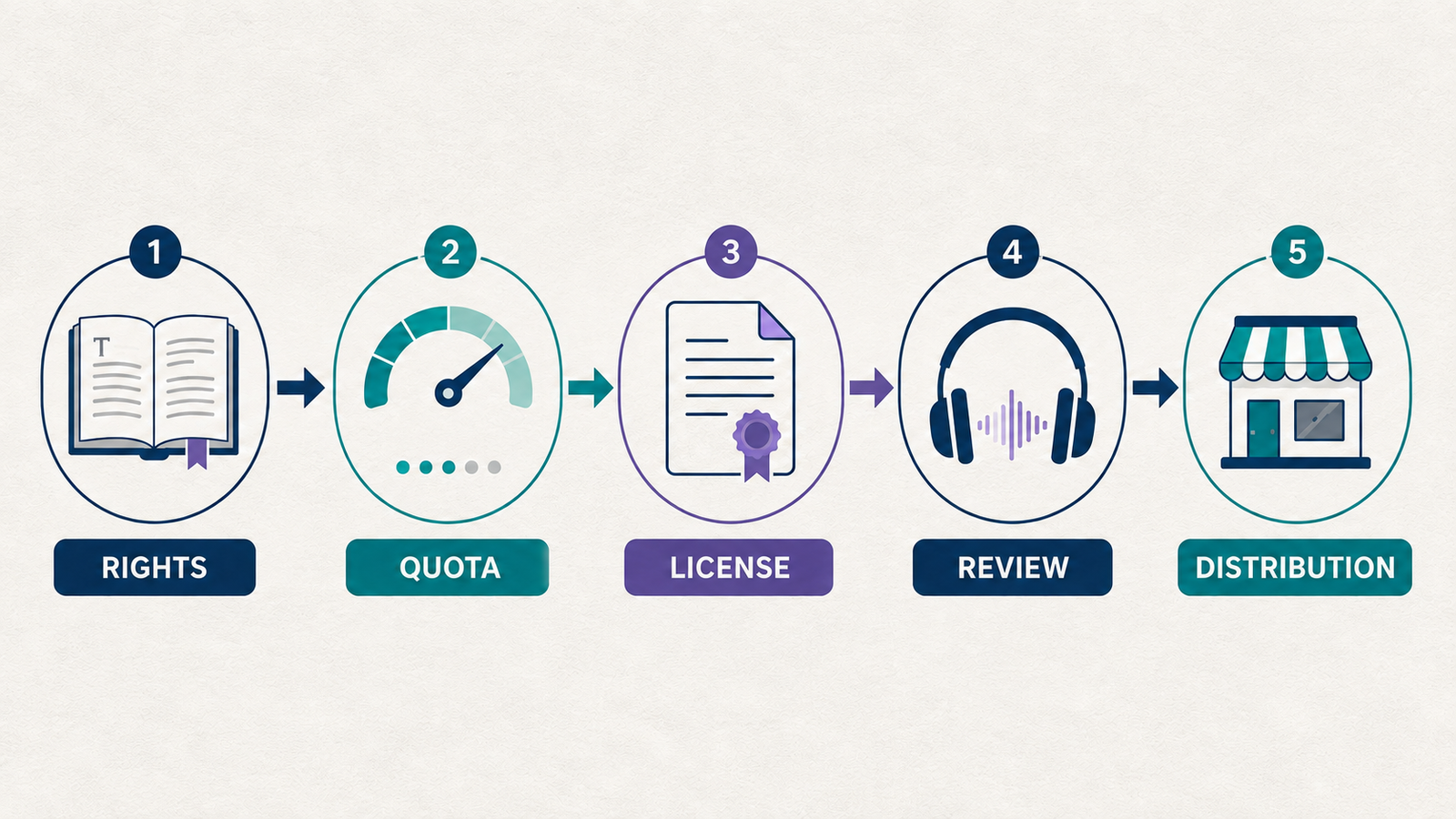
Sometimes, but the generator’s license is only one gate. You must own or have permission to narrate the manuscript, secure consent for any cloned or imitated voice, and meet the distributor’s rules and audio specifications.
Spotify for Authors accepts digital voice narration and requires creators to select a disclosure option during upload. It adds a sentence to the description and currently does not send digitally narrated titles to referral partners. Spotify names providers such as Google Play Books and ElevenLabs as examples, but acceptance still does not cure a missing voice or manuscript license.
ACX is stricter for ordinary uploads. Its April 2026 submission requirements say an audiobook must be human-narrated unless ACX has authorized another route; unauthorized third-party text-to-speech uploads are prohibited. Audible does carry titles produced through its own labeled Virtual Voice program, but that does not mean any externally generated file can be submitted through a standard ACX project.
Apple Books digital narration is a different free alternative: eligible English-language ebooks can be nominated through preferred partners, and accepted titles are produced and distributed on Apple Books with a “Narrated by Apple Books” label. It is not a general-purpose downloadable voice generator, and editorial and format eligibility applies.
How to choose without wasting a full manuscript
- Clear the text rights first. Public-domain status can vary by country, and owning an ebook does not grant narration or distribution rights.
- Test a hard passage. Use dialogue, uncommon names, dates, abbreviations and emotional transitions instead of a polished introductory paragraph.
- Calculate the complete character count. A tool offering ten minutes or 20,000 characters is a sample generator for most books, not a full production budget.
- Save the terms you relied on. Record the plan, date and license that applied when the audio was generated.
- Master and review every chapter. Listen for skipped lines, changed words, inconsistent characters, breaths, clicks, loudness and head or tail silence.
- Check the destination before production. Platform disclosure, narrator labeling and file specifications can determine whether the finished files are usable.
If you only need short narration, start with our broader guide to a free AI voice generator. Video creators can compare the separate YouTube voice-generator workflow. For better performance instructions, adapt the principles in our prompt engineering guide; teams automating narration at scale should also apply the monitoring and governance ideas in LLMOps.
Bottom line
TTSMaker has the clearest free commercial license for small audiobook projects, but its per-conversion cap makes full books laborious. Google Cloud Text-to-Speech, Amazon Polly and Azure AI Speech provide more useful capacity for technical users, with account and billing caveats. ElevenLabs, Gemini TTS and Narakeet are better treated as audition or prototype tools on free access. Before recording a whole book, verify the generator license and the distributor’s current synthetic-narration policy on the same day.


