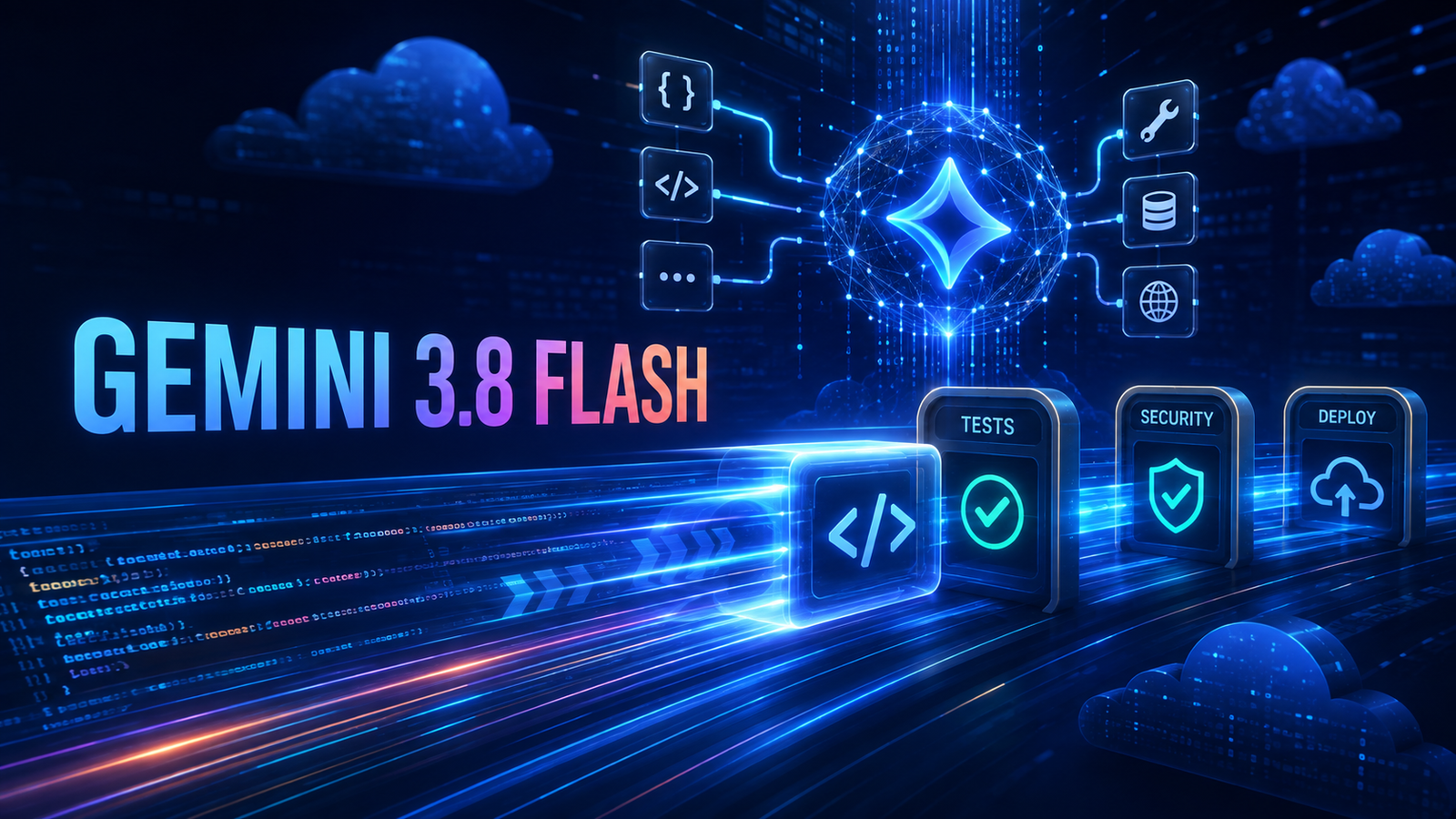

Google has made Gemini 3.8 Flash generally available for coding agents and complex workflows at the same introductory token price as Gemini 3.7 Flash. The release brings stronger vendor-reported coding results, but also migration changes, potentially higher reasoning-token use and a scheduled price increase that production teams need to model now.
NEW DELHI, September 3, 2026, 5:01 PM IST — Google has released Gemini 3.8 Flash as a production-ready model for long-horizon software engineering and autonomous agents, just three weeks after Gemini 3.7 Flash. A separate Gemini 3.8 Flash Cyber model is being offered only to approved defenders through Google’s new Fairwind Program.
The public model is available through the Gemini API, Google AI Studio, Gemini Enterprise Agent Platform and Google Antigravity. Google lists a one-million-token context window, a 64,000-token maximum output and low, medium and high reasoning levels. Its introductory API price is $0.75 per million input tokens and $3.75 per million output tokens through December 31.
For platform teams, the important news is not simply a higher benchmark score. Google’s own documentation says Gemini 3.8 Flash can deliberately spend more tokens and make more tool calls on difficult tasks. The same documentation schedules standard prices of $1.50 per million input tokens and $7.50 per million output tokens from January 1, 2027. That makes task-level cost, latency and reliability more useful measures than today’s headline token rate.
What Google released
Google’s launch announcement describes Gemini 3.8 Flash as its most capable Flash model for reasoning and coding. The company says the model improves on 3.7 Flash in software engineering, agentic tasks and specialized multi-step analysis while retaining Flash-class speed and introductory pricing.
The production model ID is gemini-3.8-flash. Google’s developer migration guide says the model is generally available and supports the same built-in tools as its predecessor. Google also made it the default model for its managed Antigravity agent and SDK, widening the launch beyond an optional API endpoint.
The separate Cyber variant uses the same foundational intelligence but has more permissive cybersecurity mitigations. Access is limited through the Fairwind Program to selected government authorities, critical-infrastructure operators, software maintainers and security partners. Google says more than 650 organizations participate in the program, but it has not made the Cyber model available through the ordinary public API.
Strong benchmark claims need production validation
Google reported that Gemini 3.8 Flash leads its comparison on DeepSWE v1.1, a long-horizon software-engineering evaluation, and scored 54.9% on HLE-Verified. It also published gains on finance and legal agent benchmarks. These are useful signals, but they are not evidence that the model will improve a particular repository, incident workflow or deployment pipeline.
Ars Technica independently confirmed the release, pricing and availability, while noting that the improvements over 3.7 Flash appear larger in coding evaluations than in several other tests. It also highlighted weaker relative performance on Google’s published computer-use comparison. That distinction matters for agents that must navigate interfaces rather than work primarily through code and APIs.
Google’s model card lists occasional slowness, timeouts and higher token use among the known limitations. It also reports a slight regression in an automated multilingual-safety evaluation compared with 3.7 Flash. Google says manual review found the flagged losses were overwhelmingly false positives or not severe, but the published result still supports testing non-English workflows rather than assuming parity.
The price is stable now, not permanently
Gemini 3.8 Flash launches at the same advertised rate as 3.7 Flash: $0.75 per million input tokens and $3.75 per million output tokens. Google’s cloud pricing page says those introductory rates end on December 31, after which the standard global rates double to $1.50 and $7.50 respectively.
Reasoning tokens are billed as output. Google says 3.8 Flash works through smaller reasoning steps, calls tools iteratively and verifies its work on complex goals. A nominally unchanged price can therefore produce a higher invoice if the model generates more hidden reasoning, repeats tools or extends agent loops. Conversely, a more reliable model can cost less per completed task if it avoids retries and human repair.
The practical unit for evaluation is cost per successful outcome. Teams should record input, cached input, reasoning and visible output tokens alongside tool calls, elapsed time, retries and completion quality. This is a core LLMOps discipline, especially when a promotional rate and a behavior change arrive together.
Migration is more than changing a model name
Google’s migration checklist requires applications to remove deprecated sampling parameters, including temperature, top-p and top-k, and to replace the older numeric thinking budget with a named reasoning level. The new model does not support a minimal reasoning setting. It also rejects prefilled model turns and requires the final user turn to contain non-empty text.
Those constraints can surface as request failures in wrappers that reuse older generation configurations. Teams should create a separate deployment target, validate request builders and schemas, and test tool execution before changing a shared alias. Pinning the explicit model ID also makes rollback and cost attribution clearer during the evaluation period.
A useful canary should include representative multi-file changes, retrieval-heavy prompts, long conversations, function calls and failure paths. Evaluate low and medium reasoning separately: low effort may suit latency-sensitive triage, while medium is Google’s default for complex coding. High effort should be reserved for tasks where the extra computation produces a measurable increase in successful outcomes.
Cyber access is intentionally separate
Google says Gemini 3.8 Flash Cyber reached a 47.2% pass rate on CWE-Bench for automated patching and exceeded 70% on an internal vulnerability-discovery benchmark spanning 20 programming languages. It also says Chrome’s security team obtained 2.6 times more correct vulnerability patches than with larger commercial models. These results are company and partner measurements, not independent proof of safe autonomous remediation.
The Fairwind model can be used with CodeMender to find, validate and repair vulnerabilities inside a customer’s cloud environment. Google requires participating organizations to limit access to authorized security, incident-response or penetration-testing staff and to apply controls such as multi-factor authentication. Ordinary Google Cloud customers can use CodeMender with publicly available Gemini models, but that is not the same product or access level as Gemini 3.8 Flash Cyber.
Security teams should keep generated patches inside normal review, testing and deployment controls. A model that finds more defects can also create more candidate changes, so provenance, sandboxing, least privilege and human approval remain essential. GravityDevOps’ comparison of CI/CD tools provides additional context for placing automated tests and approvals around generated code.
What platform teams should do now
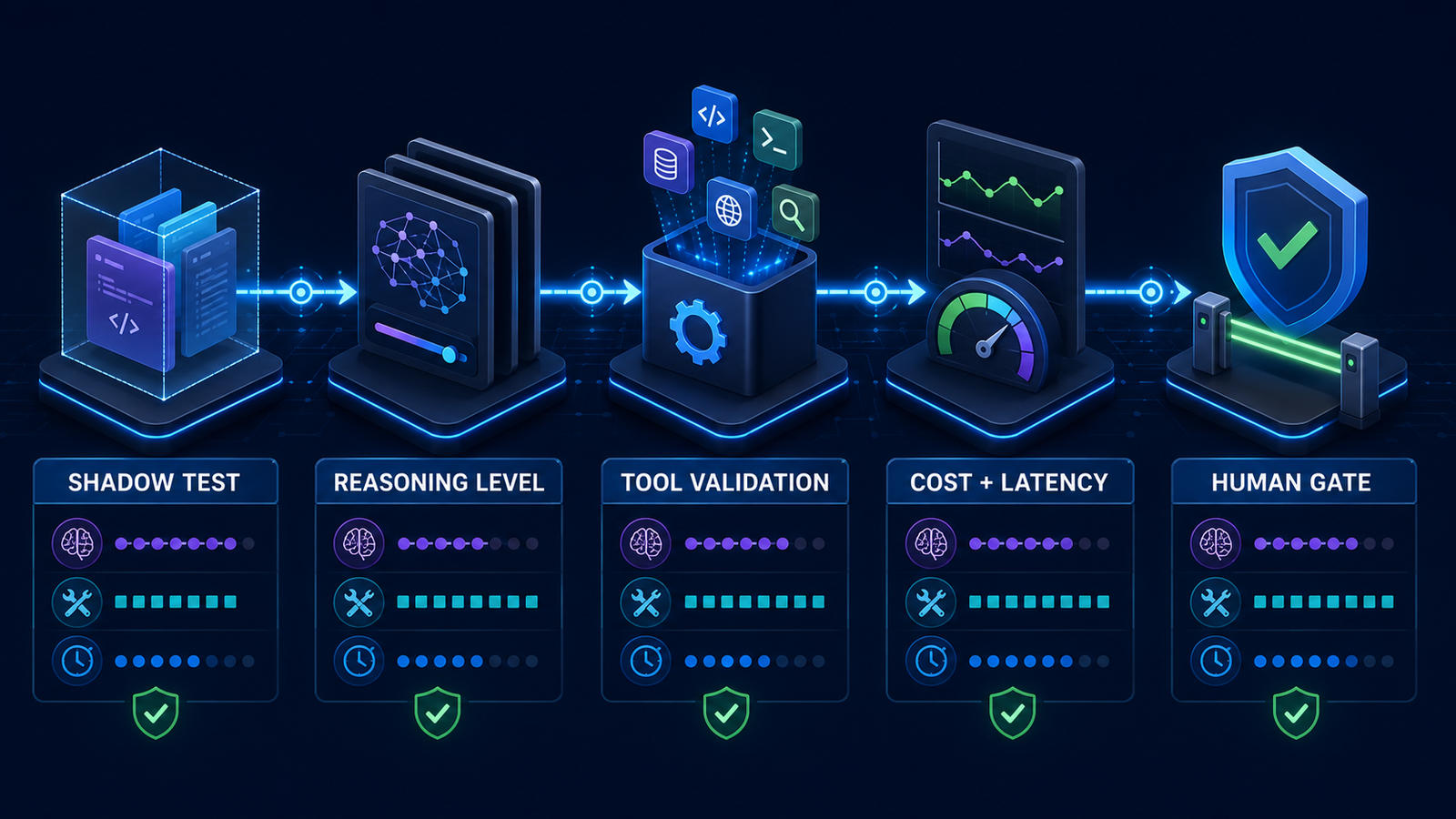
Teams already using Gemini 3.7 Flash should avoid an automatic fleet-wide switch. Run a shadow evaluation with real traces, measure successful-task cost at each reasoning level, and test the migration constraints against existing SDK wrappers. Model both the introductory rate and the January standard rate so a successful pilot does not become a budget surprise.
For agent workflows, log model version, reasoning level, token categories, tool-call count, retries, timeouts and human corrections. Keep 3.7 Flash available as a rollback target while comparing workloads. Prompt and tool changes should be versioned separately from the model change, making it possible to identify what caused a quality or cost shift. GravityDevOps’ guide to prompt engineering for developers covers the instruction discipline that supports controlled comparisons.
The release gives developers a new generally available Flash-tier model with a clear coding and agent focus. Its value will depend less on launch-day leaderboards than on whether stronger task completion offsets additional reasoning, migration work and the scheduled price change in each production environment.


