
Research basis: this guide was planned from current Google Search results around AI DevOps, AIOps, AI agents, intelligent CI/CD, DevSecOps governance, and platform engineering. It avoids duplicating earlier GravityDevOps posts by focusing on how teams should design agentic CI/CD pipelines in 2026.
Quick Answer: What Is Agentic CI/CD?
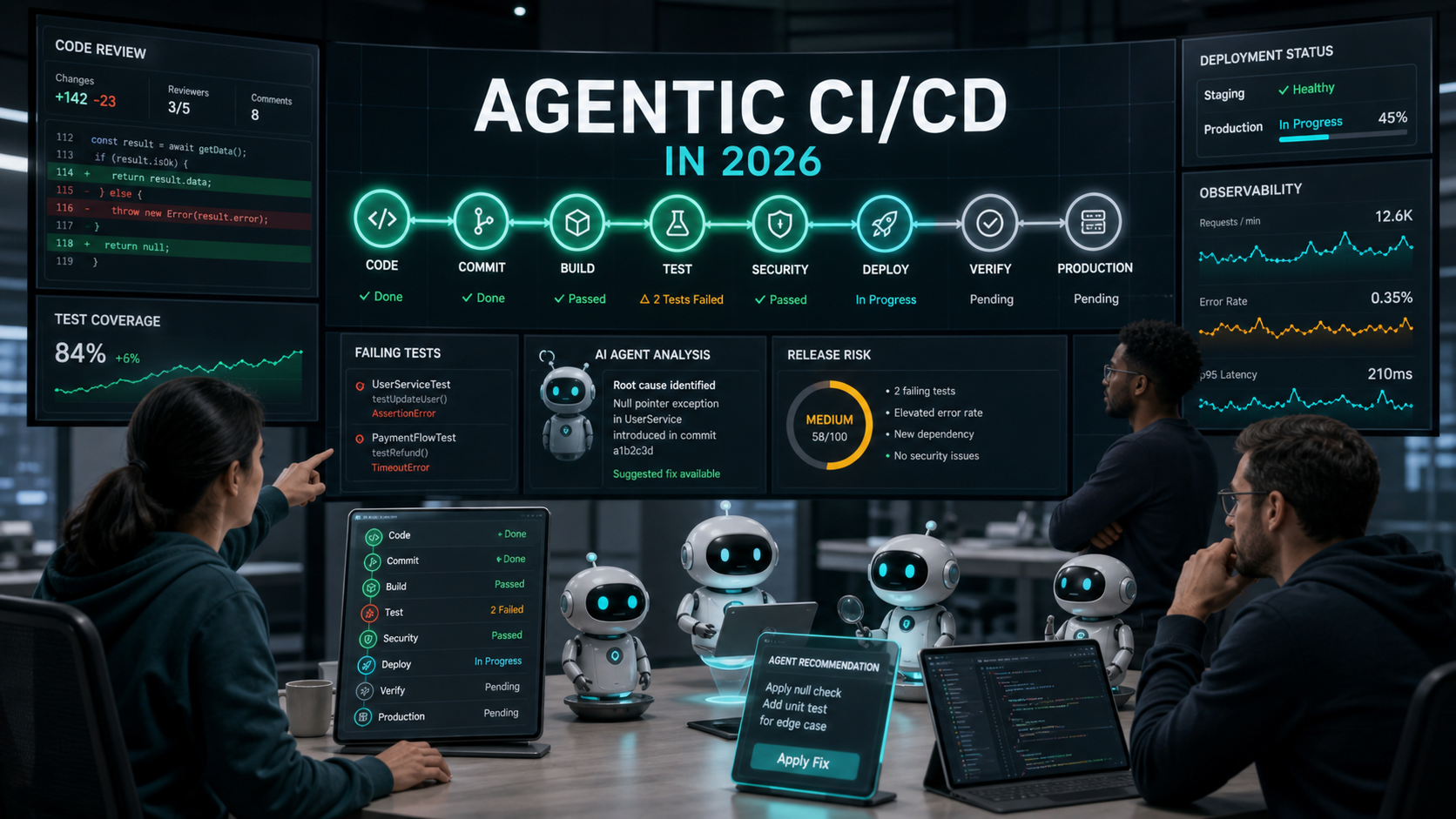
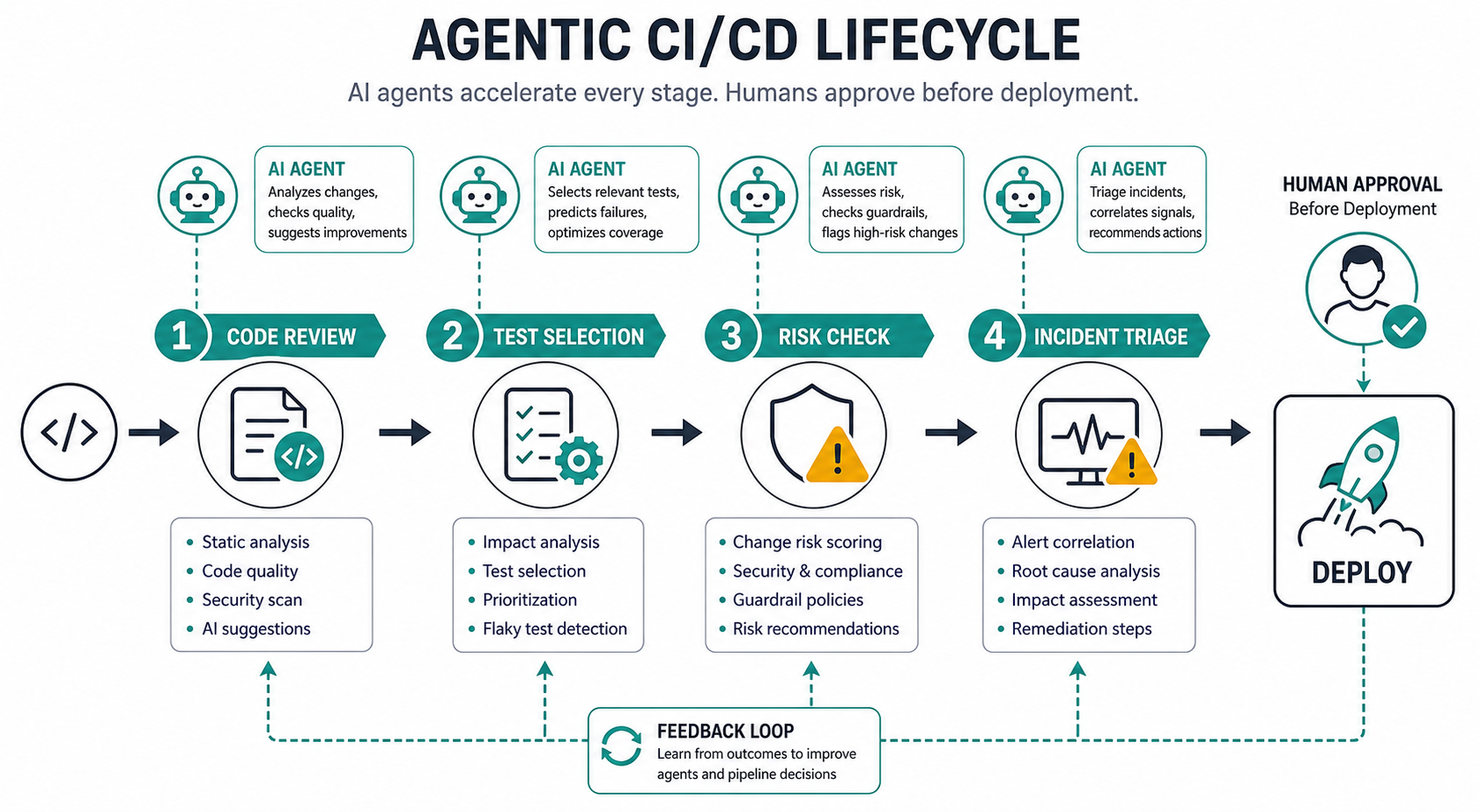
Agentic CI/CD means adding AI agents to the software delivery pipeline so they can investigate failures, choose tests, summarize risk, suggest fixes, and sometimes trigger safe remediation with human approval. It is not letting AI deploy whatever it wants. The useful version is a guarded pipeline where agents observe logs, builds, traces, pull requests, security scans, and deployment history, then recommend or perform tightly scoped actions.
For most teams in 2026, the best starting point is not a fully autonomous deployment system. Start with AI triage, test selection, release notes, and incident summaries. Move toward approval-based remediation once observability, rollback, audit trails, and policy checks are mature.
Why This Topic Is Showing Up in Search
Search demand around AI and DevOps has become practical. People ask: Can AI agents fix CI/CD failures? What is AIOps vs DevOps? Which AI DevOps tools are worth buying? Will AI replace DevOps engineers? How do I secure AI-generated infrastructure code?
That shift makes sense. Generative AI is now common in code writing, documentation, and pull request help. The pressure has moved downstream. If developers produce more changes, the pipeline, test suite, review process, and operations team must absorb the extra load. DORA’s research frames AI adoption as a systems problem and notes that AI tends to amplify existing engineering strengths or weaknesses.
Recent DevOps modernization research points to the same tension. Heavy AI coding usage can create deployment, compliance, quality, and remediation concerns when teams do not automate the rest of the lifecycle. That is the opportunity for agentic CI/CD: balancing the delivery system so AI-generated velocity does not flood production with avoidable risk.
Related GravityDevOps reading: Start with What is Generative AI? A Beginner’s Guide, then compare pipeline platforms in Best CI/CD Tools 2026 Compared.
Agentic CI/CD vs Traditional CI/CD vs AIOps
The terms are easy to blur, so it helps to separate them before choosing tools.
| Approach | Primary job | Typical input | Best use | Main risk |
|---|---|---|---|---|
| Traditional CI/CD | Run predefined build, test, security, and deploy steps | Code commits, pipeline configuration, secrets, environment rules | Repeatable delivery with predictable gates | Static rules miss context or create noisy failures |
| AIOps | Analyze operations telemetry and detect incidents or anomalies | Metrics, logs, traces, events, alerts | Reducing alert noise, incident triage, root-cause analysis | Poor telemetry causes misleading recommendations |
| Agentic CI/CD | Use AI agents to reason across pipeline, code, tests, policy, and production signals | Pull requests, build logs, test history, deployment records, telemetry, runbooks | Risk summaries, test selection, failure diagnosis, controlled remediation | Over-automation without approvals, audit trails, or rollback discipline |
AIOps is usually operations-first. Traditional CI/CD is pipeline-first. Agentic CI/CD sits between them, giving the delivery pipeline context before a release and operational awareness after a release.
What AI Agents Can Realistically Do in a Pipeline
A practical agentic pipeline is built from small, auditable tasks. Start by letting the agent read context and produce outputs humans can verify.
1. Diagnose Failed Builds
A build agent can read logs, recent commits, dependency changes, and past failures, then produce a short diagnosis. A useful output looks like this:
Failure: unit test suite failed in payment-service
Likely cause: dependency lockfile changed in PR #418
Evidence: three tests fail on missing decimal rounding behavior
Suggested next step: rerun targeted payment tests after restoring decimal-lib 3.2.x or updating expected rounding cases
Confidence: medium
This is better than a chatbot answer because it is grounded in pipeline evidence and still leaves the merge decision to a reviewer.
2. Select Tests Based on Risk
Large teams often struggle with test time. AI can help choose a risk-based test set by looking at changed files, service ownership, dependency graphs, previous failures, and recent flaky tests.
A simple policy might be:
if change.touches("terraform/") or change.touches("k8s/"):
    require("iac-plan")
    require("policy-as-code")
    require("staging-deploy")

if service.risk_score >= 7:
    require("full-regression")
else:
    require("targeted-regression")
The agent can recommend the score, but the rule should live in version control so the pipeline stays explainable.
3. Summarize Deployment Risk
Release managers need a quick answer: what changed, what could break, and how do we roll back? An agent can summarize risk from pull requests, tickets, incident history, and observability data.
A good summary includes affected services, migrations, infrastructure changes, security-sensitive paths, rollback steps, and monitoring links. A risk score without evidence is decoration.
4. Generate Runbook Drafts
Runbooks are often stale. AI can draft a first version from incident notes, dashboard links, service metadata, and past postmortems. Humans should still review the result.
5. Support Safe Remediation
The final stage is controlled action: restart a failed job, scale a deployment, roll back a canary, open a pull request, or create an incident ticket. Keep permissions narrow. Production actions need approvals, rate limits, audit logs, and a tested rollback path.
A Beginner-Friendly Architecture
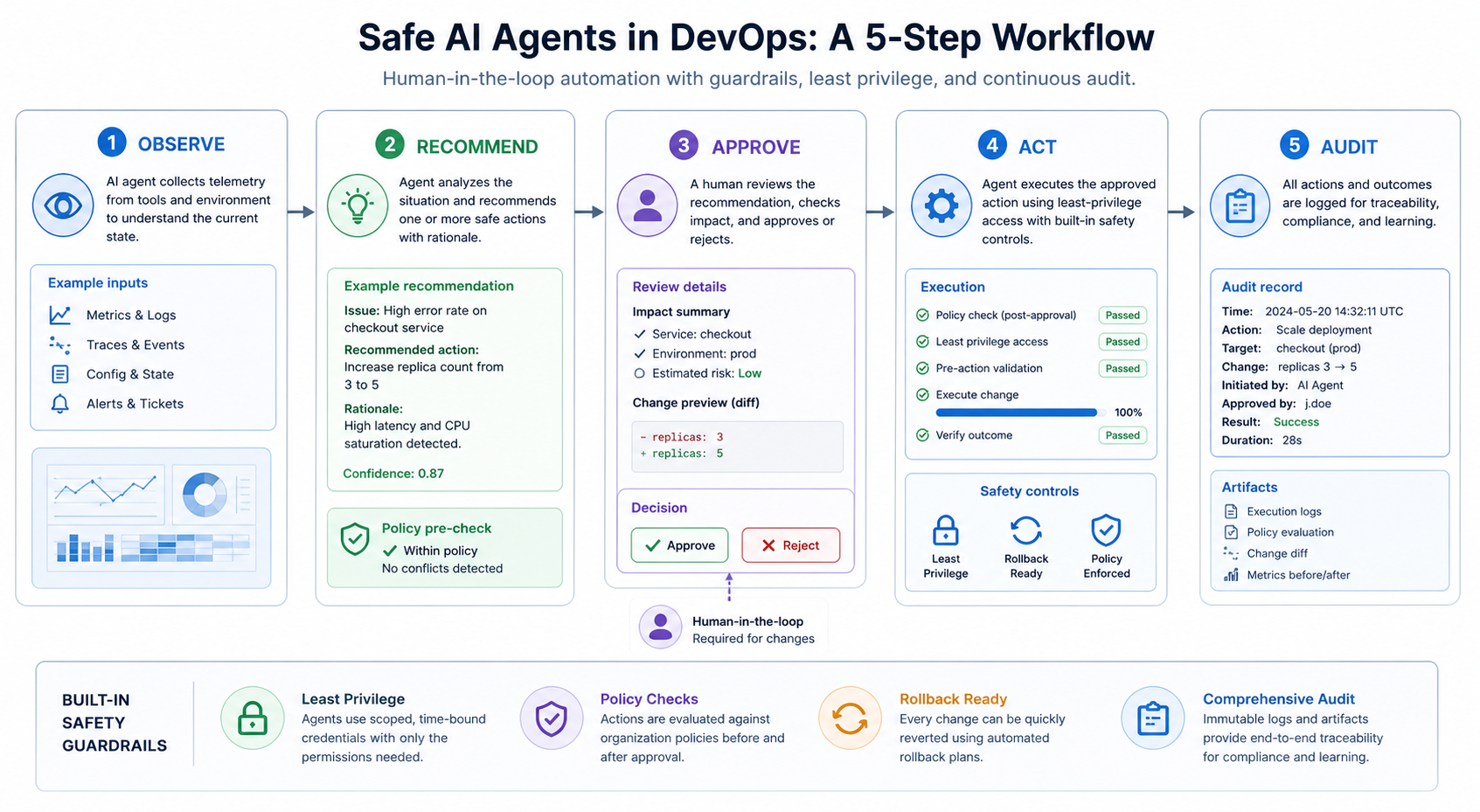
If you are building your first agentic CI/CD experiment, use a small architecture:
- CI/CD platform: GitHub Actions, GitLab CI, Jenkins, Azure DevOps, CircleCI, or another existing system.
- Context store: pipeline logs, test results, pull request metadata, service catalog entries, and deployment history.
- LLM gateway: a controlled service that handles prompts, model choice, secrets isolation, and logging.
- Policy layer: rules for what the agent may read, suggest, or execute.
- Human approval: pull request review, deployment approval, incident commander approval, or ChatOps confirmation.
- Audit log: every prompt, input reference, decision, recommendation, and action should be traceable.
Do not give the agent direct access to all secrets, cloud permissions, and production clusters on day one. Treat it like an automation service that earns trust through narrow, measurable wins.
Example: AI Failure Triage in GitHub Actions
Here is a realistic first project for a beginner or small DevOps team:
- When a workflow fails, collect the failing job name, last 200 log lines, changed files, and test report.
- Send that evidence to an internal triage service.
- Ask the model for a structured JSON diagnosis, not a free-form essay.
- Post the summary as a pull request comment.
- Track whether the suggestion helped fix the build.
{
  "failure_type": "dependency-change",
  "likely_cause": "Lockfile upgraded a transitive package used by tests",
  "evidence": [
    "npm ci changed package-lock.json",
    "three failures mention missing validateConfig() option"
  ],
  "recommended_action": "Pin config-tools to 2.8.1 or update tests for the new option name",
  "confidence": "medium",
  "needs_human_review": true
}
This gives the team value without letting the model push code or deploy. Once triage quality is consistently useful, let the agent open draft pull requests for low-risk fixes. Keep them human-reviewed.
Tool Selection Criteria
Buyer-intent searches around “best AI DevOps tools” are rising because vendors are adding AI labels quickly. Use this checklist before paying for a platform.
| Criterion | What to check | Why it matters |
|---|---|---|
| Pipeline integration | Does it work with your current CI/CD tool and SCM? | A separate AI dashboard rarely changes delivery behavior. |
| Evidence quality | Can it cite logs, commits, test names, alerts, and deployment events? | Unsupported recommendations are hard to trust. |
| Permissions | Can actions be scoped by repo, service, environment, and role? | Agent permissions must be smaller than admin permissions. |
| Auditability | Are prompts, context, outputs, approvals, and actions logged? | Compliance teams need traceability. |
| Pricing model | Is pricing per seat, per commit, per build minute, per event, or per token? | AI costs can scale unpredictably with noisy pipelines. |
| Data controls | Can you limit training use, retention, regions, and sensitive inputs? | Pipeline logs may contain secrets or customer data. |
Pricing caveat: AI DevOps tools often have two cost layers: the platform and AI usage through seats, tokens, events, or premium tiers. Before committing, test the tool on a representative month of builds and incidents.
Pros and Cons of Agentic CI/CD
Pros
- Faster failure diagnosis for common build and test issues.
- Better test time through risk-based selection.
- Cleaner release notes and deployment summaries.
- Lower toil for repetitive triage, ticket updates, and runbook drafts.
- Earlier detection of risky changes.
Cons
- Bad telemetry produces bad recommendations.
- Overconfident summaries can hide uncertainty.
- Secrets can leak into prompts if logs are not scrubbed.
- Costs may rise if every build sends large logs to a model.
- Teams may automate broken processes.
Common Mistakes
Mistake one: starting with production remediation. Start with read-only insights. Let the agent explain failures before letting it change systems.
Mistake two: using unstructured prompts. Ask for JSON with required fields, confidence, and evidence.
Mistake three: ignoring security scans. AI-generated code and infrastructure still need SAST, dependency scanning, IaC scanning, secrets detection, and policy-as-code gates.
Mistake four: no feedback loop. Track whether agent suggestions are accepted, ignored, or wrong. Without feedback, you cannot improve prompts, context, or policies.
Mistake five: buying before cleaning data. If service ownership, deployment metadata, logs, and test reports are messy, the tool will struggle.
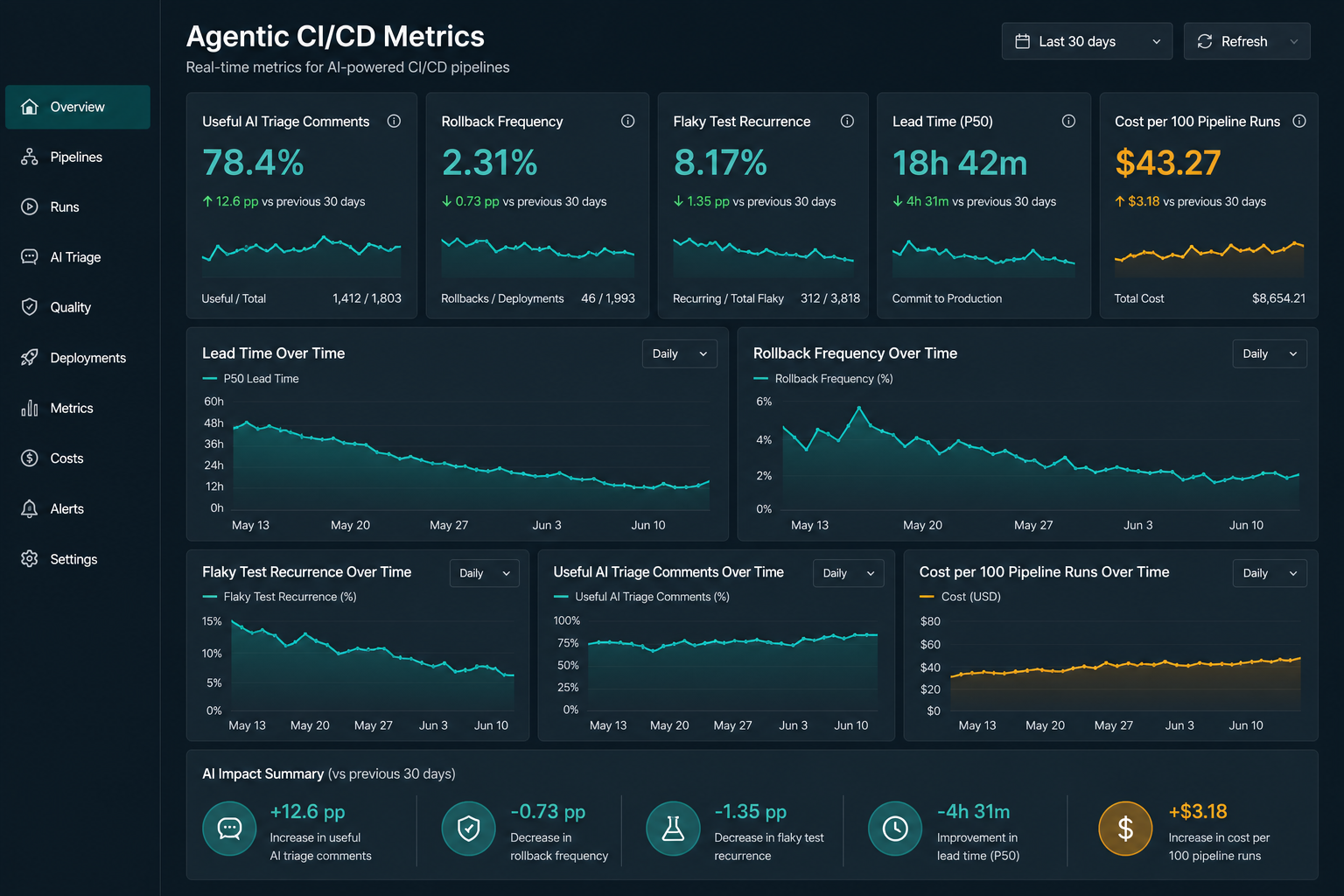
Metrics to Track
Use metrics that connect AI assistance to delivery outcomes:
- Mean time to diagnose failed builds.
- False-positive rate for risk warnings.
- Flaky-test recurrence and change failure rate.
- Rollback and hotfix frequency.
- Lead time for changes.
- Cost per 100 pipeline runs.
- Security or compliance exceptions.
The goal is to know whether the team ships safer changes with less manual waste.
Neutral Recommendation
If your team is small, begin with AI triage for failed CI jobs and deployment summaries. These use cases are visible, low-risk, and easy to measure. If you run a larger platform team, connect the agent to your service catalog, observability stack, incident history, and policy engine.
Avoid fully autonomous production remediation until you have strong rollback, canary deployment, audit logging, and approval workflows. The best DevOps teams in 2026 will design a delivery system where humans, pipelines, policies, and agents each do the work they are best suited for.
FAQ
What is agentic CI/CD?
Agentic CI/CD is a software delivery approach where AI agents help diagnose pipeline failures, select tests, summarize risk, and recommend or perform controlled actions inside a CI/CD workflow.
Is agentic CI/CD the same as AIOps?
No. AIOps focuses mostly on operations telemetry such as logs, metrics, traces, and alerts. Agentic CI/CD focuses on the delivery pipeline and uses AI agents to reason across code, tests, deployments, and production signals.
Can AI agents fix CI/CD failures automatically?
They can fix some narrow failures, but automatic fixes should start in low-risk areas such as rerunning flaky jobs or opening draft pull requests. Production changes should require approval, audit logging, and rollback controls.
Will AI replace DevOps engineers?
No. AI will reduce repetitive work, but DevOps engineers are still needed for architecture, reliability, security, platform design, incident judgment, and governance.
What is the best first project for AI in DevOps?
A good first project is AI-assisted CI failure triage. It is useful, measurable, and safer than giving an agent production permissions immediately.
How do you secure an agentic CI/CD pipeline?
Use least-privilege permissions, secret scrubbing, policy-as-code, environment-specific approvals, audit logs, prompt logging, and human review for risky actions.
Internal Link Suggestions
- What is Generative AI? A Beginner’s Guide
- Best CI/CD Tools 2026 Compared
- MLOps vs DevOps: What’s the Difference?


