

The best free AI beat makers for music producers are BandLab SongStarter, Fadr, Soundful, AIVA, Loudly and Mubert. BandLab is the strongest starting point because it turns generated ideas into editable Studio projects. Fadr is better for flipping audio you already have, while AIVA is useful when MIDI matters. Every option has a meaningful free-path limitation.
An AI beat maker can generate a musical idea, separate or remix stems, or produce editable material for a digital audio workstation. That is different from a one-click song generator: producers usually need control over tempo, key, arrangement, drums, bass and export format. This comparison was checked on September 21, 2026, using current US-facing product, pricing, help and licensing pages. Free plans change, so confirm the allowance and license shown in your account before releasing a track.
Best free AI beat makers for music producers at a glance
| Tool | Best for | Free access checked | Main limitation |
|---|---|---|---|
| BandLab SongStarter | Turning an idea into an editable project | Unlimited SongStarter ideas and access to BandLab Studio | You may use the generated idea royalty-free, but do not own that generated track |
| Fadr | Remixes, stems and MIDI detection | Unlimited basic stems, remixes and DJ sets with MP3 downloads | DrumGPT and detailed drum separation are paid; uploads must be yours or licensed |
| Soundful | Fast style-based beat drafts | Unlimited generations and one MP3 download monthly | Free use is personal, with attribution; stems and WAV are paid |
| AIVA | MIDI ideas for DAW editing | Three MP3 or MIDI downloads monthly, up to three minutes | AIVA owns the Free-plan copyright; no monetization and credit required |
| Loudly | Short samples and remix experiments | Daily free generations across most features | Free tracks are capped at 30 seconds; full exports and broader rights require payment |
| Mubert Render | Text-to-beat background sketches | 25 generations and five MP3 downloads monthly | Free use is noncommercial, fixed-duration and attribution-required |
Free allowances and license terms can change. Treat the table as a checked snapshot, not a permanent entitlement.
How we selected these free AI beat makers
We screened ten credible music-generation and production services, then ranked six against a producer-focused rubric: genuinely usable zero-dollar access, beat or instrumental workflow, tempo and key control, arrangement editing, stems or MIDI, export format, recurring limits, account requirements, commercial-use terms, ownership clarity and DAW handoff. BandLab, Fadr, Soundful, AIVA, Loudly and Mubert made the list. Suno, Beatoven.ai, Boomy and Stable Audio were screened but not ranked because their current free download, production-control or licensing path was less useful for this intent.
This is a documentation-based comparison, not a matched-prompt listening test. We did not test paid accounts, master tracks or measure audio quality under controlled conditions. Published quotas and licenses are confirmed from provider documentation; “best for” labels are our analysis of the documented workflow. For a broader song-generation comparison, see our guide to the best free AI music generators.
1. BandLab SongStarter: best overall free AI beat maker
BandLab SongStarter is the most useful option for producers who want an idea they can keep shaping instead of a finished stereo file. The official SongStarter guide lets you choose a genre, mood, tempo and key, audition three variations, and open the result directly in BandLab Studio. BandLab’s current workflow also supports editable MIDI, virtual instruments, drum tools and a browser-based multitrack project.
Why it ranks first: the generated seed is only the start. Opening it in Studio creates a practical path to rewrite drums, change instruments, record vocals and add your own arrangement. BandLab says SongStarter ideas are free and royalty-free to use, but its help page also says you do not own the rights to the generated track. Human editing matters creatively and legally.
Free-plan limitation: SongStarter is free, but several newer BandLab AI production tools belong to Pro or Max. Do not assume every button shown in Studio is part of the free tier.
2. Fadr: best for remixing and extracting beat parts
Fadr is not the strongest blank-prompt generator on its free plan. It is the strongest production utility here when you already have audio you are allowed to use. Fadr Basic offers unlimited basic stem separation, remixes and DJ sets, plus MP3 downloads and MIDI detection. That makes it useful for finding a drum groove, isolating bass, changing key or tempo, and testing a new arrangement.
Why it ranks second: producers often need transformation more than another complete AI song. Fadr’s free separation into vocals, melody, drums and bass provides workable building blocks without a monthly generation counter.
Free-plan limitation: the text-driven DrumGPT instrument, detailed drum separation, WAV export and plugin access are paid. Only upload recordings you own or have permission to remix. Stem separation does not erase the copyright in the source composition or recording.
3. Soundful: best for quick style-based beat drafts
Soundful is efficient when you want to generate many instrumental directions and download the best candidate. Its current Free plan lists unlimited track generations, more than 25 free styles and one MP3 download per month. The workflow is template-led, so it suits producers who want fast sketches within a recognizable genre rather than deep note-by-note composition.
Why it ranks third: unlimited generation encourages iteration, and the recurring download is more honest than a one-time trial. It is practical for references, writing sessions and personal demos.
Free-plan limitation: the free license is personal and requires credit. WAV files, stem packs and the Music Creator license are paid features. One monthly MP3 is too restrictive for high-volume production.
4. AIVA: best free AI beat maker for MIDI export
AIVA belongs on a producer list because its free export includes MIDI. That gives you note data to revoice, quantize and arrange in a DAW instead of locking you into a single generated mix. AIVA’s official pricing lists three downloads per month, tracks up to three minutes, and MP3 or MIDI on the free-forever plan.
Why it ranks fourth: MIDI is valuable when the generated harmony or rhythm is useful but the sound selection is not. It also supports a more clearly human-directed final result because you can change the notes, instrumentation and structure yourself.
Free-plan limitation: AIVA owns the copyright in Free-plan compositions. Monetization is prohibited and attribution is required. Treat the output as a learning, demo or ideation asset unless you upgrade and verify the license.
5. Loudly: best for short samples and remix experiments
Loudly combines text-to-music, samples, stems and remix tools in the browser. Its official FAQ says the Free plan opens roughly 90% of features with a daily generation allowance. Producers can specify characteristics such as BPM, key, mood and instrument type, then continue editing in another tool.
Why it ranks fifth: the controls map naturally to production language, and the remix workflow can generate quick stylistic variations from audio you have the right to upload.
Free-plan limitation: free tracks are limited to 30 seconds, and Loudly does not publish a durable numeric daily allowance. Its product pages place full-length downloads, all stems and full commercial licensing behind a paid plan. Use the free tier for auditioning, not as proof that a release is cleared.
6. Mubert Render: best for text-to-beat background sketches
Mubert Render can turn a text prompt, genre, mood or BPM into an instrumental track. The current Ambassador plan includes 25 generations and five MP3 downloads each month. Mubert also provides a reference-search and quick-remix workflow, although its full track editor is reserved for higher plans.
Why it ranks sixth: the recurring allowance is transparent, and fixed-duration generation is useful for sketching background grooves or auditioning moods against an edit.
Free-plan limitation: the free license is noncommercial and requires attribution. Tracks cannot be released as standalone music, placed in Content ID or sold through stock libraries. WAV export and deeper arrangement control require payment.
How to choose an AI beat maker
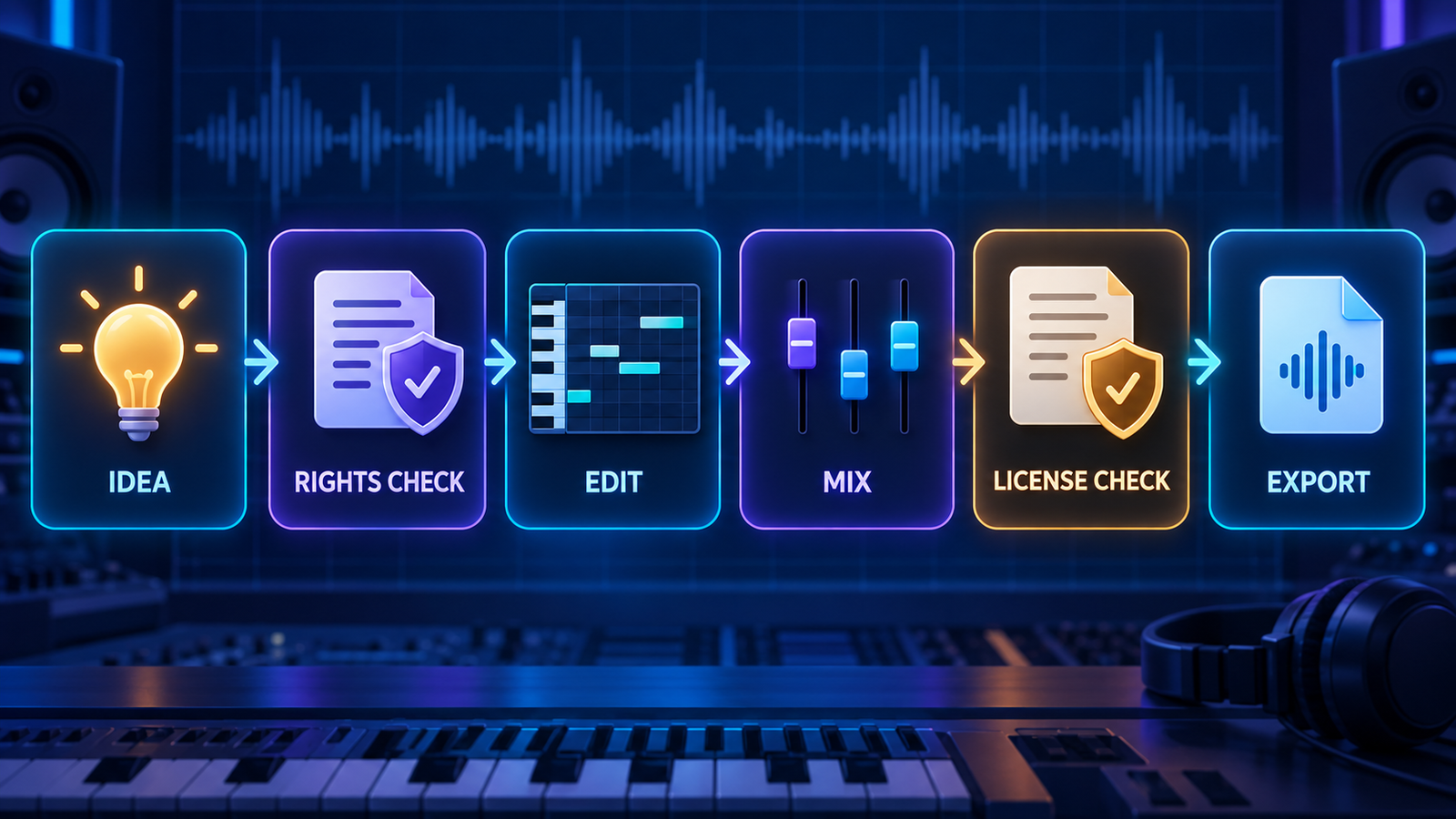
Start with the output you need. Choose BandLab when you want an editable project, AIVA when MIDI is the priority, Fadr when you have licensed source audio to flip, and Soundful when rapid genre variations matter. Loudly and Mubert are better for previews and background sketches than a release-ready producer workflow on their free plans.
Then check four boundaries before investing time:
- Export: a playable preview is not necessarily a downloadable file. Check MP3, WAV, MIDI and stem availability separately.
- License: “royalty-free” can still mean personal use, attribution or no standalone distribution. Save the license displayed when you export.
- Editability: a stereo mix is harder to make your own than MIDI, stems or a multitrack project.
- Source rights: only upload samples, vocals and songs you own or have permission to process. AI remixing does not create permission.
Prompting also improves when you describe musical variables rather than an artist imitation: genre, BPM, key, drum character, bass movement, arrangement and energy curve. Our prompt-engineering guide explains the same principle of giving a model specific constraints and a verifiable target. For one-shot cues instead of music, use our separate AI sound-effect generator comparison.
Copyright, consent and release risks
Do not prompt for a living artist’s exact style, clone a performer’s voice without consent or upload copyrighted stems you do not control. Provider permission to use an output does not guarantee that the output is unique, registrable or accepted by a distributor. The U.S. Copyright Office’s AI initiative distinguishes AI used to assist human expression from systems making the expressive choices. For producers, that is another reason to rewrite the arrangement, perform parts, document decisions and keep project files.
Also check the rules of your distributor, label, client and platform. Some free plans prohibit monetization or standalone music distribution even when the file can technically be downloaded. Content ID is especially risky when a nonexclusive model can generate related outputs for many users.
Frequently asked questions
Is there a completely free AI beat maker?
BandLab SongStarter is the closest option here: it offers free generated ideas and an editable Studio workflow. The tradeoff is that BandLab says you may use the generated idea royalty-free but do not own that generated track. Other tools restrict downloads, commercial use, attribution or export quality.
Can I sell beats made with a free AI beat maker?
Not automatically. Soundful, AIVA and Mubert restrict commercial use on their free plans, while Loudly reserves broader export and licensing rights for paid access. Review the exact plan terms, sample rights and distributor rules before selling, licensing or monetizing a beat.
Which free AI beat maker exports MIDI?
AIVA includes MIDI among its three monthly Free-plan downloads. BandLab can also turn generated ideas into editable Studio material, while Fadr provides MIDI detection from uploaded audio. The workflows differ, so choose based on whether you are composing from scratch or analyzing existing audio.
Can AI make a release-ready beat without editing?
It can produce a convincing draft, but a producer should still check structure, clipping, unwanted artifacts, originality, sample rights and the license. Human arrangement, sound selection, mixing and documentation make the result more useful and easier to defend.
Bottom line
BandLab SongStarter is the best free AI beat maker for most producers because it moves from generation into an editable project. Fadr is the better companion for licensed remix and stem work, while Soundful and AIVA provide useful recurring downloads for personal ideation. No free plan removes the need to check rights, add human authorship and review the final export before release. If the concepts behind these systems are new, our beginner’s guide to generative AI provides a concise foundation.

